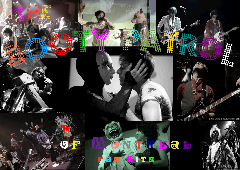
Paste: On the song “St. Exquisite’s Confessions” on the new record, when you say you’re “tired of sucking the dick of this cruel, cruel city,” are you talking about any city in particular or is it more of an imagined, kind of made-up situation?
Barnes: That’s kind of about Oslo. I have this really special relationship with Oslo because my wife’s from Norway and my daughter was born in Norway, and I spent a lot of time there, and I set up a little studio there and started recording that song there. And you know, it’s weird when you’re in a foreign country. Even though most people speak English there, it’s their second language, so you automatically feel like an outsider. And I’ve had really weird anxiety attacks and bad mental episodes in Oslo, but I’ve also had like some really great experiences. It’s a beautiful city and Norway is a beautiful country, but there’s a darkness there. There’s a real heavy darkness. There’s a lot of super-depressed people. When you have really strong experiences, they stick with you—they’re imprinted on your mind all the time. You walk down a street where you’ve had a weird experience and it kind of happens again; it’s like it never stops happening. So I wrote that song, in a way it’s that feeling of—when you feel beaten by your environment, and you’re trying to push on. Curtis Mayfield
sings about that a lot, like when you’re beaten down by your surroundings and your experiences, but you gotta keep on pushing and staying positive. I actually changed the original lyric [to “St. Exquisite’s Confessions”]. It used to be, “I was so used to sucking dick while I was in prison.” I thought that was funny—I liked the idea of this character: It would be like, “I got so used to sucking dick while I was in prison, I’ve forgotten what it’s like to please a woman, or what it takes to please a woman.” It’s kind of a funny idea, like if you’ve been in prison and you have to adapt to that world—you know, just suck some dick or whatever. It could be metaphorically speaking or actually sucking dick. Ad now you’re in the straight world again, and you’re free and you’re like, “OK, what’s it like? What do you have to do again to please a woman?” But I changed that because it just seemed too jokey, and I think the idea of sucking the dick of a city is more universal.
Paste: You touched on this in a post on your website this past summer, but, in regard to the title
Skeletal Lamping, what skeletons are you spotlighting and have you gotten any further with the question you posed about whether you want to shoot them or capture them?
Barnes: [laughs] I just want to let ’em go. I always want to change and evolve and reject the past and not really worry about it so much. I don’t feel the need to inspect my motivation for things I’ve done; I just want to continually move forward. But I think, when you make art, like a record or whatever, it’s sort of frozen in time, so it’s like turning the light on in a room and leaving it on forever. But you can also walk away from the room with the lights on—or keep paying the electric bill, but move into a new house.
Paste: How, if at all, did the negative reaction you got about the Outback Steakhouse commercial affect your approach to the new record?
Barnes: The backlash from the Outback commercial really motivated me to push myself, to make something bold and different so people couldn’t marginalize me. When someone calls you a “sell-out,” they’re basically saying you have no value; that you’ve given it up for your bank account—”well,” I thought, “I’m going to prove you wrong.” It filled me with a great energy, the desire to show these people, even though they’re sort of invisible. Like when anyone writes on a blog they’re called like AJJohnson622 or whatever [laughs], it’s like they don’t really exist. But I think what they’re saying, the thought they’re posing—if it matters to you like it matters to me, I wouldn’t want people to think I was a sell-out. But then, I have a complicated relationship with that concept, the idea of selling out. I [eventually] realized that selling out isn’t possible—I can’t sell out because I don’t make music to make money; I make music because I feel compelled to do so. I never sit down and say, “OK, I haven’t written a song in a while. I gotta do this.” It’s never like that. I want to do this. This is what gives my life meaning, what gives me a sense of fulfillment. I’m not really trying to sell records. I mean, I’d like to sell records because it makes life easier when you do sell them, but that’s not the fundamental motivation behind it. I also can understand how people get upset ’cause [when you sell a song to a commercial], in a way you’re sacrificing the song, potentially forever. You know, if it develops negative associations with people, or if it deprives people of having a romantic connection to the song, because you can’t really have a romantic connection to Outback Steakhouse. Or you can, maybe, but it probably wouldn’t be on the same level.
Paste: Like, “Man, that Bloomin’ Onion was so good!”
Barnes: [laughs] Yeah, I’ll never forget that time I spent… But I can really understand both sides of it. It still kind of hurts me though. No one had ever really said that to me before, no one had ever called me a “sell-out.” It would’ve been impossible, really, unless they would be like—I mean, some people are actually like, “You were on Conan O’Brien, you’re a sell-out.” Some people are actually like that; it goes that far. Like, “Oh, I can’t like this band anymore because they were played on the radio.” I mean, some people are like that. But the sad reality is that—if you’re an indie artist—you have to look to other avenues to earn a living. And either it’s going to be a day job that has nothing to do with music, or you can try to find some way to use your talents to earn a living. And that was actually the first time I had ever been offered anything like that, and I was so broke, and I was like, “I can’t say no to this.” I couldn’t project into the future and imagine what the ramifications were going to be, or how it would be different, and I think that if I could go back in time, I wouldn’t do it again, but only because of the scope of it—only because it’s been like their ad campaign for like three years and it’s not going away. Most bands, maybe they do a commercial and it’s there for like a month, two months, tops. And this thing has been like [McDonald’s’] “I’m lovin’ it.” And so, [if I’d known it would be like that], I definitely wouldn’t have done it. But I was so green at the time—I didn’t have representation and I had no previous experience to put it up against. So it’s the price of an education on some level. But it also really helped me financially. I was like, “Well, let’s put some more money into this next production. And now I sort of compare it to an actor or director that will make like a big-budget film in order to fund their pet project, their art project. Like I said, sometimes you have to suck a little dick to get by, just like everyone else has to suck dick, you know? Everyone has to have this other job or this other thing that allows them the freedom to do other things. But now, whenever I’m doing [anything commercial], I try not to incorporate
Of Montreal songs in that world. If I’m gonna try to do something for hire, I don’t want to use any Of Montreal songs. I want to just make something new.
: Well, now you can be like, “I’m the guy who wrote the song for the Outback commercial.”
Barnes: It’s a funny thing, too, ’cause other people—people who aren’t at all connected to the indie world, like my dad’s friends, you know, people like that,—they’re so impressed. They’re like, “Oh my god, that’s so great, man! That’s so wonderful!” Like for them, it’s like validation. And if you’re applying for a loan, and someone’s like, “What do you do?” You say “musician.” “Oh really? Have you written any songs I might know?” And then you can say, “Well, have you heard the Outback Steakhouse commercial?” [laughs] And then they’re like, “Yeah, I’ve heard that! Aw, that’s fantastic! I can’t wait to tell my friends that I met the guy who wrote the song from the Outback Steakhouse commercial!”
Paste: Tell me about how Dylan Thomas influenced the lyrics on
Skeletal Lamping.
Barnes: He’s one of those writers that he has such an interesting—almost like a self-produced lexicon. His style of phrasing things and putting words together is so original that it bends my mind. A lot of the song titles from
Hissing Fauna and
Skeletal Lamping were results of reading a Dylan Thomas poem and then trying to stay in that spirit, that frame of mind, and just write whatever comes to mind. Just sort of automatic-writing style, where you just turn off your mind and write whatever comes out. It’s great; it’s almost like a drug, like a really quick drug. You just like read one poem and try to absorb it and be influenced by it, and see what comes out of you after taking the drug. I mean, I don’t really do drugs like that, but if drugs did that for me, then I would because it’s always good to bend the mind, to gets it out of the grocery-list mentality. You know, you make lists—these are things I have to do today, and these are the people I’m gonna talk to and it’s always situation-appropriate. But if you bend your mind, you can get out of the trappings of that. It can help you think really creatively.
Paste: Have you ever done any kind of trance writing in the past? Written songs where you let go like that?
Barnes: Yeah, I do that a lot, at night usually, when everyone else is asleep and I can just—almost like a meditative state, where I try to shut everything off and just let the stream of consciousness flow, and I come up with some things that I find really interesting. So I do a lot of writing like that. And it’s also good [to try that] if you have music [already]. I think a lot of hip-hop artists do this, where they just sort of ad-lib and don’t really know what they’re gonna say next, and maybe do 10 tracks of ad-libbing, and then pull something interesting together. I definitely do that.
Paste: Where do you think the collagist aesthetic on the new album comes from?
Barnes: I guess it comes from the desire to create something unpredictable, and so it’s things that are seemingly out of place with each other, which helps create that unpredictability, ’cause if you’re listening to a song, a lot of times you can predict where the person’s going to go—you know how they’re gonna resolve the melody line and when the chorus is gonna come, and to me that’s not that exciting. I wanted to make something that was really unpredictable because that’s the kind of music I like listening to, and I want to make the kind of music I want to hear. So what I’m trying to do is make something that’s really unpredictable, but also has an immediacy to it—something that’s not completely out there and so impossible to follow that it hurts the brain. I don’t want to hurt the head too much; I just want to create something interesting that has unexpected twists. When I listen to the first two Os Mutantes records, I can listen to them all the time because they’re speaking a language I don’t understand, so it has a mystery. Musically, if you’re not following along, and you’re not looking at the CD player and seeing, “OK, this changed from track 4 to track 5,” you don’t even know when one song starts and the other ends.
Paste: I had difficult time, when we were listening to the album the first time, trying to figure out where the track breaks were. I took notes, but when I went back and looked at it again, they were all wrong.
Barnes: A lot of times, when it would’ve made sense for it to end in one place, we were like, “No, let’s just include that other thing and say it’s part of the same song.” I wish there could be hyphenated track listings or hyphenated track markers—like, “OK, this is track 6.2 or something.”
Paste: A lot the past records you’ve put out with of Montreal have been really fantastical, but I feel like this one has almost a space-age vibe to it.
Barnes: I really want to make now music. I want to make music that feels progressive, like it’s reaching toward the future rather than being this sort of anachronistic retro thing. In the early days, I wanted to make something retro. That was the kind of music I was into. But now I really want to push music into this new area it’s never been before, and I haven’t yet, but that’s definitely the motivation. So I think that might give [my recent music] a sense of being more progressive. At least, the intent was to make something progressive. I feel like music is going in a really great direction. There’s a lot of bands that are doing really interesting things—bands like Health and Gang Gang Dance and Deerhoof and Animal Collective. I feel like we’re in the middle of something amazing, that people are going look back on 20 years from now and be like, “Holy shit! All these classic records were being made during this period,” like when I think about The Pretty Things and Pink Floyd and The Beatles, and all these bands making amazing records in 1967. And I hope that this continues, where people are using the technology of the time, the instruments that are there that weren’t before to create something now, something that really feels like this time period. Even if it sounds dated 20 years from now, it doesn’t matter as long as it has a personality and an identity outside of anything before or after. I mean, everything is inevitably going to sound dated. It’s amazing to me how the ’80s—the sound is such a really strong… it has such a strong personality, and the fashion…
Paste: The gated drums, the synthesizers…
Barnes: Yeah, everything. And I think that’s so fantastic. Like, the ’90s, it had that [distinct identity] to some degree, but not on that level like the ’80s. And people joke around about the ’80s—it definitely seems silly, you know, and we kind of laugh about it, but that’s really all you can hope for: to create something that has such a strong identity that it’s impossible to take it out of context.
Paste: Earlier you were talking about the way the tracks on
Skeletal Lamping jump into each other and the erratic way the album is sequenced. All that chaos, when I’m listening to it, snaps me in and out of these trance states. What role do you think chaos plays in your music?
Barnes: Well, this is the first record where I really tried to incorporate tension, and tried to build tension in the songs and not just make it as melodic as possible. I tried to incorporate elements of dissonance. I think it’s really exciting to work in that area because that’s kind of a heavier, deeper form of composing, because you’re touching on all these different emotions. In the past, I’ve done a lot of electro-disco pop, which is basically like one emotion, maybe happy, with slightly intellectual lyrics. But this album, musically, I wanted it to have more depth and to create something that’s more mesmeric at times, even anxiety-producing at times, and in a way reflect my state of mind or the human condition ’cause you’re never just happy and you’re never just sad, there’s always varying levels of everything from moment to moment.
Paste: Why did you choose “Id Engager” as
Skeletal Lamping’s first single?
Barnes: We felt like it was dancey and fun, but it was hard to pick one song.
Paste: Are you gonna put out a few singles?
Barnes: Yeah. We’ll definitely do a couple, but “Id Engager” seemed like a safe choice because it’s not such a dramatic departure from
Hissing Fauna but it’s also kind of representative of the new record because it has so many different sections and it’s sort of out there, sort of like the freak-disco song on the record. I really pushed for “For Our Elegant Caste” because I thought that was a bit bolder of a statement. But, you know, people on the business side were like, “Well, maybe that might be a bit too much for the first single.” [The song’s chorus feature the lyric: “We can do it softcore if you like, but you should know I take it both ways.”] I feel like there’s no real way to ease people into this album—either they’re going to open-minded and cool with it or they’re not. So I felt like there was no real reason to try to dumb it down or pick the most accessible track. But at the same time, I like “Id Engager.” It’s not a totally simplistic love song. There is depth to it. And I think it’s an interesting song because the lyrics in the verse are in opposition to the lyrics in the chorus. The lyrics in the verse condemn this hedonistic, superficial relationship, and warn people against it. But in the chorus, there’s this unapologetic lyric about, “I just want to play with you, I don’t care about having a deep relationship. I just want to have a superficial, noncommittal experience.” It’s like the two voices are sort of fighting each other.
Paste: Sounds like something that goes on in people’s minds all the time.
Barnes: Yeah.