Showing posts with label music industry. Show all posts

Sunday, July 10, 2011

2011-05-10 - Spectrum Culture

Interview: Kevin Barnes from Of Montreal

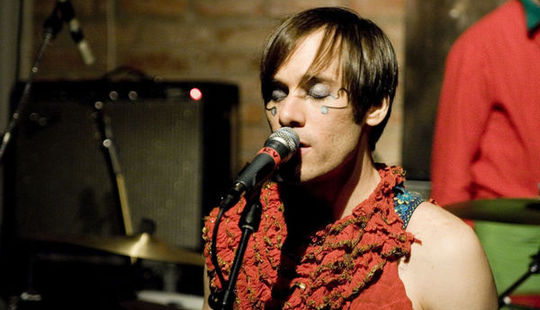
barnesint1.jpgWhether he's exorcizing personal demons on the harrowing, yet poppy Hissing Fauna, Are You the Destroyer? or putting on a stage show with skull masks and people dressed as imaginary creatures, Kevin Barnes and Of Montreal continue to push up against the confines of indie rock. From breaking down traditional song structures on Skeletal Lamping to getting his best Bootsy Collins on with False Priest, Barnes may just make the most fun music about personal trauma and sexual desire. I was fortunate to spend 45 minutes speaking with Barnes about the creative process, Sufjan Stevens, his influences and selling out. I am proud to present the Spectrum Culture interview with Kevin Barnes from Of Montreal.

Your new EP Thecontrollersphere seems like a departure from what you were doing with False Priest.

Well, the songs were written and recorded around that same time period. It's very much a sister release to False Priest. There were songs that could have been on False Priest, but for whatever reason didn't make the cut.

I read an interview with you that said when you were making False Priest you were consciously trying to keep the length of the album down. Were these the songs that got cut off or a different batch of songs?

I only briefly toyed with putting "Black Lion Massacre" on False Priest but "L'age D'or" and "Slave Translator" were definitely intended for False Priest, but I cut them at the last minute.

I feel like the music on False Priest is more traditionally constructed pop songs while these break down the structure of traditional songs, especially the first track.

Yeah, definitely. On False Priest I was trying to make something that was a bit more accessible. Just a really well put together pop record without asking too much from the listener. Some of the Controllersphere songs are a bit more esoteric and not really for everyone.

Was that decision for the format of False Priest a reaction to Skeletal Lamping? That one definitely demands more from the listener.

Maybe to some degree, instead of making another Skeletal Lamping. I was excited to make something different than that.

You mention all of these titles on Hissing Fauna near the end. Was there a conscious trilogy in your mind at that point or did it come after you wrote the lyrics?

It just sort of happened organically. I didn't have a real vision of how the records would sound. I just knew those would be the titles for the next three records that followed Hissing Fauna.

Did those titles play on any obsessions of yours or were they free association?

They are definitely more free associations. At the time, I was just trying to come up with interesting song titles and that was part of the process. I got three album titles out of it.

Speaking of titles, the song titles on this new EP are less esoteric, to use your word, than many of your past ones.

I kind of go back and forth on that. You can name it anything you want to. You can give it a name people recognize and would make sense or give it a name that has a connected meaning with the song or maybe it doesn't. Sometimes I feel like giving it a totally sensible title and sometimes I feel like giving it some other kind of title. Like "L'age D'or," for example, I could have easily called it "She's My Party Drug" or something stupid like that. I guess a lot of times when you think a lyric is powerful or interesting then you can put more of a focus on it by titling the song that way. If you don't really care or don't really feel that strongly about any of the lyrics or you don't really want to put a spotlight on them then you give it some other title.

Traditionally bands title their songs after the chorus because it's the hook. Where with "Heimdalsgate Like a Promethean Curse," most people would probably call it the "chemicals" song.

Exactly. Especially with Hissing Fauna there's so many Norwegian words that nobody can really pronounce. It's not like I would even know how to say it either and I lived there for that time period. Titling songs is a slippery slope sometimes.

Is "L'Age d'Or" a direct reference to the Buñuel film?

Yeah.

It seems to me a lot of your music practices the same principles as of Surrealism. Two major hallmarks of Surrealism are sexuality and savage desire. Those are things you are not shy about putting into your music.

Definitely not. I think we share the same spirit. The same excitement about life and its potential and being broad-minded and open to new experiences. Exploring different aspects of the psyche.

Do you notice a difference in reaction between American and European audiences when it comes to the sexual and violent parts of the stage show?

Not really. It's pretty much the same when we go to Europe or other countries. I think we appeal to a certain kind of person all over the world. That kind of person is definitely in the minority as far as human beings go. But there's a good contingent of them all over the world. We're pretty much playing to same species of human or whatever you want to call it.

We have a pretty puritanical country here and if you played a show for non-Of Montreal fans they would definitely be more upset about you taking a person in a pig costume from behind than people shooting at one another on the stage.

Yeah, but I think it's always very cartoony. Unless you have no sense of humor you will probably find most of the theatrics entertaining. You might find it juvenile. All of it is really tongue-in-cheek. We hardly ever have a serious agenda that we're trying to push or try to make people uncomfortable. We're just having fun. We feel so free. We feel so liberated physically and emotionally and intellectually that there aren't really any taboos that we're afraid of.

Are a lot of the sexual lyrics tongue-in-cheek also?

I don't know. It depends on what specific lyrics. There's definitely songs that are more personal to me and they come from a darker place. Those aren't necessarily that fun. But they can help me resolve certain issues. It's always better to talk about something and get it out in the open. It's not always fun but it's therapeutic.

Yeah, Hissing Fauna felt more confessional than the albums that followed it.

That record is out of necessity. I was going through such a difficult time and I was using music as something to help me heal. It's not like I set out to make a really personal, confessional record, I just needed to make that. If that makes sense. It wasn't a premeditated thing, "Well, this record is going to be very confessional." I was going through such a terrible time and I was using music as therapy in a way.

Now that the dust has settled, is looking back on that record and that period harder for you to re-experience? Do you feel the same pain? Are those songs closer to you because they spring from a more personal space rather than a persona?

I like that record. I like playing those songs. It's funny because we have so many songs that we haven't touched live. We haven't played anything from any of the records that came before Satanic Panic in the Attic in forever. I can't remember the last time we played any of those songs. It's kind of weird, like my mind turned around Satanic Panic in the Attic and these last couple of records. We seem almost like a different band. I just feel so disconnected from those other records but I feel really connected to Hissing Fauna, Sunlandic Twins and Satanic Panic in the Attic. I definitely feel really connected to them but some songs are harder to perform night after night. Like "The Past is a Grotesque Animal," we've played that many, many times. But it's not something I'm really feeling right now and don't want to do it. But it's cool to have songs like that. If you are in a certain mood you can exorcize those demons with a song. If all you had was really happy songs, you'd be kind of fucked if you're in a shitty mood (laughs).

"The Past is a Grotesque Animal" has to be hell to play, especially on your voice.

I'm a weird vocalist. I'm really taking chances because I am not trained at all. I have no idea really how to protect my voice or even how to warm up. I have some really rudimentary techniques I use to warm up but a lot of times I don't even warm up. A lot of times I just
take the stage and realize, "Oh shit, I'm not warmed up yet! I can't sing this yet!" Then you just have to work your way through it.

I know that as a fan singing "Past" it wears me out.

Yeah, that song is super wordy. There are songs on Icons, Abstract Thee EP that came out right after Hissing Fauna that we've never played and I can't even listen to them because it still hurts me. It's way too sad still. But I guess there is a form of detachment that happens with songs. It's detaching from the source or inspiration and taking it somewhere else. Then I can deal with it. I've played "The Past is a Grotesque Animal" so many times and it doesn't really hurt me in that way. It just felt good to do it. But with those other songs I would just feel bad (laughs). I don't even want to sing them or think about them.

I'd like to back up for a moment about the longevity of the band and not playing the old stuff. Every time I see Of Montreal I feel like the audience gets younger and younger which is pretty fantastic for a band that has been around for so long. Is it hard to attract new fans without alienating the old ones?

To be honest, I don't think it's that healthy to think about your fans because you could be a fan of one record or one song. It could change. You don't really have to be beholden to some concept of the fan's perception of you or what they want from you. What one specific person wants from you or what a majority of people want from you. I don't think it's healthy for an artist to even consider that. So, I don't really think about that when I'm writing and recording. I'm not really worried about alienating people or pleasing people. I don't really think it would help the process at all. It's very important to me when I'm creating something to not let anybody else into my little bubble. I feel like that makes it impure and takes it out of this place it needs to be for it to happen organically.

So what is it about your music that attracts the 16-year-old? There is a sophistication about it that's different than what is on the radio these days or lack thereof radio.

I'm not sure really. I can't really say. Maybe because it's liberating. Maybe seeing people wearing interesting outfits and dressing up. I think it appeals to the side of people's personality that is in a hibernating state most of the time. Then they get a chance to cut loose because it's like Halloween or a costume party. It's always fun to go to a costume party when Halloween rolls around because everyone gets into it. Pretty much everybody has that side to their personality but most of the time it's in this hibernating state.

kevinbarnesint4.jpgBack to the breaking down of song structures - another artist I feel is doing similar things is Sufjan Stevens with his newest record The Age of Adz.

Yeah, I love that record.

Someone was telling me that you do. I do see some similarities between his music and yours. I know that record, like Hissing Fauna, came out of personal strife.

That record has really meant a lot to me. It is probably the record I have connected with the most over the last five years or so. Not only because of its emotional content but also musically I feel like I've never heard music like that before. It's one of the most groundbreaking records we've ever had as humans. It is weird to me that it hasn't gotten more acclaim. I mean, it has gotten a lot of critical acclaim but I saw the records making critics' album of the year lists and I just couldn't believe that record wasn't on top of all the lists. Anybody who really loves music and loves the art form should see that it was the most fantastic, most exceptional record made that year.

I think one of the problems was that people were expecting another Illinois and it's completely different than that.

With artists, all of their records are held up against each other. If that was his first record and there was no other reference of what Sufjan does and what he is capable of it probably would have had a completely different impact on people. I was thinking about a review I read of the new Deerhoof record. I love Deerhoof and I think they're incredibly creative and extremely wonderful and important. I couldn't believe this writer was giving them such a mediocre review. I was thinking about all the other records that were getting good reviews that were so much more derivative and so meaningless. Well, not meaningless but I can't imagine them having any sort of value 10 years from now. It's weird that certain records that are more adventurous, more cutting edge and more valuable....

Not everyone wants to be challenged when they listen to music.

Yeah, that's true.

Have you seen Sufjan play those songs live?

No, I haven't seen him yet but I think we're playing a festival together this summer so hopefully I will get a chance to see it. I can't imagine how he'd do it live.

Speaking of stage shows, the last time I saw Of Montreal, it seemed to be more Kevin Barnes-centric than ever before. The band surrounded you in a horseshoe shape and you had the entire stage to roam around. Will we be seeing less and less of the other band members?

That was just an idea for the last tour because we wanted to do something different from the previous tours where we had a lot of action with the performance artists. We'd done tours before where we had this room where most of the theatrics took place but that was an insanely heavy stage and it broke everyone's backs (laughs). So we decided to make it a little easier on ourselves so we created that horseshoe shape. I wasn't playing guitar on that tour. It was fun for me to be a front man and dancing around and have that sort of persona. On this new tour, it's kind of similar to that but we're getting more people involved with singing songs. We're getting band members involved in different ways. We kind of felt it was weird to have the band so displaced in a way and have them pushed into the shadows. We want to get people more involved this summer.

Is there a line where theatrics can overshadow the music?

I never really felt that because the music doesn't change just because something is happening on the stage. It doesn't get quieter. If people are really trying to focus on the lyrics but they're getting distracted is one thing, but I don't think you could ever have too much going on on stage for me. If I go see a concert 99% of the bands that really have any sort of theatrical elements to their shows, they might have some video stuff but I would never think that. It's obvious if you've seen our shows that we wouldn't think that. I wouldn't feel that way about theatrics. I always loved what George Clinton did. I always loved the theatrical side of Parliament and how they had so many different layers to what they were about. We view ourselves in that vein. We think of ourselves as the grandchildren of Parliament.

On your last tour it seems like you found a great foil for yourself in Janelle Monae.

She's amazing. She has become a really close friend of mine. It's amazing to develop new friendships, especially artistic relationship like that. It's something I treasure and hold very close to my heart.

Did she help you come up with that Michael Jackson tribute at the end of the show?

No, that was our idea. We wanted to come up with something we could all do together. We didn't really think of the tour as Janelle Monae and Of Montreal. We wanted there to be a lot of integration between the two groups. We just wanted to have a lot of cross-pollination. The Michael Jackson thing at the end was a really great way to close the evening together, holding hands.

I also saw you do a Franz Ferdinand cover and a Nirvana cover once to end your show.

It's kind of hard to pick them though. That's the tricky thing. It's always fun. The Nirvana was great. It seemed like the right time and it had been long enough for people to get back into Nirvana. It was around the time of the anniversary of Nevermind. That record meant a lot to me at one point so it was great to do that one again. It's a great song. The most badass rock song ever.

Which cover song ideas have been floated around that will never see the light of day?

We tried a number of things we felt like we couldn't do. It's hard to do a Marvin Gaye song or Al Green. If you don't have that voice, it's going to sound kind of weird. I guess you could always do it. We were listening to the Slits version of "Heard it Through the Grapevine" yesterday and realized how incredible that version is. In a lot of ways, it's just as good as all the other versions out there but it's not Marvin.

Speaking of your voice, I feel like your vocal style has been moving closer and closer to Prince. I know you referenced '70s musicians such as Parliament and Stevie Wonder but has Prince been a direct influence on your songwriting as well?

Yeah, definitely. Without question. I adore him and I adore everything about him. He's an incredible professional.
He's an incredible musician and incredible vocalist and dancer. You couldn't really ask for a better human (laughs). I mean on an artistic level. Especially his earlier records like Sign O' the Times, Parade and basically everything up until Diamond and Pearls is, I think, the most incredible pop writing we have.

I remember reading somewhere they floated doing a Prince and Bob Marley duo at one point. But Bob Marley wouldn't do it because Prince was too effeminate. I should probably Google it to be sure. That would have been pretty interesting.

I guess Stevie Wonder did some stuff with Bob. I was doing some Googling about that. That's awesome but I don't think there is any footage of it. There's a recording of a show Stevie did in Jamaica maybe, and Bob Marley played and they played some songs together. It was pretty amazing. Yeah, Prince and Bob Marley would have been pretty great.

Stevie Wonder is another guy who had an amazing run of albums.

Yeah, it's insane. I was listening to a lot of Stevie Wonder when I was doing False Priest and rediscovering Songs in the Key of Life and Innervisions and Music of My Mind and that whole period. Songs in the Key of Life is one of those records that really inspires you and you really love it but at the same time it can make you feel like, "Why do I even bother?" I'm never going to make anything that great (chuckles).

Is it reasonable to hold yourself to a standard like that?

No, definitely not. That's why I have to be like, "Fine, I'm not Stevie Wonder. I'll never be that great." But I'm not going to not make music because I'm not Stevie Wonder. There is that little voice sometimes that's like, "God, man. I wish I was that good" (laughs). You know, that's all right. I'm sure he probably felt that way about other people too. I'm sure he probably felt that way about James Brown or Otis Redding or whoever. Everyone has that insecurity. Jimi Hendrix didn't like his own voice. Things like that. How could Jimi Hendrix not like his own voice? He sounds great!

You have definitely mined the funkier side of Stevie Wonder but have you ever thought of doing something as heartbreaking like "All In Love Is Fair" or something like that?

Those kind of ballads are actually my least favorite Stevie stuff, even though it's great. I can appreciate it but I don't know. Writing about love like that is kind of tricky. If it really comes from the heart, that's one thing. But so many times people will sit down and write a song and they just write about love because it's the conventional thing to do. But I'm not really that into love ballads at all. They just don't seem that genuine most of the time.

barnesint3.jpgYou don't feel like something like "Let's Get It On" isn't genuine?

No, that's genuine, for sure. Sexuality is a real, natural thing. If I thought about it I'm sure there's some love songs that really touch me. I feel like John Lennon's songs for Yoko seem genuine. There has to be a rawness too. If it's just super flowery and sentimental it doesn't really have much impact.

What songs in your lifetime have meant the most to you?

Definitely the first two John Lennon solo records.

Plastic Ono Band and Imagine?

Yeah, Plastic Ono Band plus Imagine. Definitely Neutral Milk Hotel's In the Aeroplane Over the Sea. There is always an emotional impact and potency in those records. All the Beatles records. All the '60s Kinks records, Os Mutantes, Sly and the Family Stone with everything up until Fresh. Curtis Mayfield's first couple solo records. There's just so many.

It's pretty amazing that we get to experience this stuff, isn't it?

Yeah, it's great. I was talking to someone yesterday about as an artist it's kind of incredible that in 2011 that you have Stevie Wonder, Parliament, Prince but you also have Sufjan Stevens and Animal Collective and Caribou and other people like that. There's so much incredible music from earlier times and even world music. Especially now, everything is so accessible. All this incredible stuff from the '60s like Ethiopian funk. You can get your hands on that. Like Cambodian music. It's crazy how much access we have to so much incredible stuff.

How do you find time to listen to music?

I like listening to music when I'm doing little things around the house like cooking or chilling out. I always want to have music on when I'm doing something non-musical. It's not going to be a distraction. A lot of times if I come into the studio before I start work on something, I will listen to something to get into the spirit of it and let that inspire something out of me.

Let's talk about the music industry. I just watched Morgan Spurlock's movie about advertising. The whole conceit of the film is selling out vs. buying in. This is about the Outback thing. I feel like the whole attitude of the country has changed lately. Back when Of Montreal started out, people would have been pissed off about a band jumping from an indie label to a major. Now there is no radio or MTV and people don't care about a Wilco song on a Volkswagen ad or your song on an Outback commercial. Was it hard for you to make that decision? Is that the only way to get your music out?

It's kind of a tricky thing. As an indie artist, everyone is always so broke all the time. They've been broke their whole lives probably. When these big companies come to you with a check for more money than you've ever seen at one time, more money than you'd probably make all year, it's really, really difficult to say no to that. But then there's that dilemma because you know there's going to be a bad backlash. I think it still exists in the community. Not with everybody but there's definitely a punk rock attitude still prevalent in the scene where you don't lip synch or do certain things. There's these unwritten rules as far as maintaining your credibility. If you put a song in a commercial and it's pitching some stupid product and your song gets associated with that stupid product it's kind of terrible because the song has been ruined for people. You just throw trash on the song in a way which is not respectful to your own art. But at the same time, you need that money to keep going and to keep putting out records.

People would say, "Well, R.E.M. wouldn't do that and Radiohead wouldn't do that," but they are not in the same financial position as a lot of indie acts.

Totally. For them, there is no reason to do it because they don't really benefit, necessarily, from having a song in a Volkswagen commercial. It depends who you are. I think what you're saying is true. People aren't as critical as they used to be and it probably wouldn't be death to band. There would probably be a handful of people that would be like, "Fuck that band. They're sell outs, blah blah." You don't really hear "sell out" that much anymore. It doesn't seem like it really comes into the conversation that much anymore.

Right, the attitude has changed.

I'm sure if you're a punk rock band and that was your whole thing , anti-corporation, then you'd lose everything if you did that. For most people, you gain people who are like, "Oh, actually that song was really cool."

What was your experience with it? Did you gain more fans or was there backlash?

I think we had both. Definitely there was major backlash. We had people coming to the shows....There was one show we played in Austin, Texas where these people brought a big Outback Steakhouse banner. They went so far out of their way. They got napkins from Outback Steakhouse and were throwing them in the air (laughs). It was something they had to spend money on actually and that's a lot of time. That was like next level backlash. But we had people still come to the show and stuff. It wasn't like nobody was supporting us anymore.

No one threw a Bloomin' Onion at you?

I think they had a Bloomin' Onion that they wanted to throw but then someone somehow caught it beforehand (laughs).

Would Kevin Barnes circa Cherry Peel feel the same way?

About selling out?

If you got approached with that sum of money.

I think it would be the same situation. It hasn't really changed. During Cherry Peel I had this telemarketing job. All of us had these terrible jobs so I think if I had got offered a way out of that even in spite of losing some credibility in some people's eyes, I don't think I would be able to refuse it. You have to really sacrifice a lot to maintain that level of anti-corporate whatever. You can't really get around it. Everybody shops in the same places. Everybody is supporting these corporations anyway. What difference does it make if you have a song in a commercial or you go there and buy their hamburger? It's the same thing in a way. At least if you sell a song for a commercial, you're getting something out of it. I could see it both ways. I can see how it's potentially damaging
to a song, at least, and to some degree people's perception of you and your commitment to your art. There are other hard realities you have to accept as an adult.

I interviewed one indie artist who said the goal nowadays is not to be rich but not have to work a day job anymore.

That's pretty much it. You just want to be able to make your music. No one is really trying to get yachts and Mercedes Benz. We're just trying to stay afloat and be in a situation where we can focus as much as possible on our art.

Do you self-finance all your own records?

I have a deal with Polyvinyl where we split all the expenses. But I have my own studio where I record. With the exception of False Priest everything I have ever recorded was recorded in my home studio. Studio might give you an exaggerated concept of what it was, especially back in the day. It was basically a 4-track and a $100 mike. Slowly, with each record, it has gotten a little bit better. I have understood how to get better sound, slowly, over time, by just learning little things, little engineering tricks and little mixing tricks. Pretty much everything is done on a shoestring budget or no budget at all.

You seem to have a lot of ideas circling around your work. Where are you headed next?

I started working on a new record. I'm basically done, actually. All of the songs are a lot longer. Much of the songs are about eight minutes long. It's a little bit like I was doing with Skeletal Lamping, having these longer, slightly fragmented songs. These ones are less fragmented. They feel more like one composition and not a bunch of different compositions pieced together. I've incorporated a lot more symphonic instruments. There are a lot of woodwinds and strings and brass. Things I haven't really used in the past very much.

Are you playing these or do you have people coming in?

Yeah, I can't play those instruments. K Ishibashi, who plays in the band now, plays violin and is doing all the string arrangements. He's turned me onto a bunch of his friends that are really talented and also excited about experimental arrangements. Which is important because a lot of people can play an instrument, but they don't have much imagination. They have all these rules in their heads, especially classical musicians. They have all these rules in their heads about what you can do and what you can't do. They are a bit robotic about it. Then you get that great combination of virtuosity and imagination. I feel really fortunate that I've met a couple people that fit that description.

Is there a thematic preoccupation in your new songs?

It's definitely more intimate. It's more personal. It's not really as sexual. There are a couple of funkier moments but I wanted to make something that sounded more intimate just because I was going through some different things as of late. Similar to Hissing Fauna, I was using music as therapy to get over these things and resolve them.

Do these songs have movements and tempo switches like the Sufjan songs?

Each one is different. The Sufjan record definitely feels almost like a through composition. You could listen to the whole thing and think about them as different suites because it definitely feels consistent throughout, which I can't even imagine how he was able to sustain that focus on something, to my ears and to my mind, that seems so complex. To have that complexity sustained throughout the 70 minutes or however long it is, that was something I was extremely inspired by. There is a lot more repetition on his record than there is on my stuff. I don't repeat very many sections. I create these expansive soundtracks. A lot of the songs go into these weird, less lyric-based and more music-based moments. There are definitely moments of heavy lyricism but there's really, really moments of instrumental periods. That's really different for me because I haven't really worked much with instrumental music.

I know Sufjan used a visual artist as his inspiration. Do you use any external stimuli when it comes to writing or does it all come from within?

There are definitely a lot of outside influences, especially musically. I hear something like Stevie Wonder for example or I hear something like "Boogie on Reggae Woman" and I listen to what he's doing on the keys and I think, "I want to do something like that. That's so incredible." So then I'll make something like that. It won't sound like Stevie. Nobody can sound like him, anyway. But often, Parliament and Prince and Sly, all these people influence me greatly.


by David Harris

Saturday, December 11, 2010

2010-10-01 - Drowned In Sound

"If I make sense, I fail". DiS meets Of Montreal

According to the full version of the above photo, there are potentially a full 13 people in the ever-evolving Of Montreal's current incarnation. As you know, just one of them really matters: Kevin L Barnes, the genius/fruitloop behind all ten of their albums to date, including last month's funky/fucked up False Priest. On the eve of a walloping great three date UK tour, DiS caught up with Mr Barnes to talk about fish slaughtering ex-girlfriends, the futility of religion, and why you can't change the world via the medium of lampshades.

DiS: Did you have any particular plan for False Priest? It’s clearly a different mode of songwriting to the fragmentary approach you adopted for Skeletal Lamping...

Kevin Barnes: I think because I’d done that collage style writing on the last record I didn’t want to do that again, I felt like a change, so, um I leaned it more towards slightly more linear arrangement with the songs. I also wanted to create longer vamps within the songs. Skeletal Lamping was very jarring, with this one we wanted to bring out the rhythm element more. But I was still very much under the influence of Skeletal Lamping, it’s still very funky and still a fairly sexy record. But I started getting into, I guess, the heavier end of funk music.

DiS: Why did you decide to cut the entire record with live instruments this time? Was it because you had more money?

KB: Well I actually made this record at home, and by my standards it was basically done. But I’d been sending rough mixes to [producer] Jon Brion and I guess he had sort of gotten it into his head that he would like to help me realise a fuller sound. So he invited me out to California and I went in with a session drummer called Matt Chamberlain who came in and drummed on every single song. So once we’d improved the fidelity of the drum I was like ‘maybe I should recut the bass too’ so I just went through song by song and redid all the bass lines and then we sort of realised ‘well, why don’t we replace a couple of these digital pianos with real pianos’ and we kind of got carried away and sort of replaced everything.

DiS: So what you’re basically saying is that you technically made the same album twice?

KB: Yeah... it all just happened organically, I found myself out there working with this wizard of a producer and a musician and transforming my record, it’s been such a great education for me.

DiS: False Priest seems a bit more playful than your last few records; do I take it that not so many of the songs are biographical this time?

KB: Everything is based at least loosely on true stories...

DiS: So ‘Our Riotous Defects’... that actually happened to you?

KB: Yeah.

DiS: Wow. So you had a girlfriend who killed your fish?

KB: Yeah, she killed my Betta fish over some really small shit...

DiS: Wow. On the second date?

KB: Er, no, it was later, well into the relationship...

DiS: It’s not your wife is it?

KB: No, previous relationship.

DiS: How does the subject feel about the song?

KB: Um... well, they’re not really a huge Of Montreal fan, they might hear it on the radio at some point... but I don’t care, she deserves it.

DiS: Yeah, it, er, sounds like it! Does it get harder finding stories like that now you’re settled down..?

KB: It’s pretty easy I guess – when I’m feeling inspired I just let whatever happens happen and I don’t really edit myself or second guess it I just let it flow... it’s funny, a lot of songs I can’t explain the inspiration or influence behind it, I can’t remember writing or even recording them. I just have a really bad memory I guess.

DiS: Skeletal Lamping, False Priest and your upcoming The Controller Sphere EP all take their titles from a single line of the song ‘Faberge Falls For Shuggie’... is there any meaning to them beyond that? Bar the anti-religious monologue at the end of the ‘Do You Mutilate?’, False Priest wouldn’t seem to be much to do with religion...

KB: I think that maybe it has some connection to the part before it, the ‘try to connect XX infinite pleasure’, but it is abstract, that’s the only way I can really write. If I try and make sense than I just fail. I might be failing anyways, but at least I’m doing it in a way that works with my normal brain function.

But I don’t really have any strong agenda. I mean, I was raised a Catholic, I did go to church for 18 years, went to Sunday school for 18 years, my mum is very involved in the church, but I don’t think that much about it or care about it... I don’t feel like the Catholic church is bringing about the end of the world or anything. But what I was trying to say with that very frank lyric at the end, which is something that my brother and I talk about a lot, is that we should put humanity first, that we shouldn’t put god above humanity, we shouldn’t think of a religious prophet as more important than just day to day helping people. I think people get carried away by the mythology of these things, the mysticism of it, that if you don’t on the surface act a certain way they you’ll be punished and if you act another way then you’ll be rewarded in the afterlife... but who cares about the afterlife? I can’t really understand that obsession. We can do better without God, because we can do away with all the uncertainties, leaving just the certainties. If we got rid of religion and just concentrated on trying to empower each other then I’m sure that would help us a lot more.

DiS: It sounds to me like you’ve been pushing your vocals a lot more on this album, not technically, but in terms of a few more vocal personas. Is that something you were aiming for?

KB: Yeah, definitely, and I think listening to people I really like live David Bowie, Stevie Wonder, Sly Stone, Prince, a lot of people have different vocal personas and with an album they go through four or five different personas. I’m just trying to be very expressive and experimental with what potential I have on this record, really trying to put my heart into every vocal performance and just make it more unconscious, sort of natural expression. It’s a cool thing because on this tour I’m not actually playing an instrument I’m just singing.

DiS: I can imagine you’ve wanted to do that for a while.

KB: Yeah, I’m sure I’ll miss playing a guitar but it's an interesting challenge and it will allow me to put all my energy into my singing. And of course there’s the dance moves, which are really tricky.

DiS: [laughs, unsure if he is joking] Speaking of Bowie: he always took pains to point out the inauthenticity in his dabbling with black American music, referring to it as ‘plastic soul’. Do you feel similar with what you’re doing?

KB: I’m not really TRYING to make soul music, but I don’t believe in that thing that if you’re white you can only make ‘white’ music authentically and if you make music that was created by black people then it’s obviously phoney. Maybe it was at one point, but I think now there’s so much cross pollination and intermingling of ideas and releases and cultures, I don’t feel any more of a phoney doing this than when I was making Coquelicot... which was influenced by the Gershwin brothers... now it’s just a sort of different obsession, but it's emotionally and intellectually connected to me, it doesn’t feel like I’m putting on a persona or anything.

I think that it goes both ways too – I think there are a lot of R&B producers seeking influence from outside sources, it’s not as homogenous as it once was, people are starting to nod to each other... it’s kind of similar to what was happening in the Sixties, Otis Redding covering Rolling Stones songs and Aretha Franklin covering Beatles songs... I don’t really know what happened in the Seventies to make it all so segregated again...

DiS: Do you ever feel at all self-conscious about the music you make? Like, does it require a special effort to psyche yourself up to do a vocal as OTT as the one on ‘I Feel Ya Strutter’?

KB: Er, no, when I’m recording I work on my own and just forget about the world. I don’t think about playing the music live or anybody else ever hearing it, I just want to make it exceptional, powerful, and not question myself. So much of funk music and soul music is so much about swagger, about attitude and confidence and you know I think I’ve reached this point, I know I’ve accepted my flaws, I’ve accepted that I’m not a perfect person, that I’m a total fuck up and I don’t really care, because everybody’s the same way, you know? I think self-forgiveness has really allowed me to go out there and not feel vulnerable, I don’t feel like anyone can take anything from me. It’s not like a cocky thing... I’ve just been down so low that I’ve got a new understanding about myself, what can be taken and what can’t.

DiS: ‘Enemy Gene’ and ‘Sex Karma’, the tracks on False Priest with guest appearances by Janelle Monae and Solange Knowles, are very explicitly duets, it’s not just a chorus hook or whatever; is that a mode you’d been interested in writing in previously?

KB: I’ve been a big fan of Marvin Gaye and Tammi Terrell’s stuff for a while and I became sort of really obsessed with it while I was working on False Priest, so it was something that I was excited about. But I felt so privileged and so honoured to be able to work with Solange and Janelle, I think they're two of the most exceptional singers and artists and performers and human beings that we have among us on the Earth right now.

DiS: There are no novelty editions of False Priest, whereas Skeletal Lamping had all these special editions that were just a download and a fancy object; did that not pan out how you’d hoped?

KB: Um, it was kind of a funny thing, because we thought it was going to completely revolutionise the music industry. And that kind of didn’t happen, it didn’t even seem to be that big of a deal. And then you see other people who came out with similar things afterwards and we didn’t get any props for it. But we’re just some underground indie band... and maybe somebody had come up with the idea before us and I just didn’t know it. But we were all a little bit deflated because we thought it was going to be this big event, you know, abandoning the conventional product that goes along with the record and doing something totally far out.

DiS: I bought a lampshade.

KB: Maybe it was because the things that we were able to make on our budget weren’t that outrageously commercial... we were just crazy, now I think about it. We thought that this elaborate lantern or wall decal was somehow going to replace the TV or the microwave or something. But for The Controller Sphere we do have plans for some really cool packaging, something that we’ve been working on for a while.

DiS: Should we expect anything different from this tour?

KB: I think the same spirit but we’ve expanded out line-up so that we’re now an eight piece band, so this with the exception of a few samples everything is live. We’re trying to just get completely away from any sort of oppressive backing track, just try and create spontaneous energy, like we did it back in the day. We just want to be a real band, follow the spirit of Parliament. But there’s definitely going to be a theatrical element to it, we have a lot of new props that we’re very excited about bringing over to Europe.

DiS: Do you have a mental cut off point over how far into your back catalogue you’ll go?

KB: I’m weird about my back catalogue and my past in general, it’s almost like another person wrote those songs and I’d be covering some other artist if I played anything before Satanic Panic in the Attic. I think the False Priest tour will be very False Priest heavy with a few Hissing Fauna... and Skeletal Lamping songs thrown in. Luckily we don’t really have any major hits, so it’s not like anyone can go ‘they didn’t even play that’.

DiS: What about ‘The Past is a Grotesque Animal’?

KB: Yeah... that one’s hard though, it’s like a ten minute journey into hell... but I guess we’ll probably play it a couple of times. We’ve never done it with this line up, with a violinist, I think we could definitely create an interesting version of it. Maybe we’ll do it in London.

Saturday, June 27, 2009

2008-11-13 - Paste (part 7)

Of Montreal's Kevin Barnes: The complete Paste interview

Steve LaBate, photo by Jeremy Cowart |


Paste
: Tell me how you got your first record deal.
Barnes: I had this friend, we were like best friends in Florida, and he was way more in touch—he had an older brother who turned him on to some things, and he knew about the indie scene, about indie labels, which I had no clue about. I guess there was some list that had all the indie labels, and there was this book about how to put out a record on an indie label, or how to start a label or something like that. We wrote songs together, and I wrote my own songs on the side. He got a list of all these labels, so we made a demo. Nobody seemed at all interested except Bar/None who wrote back and said they liked what they heard and wanted to hear more, so we sent them more and they were like, “eh, that’s pretty cool,” but they weren’t that into it. So, in secret, I sent my own tape with my own songs and they were like, “hey this is cool, we like this a lot,” but this put me in a weird position with my friend because they rejected the songs we wrote together and they liked the songs I wrote myself. For a while, I tried to sneak him into the contract, where we’d write the songs together and I’d sing them, but I’d try to sing them in his style, but [the label] wasn’t really that into that, and eventually it was obvious they didn’t want that stuff, they wanted my stuff. After a couple years of trying to work it out, we started to split apart, and I realized I’d be better off working by myself, so I just signed the contract with Bar/None and put my own songs out.

Paste: Are you from Athens originally?
Barnes: No, originally I’m from Cleveland, Ohio.

Paste: After Florida, you ended up in Cleveland and Minneapolis for a bit. Tell me what was going on in your life then, and about what made you come to Athens.
Barnes: The funny thing is, the guy I was telling you about, my friend from Florida, he was a huge R.E.M.
fan. He got his hands on a copy of Athens, GA Inside/Out, the documentary. We were trying to find a place to move, to get a band together, and Athens seemed like this fantasyland. We really romanticized it.
Julian Koster [of the Music Tapes] lived in Athens at the time and was also signed to Bar/None with his band, Chocolate USA. I was talking to Bar/None, saying I was trying to get a band together, “Where do you think I should go?” And they were like, “we have this other artist who’s kind of in the same position you guys are, he lives in Athens and he seems pretty happy, you should go meet him.” So I called him and talked for two hours, and it was like, “this guy’s awesome, he’s totally on the same page.” My friend and I moved to Athens together, but for whatever reason, he decided he didn’t want to live there anymore and moved away, but I stayed. I ended up living in the same house with Jeff Mangum [of Neutral Milk Hotel] and Will Hart and Bill Doss [both of Olivia Tremor Control]. It was amazing. All of a sudden I realized, “I’m not a freak! There are people who are into the same kind of music, and four-track recording and the DIY ’60s-psych-pop thing.” I think that was super-important for my development, to give me the support to keep going. I’d felt like I was the only one doing this thing, so it was so exciting to meet a group of like-minded people—it’s like, “holy shit, you’re doing the same thing and you’re 10 times better than me, this is so exciting!” But after a while, sometimes when you’re a kid—I was 18 at the time, and I had saved up money to move to Athens, but of course I spent all my money in a couple of months. I couldn’t really manage to support myself so I had to move back to my parents’ house in Florida. I should have just moved back to Athens when I had the money again, but I decided to try a couple of different places. I tried Cleveland because my sister lived there, and tried Minneapolis, but that didn’t work out. Eventually, I came back to Athens and have been here ever since.

Paste: Since it took so long for Of Montreal to have any kind of commercial success, did you ever doubt yourself and doubt the music you were making?
Barnes: I never really doubted myself. It’s kind of like that thing—when you believe in it, even though it’s not selling, you can always say, “well, people just don’t get it.” It definitely was frustrating as hell. I wasn’t very happy during the early years. I hated working at these non-committal jobs and having to spend so much time doing that.

Paste: What kind of day jobs did you have?
Barnes: I worked at a video store forever, and I did some telemarketing—all sorts of jobs you can’t really get any fulfillment out of. It seemed really impossible to earn a living playing music. It was like this code I just couldn’t figure out how to crack. How are these other people doing it? Are they more talented than I am? Are they smarter than I am? Why can’t I do it? But I never gave up because there was no reason to give up. Making music was the only thing that fulfilled me. I wasn’t going to give up just because people weren’t buying my records because that would’ve deprived me of something super-important in my life, of my whole focus of existing. It was definitely frustrating and depressing, and I almost feel like I paid too many dues. I’ve been kind of scarred by the amount of dues I paid. I was so emotionally invested in every show, and you go on tour for years and play to 50 people, and you’re like, “What the fuck, this is our third record, our fourth record, our fifth record and we’re still playing to 50 people. What the hell’s going on? Why isn’t it clicking with people?” You just can’t figure it out. And then, like magic, all of a sudden people start caring and you’re like, “What happened? Why is it different now?” But I’m happy. I’m psyched people care now because I know all too well what’s it like to play when people don’t care.

Paste: I interviewed you before a show at the 40 Watt in Athens right before Sunlandic Twins came out, and you seemed like you were in a pretty good place at the time. You told me, “I got married and I felt really emotionally strong. I was stable and happy and using that energy to make music.” But between then and Hissing Fauna you went through a difficult period—some depression and you and Nina split up for a while.
Barnes: Yeah, we split up for 3 months.

Paste: What was this time in your life like, and what do you think brought on this depression? How was your mindset when making Hissing Fauna?
Barnes: When I look back on it now, I think that it all centered around having [my daughter] Alabee. Being married is one thing, that sort of connects you to the world on one level, but there are so many anxieties that come with being a father that I wasn’t prepared for. I was living in this fantasy world inside my head, in this sort of bubble, and having a child roots you to the earth on such a huge level. It really slaps you in the face, like, “I am mortal, I am not going to last forever, I am responsible for this little thing, I have to take care of her.” It puts you in this strange, fractured state of mind, especially when you’re so used to being self-centered and egotistical all the time. That was really difficult for me. Also, the scenario around her birth—we were in Norway and we didn’t have a place to live, didn’t have a house of our own. We were couch-surfing, which is so insane when I think about it now. Nina’s eight months pregnant and we’re couch-surfing in a foreign country. Even though Satanic Panic had done well, we didn’t really have any money to speak of. There was no way we could’ve had Alabee in the United States because it would’ve ruined us, we would’ve been so far in debt. But in Norway, they take care of their citizens—they actually give you money [when you’re having a child]. You don’t have to pay for anything; they give you money to help out. So we decided to do it over there. We took everything out of our house and put it in storage, and went to Norway—without a home, without a country, just floating around, waiting for this child to be born and freaking out. Sunlandic Twins was done but hadn’t come out yet, and I knew I was going to have to go on tour once the record was done. It was a really weird transitional period, and that transition was really difficult for me. It took me a long time to find my footing again after that. I think that was the cause of my depression, but also, a big part of it was being on tour and Nina has this two-month-old baby back in Athens, living in this little apartment. I’m on tour, which is like a party. I’m having fun and she’s got all the responsibility. I wanted to be there with her to help her, but this is my dream, this is what I’ve wanted to do forever and things are really evolving in a positive way: We’re playing bigger shows, selling more records. But, at the same time, Nina is at home and suffering, and there’s nothing I could really do about it. So I was torn. I couldn’t satisfy everyone and I couldn’t satisfy myself. Eventually, it came to a head, and that’s why we split up. It was like, “Well fuck this, I can’t do this anymore, it’s driving me insane. I’m not going to quit music, [and I’m] not going to stay home. I can’t do both, so you have to go away.” It was really fucking hard for her. It’s so like a man to be, “OK, you take the kid and go.” And [she] takes all the pain and responsibility, and it’s so like a woman to be able to handle it. I would’ve totally lost my mind, but she’s so strong. She’s a fantastic person. And for her not to hate me after that, I think proves how strong our bond is. I couldn’t think of being with another person, and I don’t think she can either, so she just forgave me and we got back together. All that happened while I was touring for Sunlandic Twins and writing and recording Hissing Fauna. “The Past is a Grotesque Animal” is about our breakup. And that was difficult once we got back together—here’s this record documenting our hard times but it’s only from my perspective. The world only knows my side of the story; they don’t know her side. I think for a while that was kind of hard for her too, me airing out our dirty laundry for the whole world to see. But then, she’s like me, she’s an artist as well, so it’s like, “I understand, that’s what it’s about, you’re an artist.” There are tons of examples of people going through these breakups or tough times and writing about it, and the other side has to deal with it being out there.

Paste: How was your mindset while working on Skeletal Lamping as opposed to the more turbulent times that led to Hissing Fauna?
Barnes: I’m slightly more stable now because I’ve been on anti-depressants for a couple years, and things are a little bit less insane—still insane, but less insane. I think I was in a happier state of mind because I don’t have to worry about money as much, and don’t have to worry about doing my part with Alabee because things have worked out, she’s in school and my mom’s there to help. I just focus on making music. In a way, it’s sort of established now too—it’s a silly thing, until you start making money with music, some people are always going to be like, “Don’t quit your day job.” When [playing music] becomes your primary source of income, people give you more respect and give you more space to do what you need to do. So I take advantage of that and spend as much time as possible working on music.

Paste: The word ‘whimsical’ has been used to describe Of Montreal. It’s even in one of the band’s album titles, and I’ve heard you use that word to describe the music before. What does that word mean to you, and do you think it’s still the best word to describe Of Montreal’s sound and approach?
Barnes: It’s definitely still a pretty good description of the band. When I think back on the earlier records, people would always say we were twee. At the time, I was super annoyed: “How can they say that, it’s not twee; it’s really emotionally heavy and blah blah blah.” But now when I look back, I’m like “Yeah, it is twee, it was twee, that shit was extremely twee.” At the time it really offended me, I didn’t really understand it, which is insane because it just shows how delusional a person can be. Obviously, now, things are a bit heavier emotionally but it’s funny how people have this perception of emotions like, things are light if they’re happy and dark if they’re sad. It’s not necessarily that cut-and-dry. It’s not like something has less value because it’s happy. But for a while I got into that state of mind: I don’t want to make super-happy music because it might seem like it has less legitimacy. [2002's] Aldhils Arboretum was actually the one record I was more influenced by the outside world. While I was writing that, I was trying to make something that seemed slightly more mature than the past records had been. I abandoned that with Satanic Panic and just did what I felt like doing. And now I’m still in that state of mind. [Aldhils] was just a brief departure into that world. It was also at a time when we had been a touring band for a long time, and we were trying to crack the code in a way: How can we do something that we still find creatively interesting, but that doesn’t make people disregard it as twee or preschool music, music for babies.

Paste: You’ve been making music under the name Of Montreal for almost a decade now. When you look back at all these different records and this body of work, how do you feel about it?
Barnes: I never listen to the old records, but I’m happy with them. I’m proud of them. I’m proud of the packaging and the personality of each one. I’m also really happy that each record has its own individuality, but it all works together. I kind of toyed around with the idea of changing the band name for Satanic Panic and closing that chapter and moving on. But I decided it’s cooler to have it all under the same heading. It’s interesting that it’s pretty diverse. When we first started getting [a lot more] people into the band around Satanic Panic and Sunlandic Twins, I knew they weren’t going to like Gay Parade or Coquelicot. It’s very unlikely they would listen to that and be like, “This is awesome.” I think in 20 years time, hopefully, I’ll still be putting out different kinds of records, and still developing as an artist and trying different things. Hopefully, Sunlandic Twins, Hissing Fauna and Skeletal Lamping will be just as foreign to what I’m doing 10 years from now as The Gay Parade is to what I’m doing right now.

Paste: When I was listening to the new record, I was thinking, “you could play a lot of this in a club.” But I bet [Coquelicot’s] “Good Morning Mr. Edmonton” would really clear a place out.
Barnes: Yeah, definitely.

Paste: The name Of Montreal came from a relationship you had with a girl from Montreal.
Barnes: Yeah.

Paste: How much do you still relate to that name? Or is it just something you picked and stuck with?
Barnes: At the time, it made sense, but it was very shortsighted of me to pick a name that was always going to be connected to this relationship I had. At the time, it was the most important thing in my life, but I should’ve known 10 years from that point it wouldn’t really have the same value. [But] I think just the fact that the impetus for calling the band Of Montreal was centered around a life experience—I think that’s still true. Everything I do is centered around my personal experiences. Each record is a time capsule for what I was going through at the time—what I was listening to, what kind of films I was watching, books I was reading, people who were in my life. So I think the name is still appropriate in a way, if you think of it in a broader sense than just a failed relationship.

Paste: Have you ever considering producing records?
Barnes: I’m actually doing my first production job in a couple weeks, with this French band. I’ve never really produced anybody before. I’m kind of excited, but also a bit nervous. I feel kind of like a charlatan even though I’ve self-produced and engineered all [the Of Montreal] records. I feel like I’m not really proficient enough to call myself a producer/engineer. At the same time, I guess I am, I am producing and I am engineering, and if people think it’s OK and they like it, then there’s no reason not to try it. I would really like to do it as long as I’m on the same wavelength with the person. I would want to collaborate with people and be creative in it, and not just sit there and say, “Oh, you want to record guitar now?” and then get up and move the microphone to the guitar. I definitely would want a more hands-on relationship with the band. But I think it would be a lot of fun.

Paste: I heard you were going to be in a new Joe Swanberg film. I guess it starts shooting in September?
Barnes: That has actually been postponed for a while. Originally, I was supposed to do this film with him and then he called me—“Hey, I want to do this other thing.” He’s been working with Noah Baumbach a lot, and he’s like, “We want to do this project that’ll be a bit different.” And then this production job came up with this French band, and I’d rather do that. But I’d definitely like to get into acting at some point, if it was a good role. I’d really like to do something where I could be really freaky, like a Crispin Glover thing.

Friday, June 26, 2009

2009-02-04 - Drowned In Sound

DiS meets Of Montreal - part #2

44714

In the second part of our in depth interview, Brainlove & Alcxxk met with Kevin Barnes on the eve of the inauguration to talk Barack Obama, lampshade vs CD vs vinyl, 70s funk, dancing buddhas, and what comes next for Of Montreal.

DiS: Are you feeling positive about the new presidency, like there'll be real change, or do you think a lot of it's hype?

KB: "Well it's definitely good superficially, the symbolism of a black man in power, politics has been dominated by wealthy white men and that's not healthy. It might seem superficial, I mean Condoleeza Rice was black but she was as white as anyone in her thinking. Just because you're black doesn't mean you're going to be progressive. But I think Barack... there's a lot of rhetoric and his rhetoric is very positive, so I'm hoping there's something more behind it."

DiS: Do you have a suggested to-do list for Barack Obama?

KB: "I think setting up more accountability in the government and in corporations. Republicans feel like the government should stay out of the private sector, and I'm not sure that's such a healthy thing, because we've proven ourselves to be not the most moral characters. You can do a lot of things if you're protected by it being business. Business ethics is almost like a contradiction in terms, people seem to think they can get away with things that are inhumane because it's the business that's doing it not them personally. I feel like we need watchdogs that are gonna make corporations protect their employees and regulate products so we don't get products that hurt people. We have a lot of crap from China that makes people sick... I'm suspicious of the food and drug administration, and their ability to control quality.

But there's a number of things... obviously it'd be difficult for one man and one administration to change things, but obviously there's ecology and more green policies, that's essential."

DiS: You guys have been around for a long time now and built up slowly. What do you think about the rapid turnover of bands getting signed and dropped earlier and earlier in their career?

KB: "Well we've been around since 1997, and we've never ever really had that much support from labels or from the press or the industry in general, but we kept trucking along because we just love making music. What I get from music doesn't come from the outside world, I get it internally. It doesn't matter that much to me if it sells and if it gets good reviews and people come to the shows. That's not the motivating factor. For me the creative process keeps me going. A label couldn't keep me from making music. I mean, if I wasn't getting support from my label, I'd just say 'fuck you' and go figure out a way to make it work. Forever we weren't selling shit, you know, we had day jobs. I had one operating a spotlight at a circus, but that was an interesting one - we've had miserable stuff. Video stores, telemarketing, soul-sucking non-committal jobs that we could leave and come back in a month from a tour, reapply and just get it again. They need people because nobody can stand to work there for more than a couple of weeks.

If you think about it realistically and you're on a major label, you're an investment. You're like any other product. These people are investing money in it, and if they're not seeing a return on that they don't have a reason to keep you. There's no big artistic ideas about what they're doing. You don't get people thinking "I'm so proud of working at Universal because we get to give the world Christina Aguilera" or whatever, you know? But if you're on an indie and they don't expect you to sell more than five or ten thousand records, and their overheads are so low that you can't really fail as long as you have a good relationship with the label, and they're into it it and you want to keep doing it, you don't have a problem. It's a problem if you really want to strike it rich, that scene is superficial and unhealthy. It's better to be on a label that doesn't really expect you to sell a certain amount and they believe in what you're doing and they wanna be part of it, and it becomes more like a family."

DiS: How's your side-project (Blikk Fang) with MGMT going?

KB: "It's slow going right now, we've both been traveling and touring. I've been building a studio, I haven't had a studio for a while, and he's been out of pocket and doing different things, so hopefully it'll happen this year. It's one of my new year's resolutions to make that happen."

kevin barnes

DiS: You've said your inspiration comes from older pop music - how do you think 'hit factories' like Motown, which came out of the soul, gospel and blues tradition, compares with similar things today?

KB: "Not very inspired and not very exciting. But then every once in a while there's something great. There are actually a lot of songs that come out of the major label system that are really cool, like Britney Spears' Toxic, but there's a lot of crap. But there's just as many crap indie bands. Well, I say crappy, but I mean it just doesn't appeal to me, and I don't think it's good. But that doesn't mean they shouldn't put out records or whatever. I think it's easy to romanticise a period that you're not involved in, to fall into that trap of thinking something that happened a long time ago is more interesting, but there were probably kids born in 1968 who hated The Beatles for being so commercial and just were like 'John Lennon, just go away' or whatever.

Production has a lot to with it too I think. I love the sound of the 60s and 70s. You can't ever really duplicate the sound of those old records because technology moves on. You can try but it'll just end up like a retro sounding record. And that can make older records more interesting because nobody's making things that sound like that any more. That's one thing I love is that when you record music it's like a time capsule, it's put down and it can never be replicated.

A lot of what I listen to is because I like the sound of it. I'm listening to Sly and The Family Stone, their record 'There's a Riot Going On' is one of my favourites. And I love Stevie Wonder and Curtis Mayfield's 'Curtis' is one of my faves by him. I listen to Mingus, 60s and 70s. For a long time that was the only stuff I listened to and I didn't wanna listen to anything contemporary, it had no charm. No mystery.

But I'm more in touch with my contemporaries now. I'm really, really excited about what people are doing now - Animal Collective's new record is fantastic, and I love Gang Gang Dance. Now I really wanna make music that's progressive so I'm listening to my contemporaries and drawing from what they do more than I ever have in the past. I mean, The Kinks, Ray Davies' songwriting, John Lennon and Pete Townsend, those are my idols. But I am looking more to my contemporaries now."

DiS: I've seen you play with a couple of different setups, with backing tracks, and with two drummers, which I thought added a lot...

"Yeah? We've actually gone back to one drummer. It was great to have Ahmed, but we're so used to playing to playing to the backing track, and it's so hard to play to the backing track and have a live drummer. So we had a click track in our ears, and it was so demoralizing, you know? It was so hard to get into with this "clack, clack, clack" in the background through every single song. So it's almost better on a personal level to play to the backing tracks just to not have to have the click. But we'd like to eventually have another full time drummer, having someone actually play the drums is so much more visually interesting than just a CD player or an iPod. But a lot of bands do it, I mean I could just do it by myself and put everything on the backing track, some people don't have any musicians. But I think it's a better experience for the audience to have as many people onstage playing instruments as possible."

DiS: Is the theatrical show with extras and costumes something that you always wanted to do, or did it grow alongside the stages sizes and possibilities?

"It's all kind of learning as we go. Well we always wanted to do something visually interesting and create these almost photographic moments, cinematic moments that'll just look good. A lot of stuff you have to process so quickly in the audience, we wanted it to be over-stimulating, so that people will talk about later over coffee and be like 'do you remember that part, and what about that part'."

DiS: Do you have a frame of reference laid out for the visual iconography, or is it more free form than that?

KB: "Yeah it's more like the series of wild ideas. We tried to do all kinds of visual things like the golden buddhas, we're like 'can it be done?' and then we take it as a challenge and try to make it happen. A lot of the people in the band are also artistic and crafty, like our sound guy helped build the set, our bass player does electronic and built the fog machines. It's an exciting thing, having an idea and making it happen. It's the same spirit with the collection of objects that go with the records, like the Chinese lantern with my wife's artwork. Polyvinyl helped out and got their interns involved and all these different people involved to make it a reality. It's so awesome to have an idea and then figure out a way to make it real."

DiS: Did the thinking for the equally flamboyant formats of Skeletal Lamping come from the band, or was that from the label?

"Well we were thinking that now that the industry is in a difficult position and needs to rethink everything, artists actually have more power - we can say, let's try this idea or this idea, and they might so okay, whereas before a label might have said the cost was prohibitive or whatever. But now they need to create value in objects again... Polyvinyl were really supportive, another label might have said no. I hope it catches on, it would be really cool if you went in not knowing what the record you wanted was going to be..."

DiS: That would be great! Choosing between the formats of boiler suit or kitchenware...

KB: "Yeah, then there'd be another function, if you're going to download it anyway you might as well get a piece of silverware that you're gonna use every day."

DiS: Do you collect any formats or are you an MP3 person?

KB: "Well, I don't collect anything really. I like vinyl but not an extreme enthusiast, for me it's all about listening. I only have a crappy turntable so I don't even have good stereo. I listen to more on my computer. But I do like the physical weight of the vinyl, it's an impressive physical object. CD I hate, I can't stand the plastic, it drives me crazy. Polyvinyl are great, they release everything on big heavy quality vinyl, it's always gatefold, they spend a lot of time on the packaging."

DiS: How did you feel about the slightly cooler critical reception Skeletal Lamping has had compared to Hissing Fauna?

"Well, I'm a fan of Drowned In Sound, it was one of the few places that really got Skeletal Lamping. Drowned In Sound gave us the review that I kinda hoped Pitchfork would give, it really got the record."

DiS: I've found Skeletal Lamping to be a record I love more and more after struggling with it at first, but then Hissing Fauna was like that too...

KB: "Yeah? I think, some music you don't really get straight away, like Fiery Furnaces or Animal Collective, it's not as easily classifiable and some people get frustrated because they don't get much time or whatever, and they have deadlines to review. I sometimes get people say 'I gave this a really crappy review and now I really like it'. I remember Neutral Milk Hotel In the Airplane Over The Sea got really crappy reviews, but now it's considered a masterpiece. A lot of times people jump too quickly but I guess they come around to it later. I mean, I spend a whole year working on a record, and sometimes a journalist will get like only a few listens or days to create a whole synopsis or description of the record that people can use as a reference."

DiS: You played the Hissing Fauna live show for a really long time, are you planning to do the same with Skeletal Lamping?

KB: "Yeah, we've already done a lot of Skeletal Lamping shows, this is our second time here on this record, we have Australia, New Zealand, Japan and Singapore in March and then th US again in April. We're hoping to come back over here for the summer festivals."

DiS: And are you working on new stuff?

KB: "Yeah I am. It's probably gonna be even less accessible... I wanna make something progressive, maybe not pulling as much from my outside influences, but something more personal, something only I could make, not like genre-hopping pieces where I'm channelling Prince or channelling Sly Stone... a lot of the stuff I've been doing has clear reference points like Arthur Russell or Brian Eno or whoever, you know. And that was the fun thing, doing collage work, pulling from other people and putting into this blend. But what I wanna do now is really create something a bit more esoteric, that's the direction I'm going in, that's what I'm excited about. More textural, more atmospheric, still with lyrics, for me at least it's good to have lyrics, that's interesting, and then musically what has developed so far is like a controlled chaos, things rising up for a moment and taking your attention then being overtaken by something else. In abstract terms I see it like an oceanic storm, but it wasn't water it was all these different kinds of substances, all intermingling or fighting each other, then a wave comes up and breaks, and you see it and get a bit of it's personality, and then it sinks back down into the chaos, and it's gone again."

2009-01-20 - Clash Music

Interview Posted by Mike Diver Tue, 20/01/2009

Kevin Barnes is a softly spoken gentleman, a red wine drinker rather than a lager lout. He will not be badmouthing peers and providing sensational soundbites this afternoon; he will, instead, answer with consideration and genuine enthusiasm, dissecting his stand-alone art in a fashion most singular.

The man when removed from his music is unlike so many other artists when sat in the interview hot seat: not for him the massaging of an ego precariously close to bursting, or self-mythologizing psychobabble glaringly misplaced, despite the depths evident for exploration. It’s quite the contrast, given his music as the lifeblood and lynchpin of of Montreal is so colourful, psychedelic cacophonies laced with erudite lyrical turns and peppered with sparkling pop micro-passages. It’s one of the few 100 per cent exclusive sounds of modern pop.

of Montreal’s most recent album, their ninth, is ‘Skeletal Lamping’, released late last year via Polyvinyl. Charting higher than any of Barnes’ previous releases, it’s the group’s most commercially successful yet. Yet it’s also their most ambitious – conceptually the songs are acted out by Barnes’ character Georgie Fruit (think Bowie doing Ziggy, only superbly sexually charged rather than purely loving the alien), and compositionally it’s a patchwork of myriad styles, stitched together to form a whole that’s served to split opinion.

Album eight, 2007’s ‘Hissing Fauna, Are You The Destroyer’, raised Athens, Georgia-based of Montreal’s profile significantly, earning unanimous positive feedback. Barnes’ latest, for all its highlights, hasn’t proved as universally admired, and this is one of many things he talks about when we meet in a central London pub.

- - -

of Montreal – ‘Id Engager’ (from ‘Skeletal Lamping’)


- - -


You’re in town to play Heaven, with Franz Ferdinand, before playing further shows in the UK and Europe. Are the crowds good to you here?

Yeah, definitely. It’s a step down from what we’re doing in the United States, as we’re bigger in the US, ut we intend to come back here again and again to build it up. It’s definitely building – we had a great show at Koko the last time we played London.

There’s a feeling here that Koko’s not so great from a sound point of view, despite it being a decent venue otherwise. Did you have any problems?

It’s hard to tell from our perspective, but there was a lot of slap-back. Some venues really aren’t designed for a band like ours.

Because you are a band that sets out to really bring your records to life live, right?

Yes, we try to reproduce the arrangements on the records as closely as we can, and we’ve always done that. I’m schooled like that. Some people think that a record is one thing, and you can reinterpret it live, but I’ve never done that. Even when we do cover songs, we cover them very close to the original. We try to reproduce them. I never worry about how a song will translate live when I record it – the record is the document, and will be around a lot longer than the show.

Talking about documents, it’s interesting what you’ve done with ‘Skeletal Lamping’, releasing it on formats including a t-shirt and a paper lantern, with a digital download, alongside the regular CD and vinyl. It seems you’re highlighting both the disposability of traditional formats, but also working to preserve the album as an artefact…

Yeah, that’s something we were talking about earlier today – nobody’s really taken the approach on, to release items like these. Well, not many people. I think it will, eventually, become the norm, because music right now has little value in CD form. If you want someone to buy your record, you should want to give them a physical object that has value, and that is exceptional in some way. We’re going to put out another collection in a couple of months, and when the next album is done we’ll do the same thing. That’s how we’re going to roll from now – putting out a collection with each record.

It almost sounds like the band is becoming a brand – perhaps with a ‘collect them all’ mentality?

Maybe, but perhaps that’s inevitable, to ensure continuity. For us we’re doing it as it’s an opportunity to create objects that we want, for ourselves. So even if nobody buys the Chinese lantern, I’ll have one. I have one of everything.

I think you’re right to observe that few people actually want a CD nowadays – they buy it and burn it onto their laptop, or whatever, and then the CD sits there collecting dust.

CDs, I mean… I guess physical formats are not so practical now. It’s easier to have everything on a portable MP3 player, or whatever. The real tragedy is that you have to deal with such compressed audio in that format.

But people – those who perhaps don’t listen as closely as you, as a musician – would rather get something quickly than have something of quality. At least that’s the way the market seems to suggest things are going, with downloads up and physical sales down.

I guess now everyone wants the immediacy of the download, so what we’re trying to do is bring back the album, both in terms of format and design. Not every song I write is a radio-friendly song, and I mean to do that deliberately. I rarely listen to just one or two songs on an album; I want to listen to the whole album and then decide if the band’s worth me being excited about or not. I can’t come to that conclusion after just a couple of songs.

But it’s easy to assume an album’s great based on a handful of hits. Look at MGMT – much-revered last year, but their album doesn’t stand up to too much scrutiny.

I’d kind of disagree – the songs that are not everywhere are my favourite ones on that album, the ones that aren’t so easy to digest. Some of the criticism that ‘Skeletal Lamping’ has received is for that reason. The Pitchfork review mentioned hits and misses, like you as an artist are trying to make a hit every time. I don’t feel that way. I don’t feel that a song needs to be a dancefloor burner for it to have value, and often it’s those songs that prove to have the most value.

Sounds like you’re the kind of artist who likes to keep track of how his albums are being received.

Well, that review was a really touchy thing for me. I have the sense that there’s a clique at that site, and I’m not sure how to identify with it. What they do well is support bands that are not getting into the mainstream, and I read it for that, but that review stung. It’s almost like your brother or someone saying it to you. I know this album is very polarising, but I think that those who love music as an art form will appreciate it. You might not want to put every track from it on a tape for your girlfriend, but if you are a true fan of music, you have to recognise it’s an exceptional record, regarding how it’s constructed.

It’s not like reviewers didn’t know what to expect – you said yourself that the album would be made up of loads of short passages, hopping all over the place style wise. You said it wouldn’t have much of an air of continuity.

Yeah, the reasons that they (Pitchfork) give for not liking it are the things that were announced before the album was released.
- - -

of Montreal – ‘Gronlandic Edit’ (from ‘Hissing Fauna…’)


- - -


But it’s also your highest-charting album so far, breaking into the top 40 stateside.

That was a good thing – all our shows are selling really well, too. Because ‘Hissing Fauna…’ did so well we did think that maybe people wouldn’t go for ‘Skeletal Lamping’, but they have. We’re enjoying the most success we ever have at a commercial level.

And you’ve done it without repeating yourself. The new album follows on from ‘Hissing Fauna…’ conceptually, but it’s no retread.

I think a lot of bands get conservative if they’ve found a degree of success – they look to keep the momentum going by writing the same record as before. But I think that’s the unhealthiest thing you can do. It’s important to not listen to what people are saying, because it can go both ways – you can be influenced to write a certain way, like it’s affected your subconscious, and it’s counter productive. That happened early on with me, when I was very sensitive to negative reviews. I still am, but not as much as I was back then. But I’d change the trajectory of a song I was writing, a song that was very personal, because of some very nasty reviews. I thought that I didn’t want to make myself vulnerable in that way, but I soon realised that I had to make a stand and write how I felt, how I wanted to.

You seem to have guarded yourself against lyrical criticism by playing a character on this new album, Georgie Fruit…

Yeah, and initially I thought it’d be a good vehicle for writing in a certain way – it’s not me talking, it’s this character. But, of course, anything that’s put down is coming from me, whatever the device; it’s my personality in there.

I note it’s something that even BeyoncĂ© has done on her latest album, write from a character’s perspective…

I mean, there’s nothing new in adopting a character. David Bowie is someone I really admire, and I’ve sort of patterned my career based on his. He went through so many different phases, and commerciality was never the most important thing to him. I think a lot of the Berlin-era records, like ‘Lodger’ and ‘Scary Monsters’ which came afterwards, those feature non-hits on them, but it’s those songs I like the most. Like, he wrote radio hits, but the albums featured a lot more. That’s when I realised that an album doesn’t need to be full of hits to have value. Some of Bowie’s albums are only now finding their place, years after their release – it took me ages to get into ‘Lodger’, but now I just adore it. Sometimes when people create something that’s an instant hit, it doesn’t evolve – you can’t live with it, and it becomes very superficial. Great records are those where you have a breakthrough moment: “Wow, I never got this before, but now I do”. All of a sudden those albums become your favourite things.

Do you think your albums are ones that reveal themselves slowly, so perhaps they’ll be appreciated differently ten years from now?

Maybe, I mean hopefully. There’s lots of music from the ‘60s and ‘70s that I listen to now, which I love. When I found the ‘…Village Green Preservation Society’ by The Kinks, it seemed a bit weird – I was living in south Florida, had just gradated from high school, but I found this album and it changed my life. And that was 25 years or whatever after it came out.

I’ve often thought The Kinks are rather left out of the Great Influential British Bands equation, you know? But perhaps that’s changing.

I think when things aren’t that commercial – when songs are not on the radio every day – they have a greater personal dimension to them. When I was listening to The Kinks at that time, nobody else liked them. So that felt like discovering something really special – music can be romanticised in a great way. To me the trick is to be slightly commercial so you can continue to create art. You have to make a living, but there’s a fine line. Cross that line and you lose that value. I think our records can go into the part of your brain that doesn’t classify it as it would Kleenex, or hot dogs – it recognises it’s not part of the everyday.

And it’s never the same as what’s come before it.

I think it’s easy to fall into the trap of watering down what’s come before, even in the context of one band’s career. You produce a great album, and people really like it, but the second is a tamer take on the first.

I look at how major labels handle bands now, often ostensibly with pressure on the first album release, and wonder if acts like Radiohead would have ever made it if they’d released their debut today.

Well, they probably had that pressure at that time. I don’t think things have changed all that much since when pop music started and its commercial potential was realised – there’s always pressure, because investors are involved, and they need to see a return on particular products. Plus there are so many overheads at a major label. Working on Polyvinyl is great because they only have about six staff.

Would you not consider a self-release strategy then?

That’s definitely too much for most people to take on by themselves. If we were running our own label and handling all the promotional duties, and everything else, it’d be overwhelming. But we’re in complete control at Polyvinyl – if they suggest that maybe a song shouldn’t be on a record, but I think it should be, it goes on the record. Now we’re in a position where we have more leverage, and I can make the album I want to make. The new stuff I am working on is accessible but excitable – it might not be the record of the year, but for me the important thing is that I get what I need out of creating, otherwise there’s no point. Otherwise it’s cheap. I’m not trying to crack any codes. There are people making pop music that’s fun and exciting, but not everyone’s ambition is to do that. Some people want to make weird albums. I want to be the weird uncle, you know what I mean?

- - -

of Montreal – ‘Heimdalsgate Like A Promethean Curse’ (from ‘Hissing Fauna…’)


- - -

Yes, I get what you’re saying. Barnes sticks around for further off-record conversing, before disappearing into Soho in search of nourishment. Well, two glasses of not-so-quaffable red will last you only so long.