The Surreal Life
– Rolling Stone, 2008-10-01

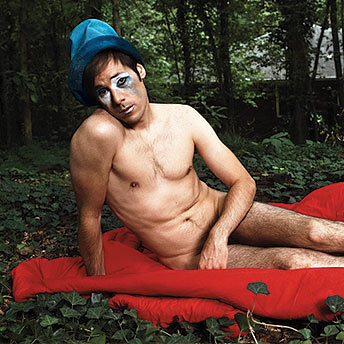
Of Montreal's Kevin Barnes is obsessed with Prince, suicide, and borrowing his wife's tights. Meet rock's newest damaged genius.
There are many things that Kevin Barnes' wife might prefer he not talk about. For instance, when she became pregnant a few years ago, the idea of becoming a father so terrified Barnes that he considered committing suicide. Or that after his daughter was born, his misbehavior on the road nearly destroyed their marriage. Or that he suffers from chronic depression, which he treats with the powerful antidepressant Cymbalta in a haphazard regimen. "I take it every three days or so," says the 34-year-old leader of the cult-fave psychedelic pop group Of Montreal. "I should probably take it more, but I kind of like that it messes up my mind. Every day is like a roller coaster — sometimes I feel really good, and sometimes I feel all tingly." Today is a Cymbalta day, which makes Barnes feel "introspective and weird." In the Athens, Georgia, band's industrial rehearsal space, downwind from a chicken-processing plant, Barnes stands quietly among his cheerful, PBR-drinking bandmates, with a purple Vitaminwater at his feet and a glossy Rickenbacker strapped to his slight frame. Dressed like Ziggy Stardust on a casual Friday — skintight red jeans, octagonal clear-frame sunglasses, a jaunty blue scarf adorned with tiny white stars — he absently noodles on "Day Tripper" before calling the song "Triphallus, to Punctuate!" from the band's new album, Skeletal Lamping (out October 21st). Three of his bandmates grab basses and pick out complex, strangely melodic lines as Barnes lets loose with an effects-heavy series of "ooh-ooh-oohs" that sound like Freddie Mercury on helium.
As with the last two Of Montreal records, Barnes recorded Skeletal Lamping (the title came to him after reading a Dylan Thomas poem) at home on his computer. An idea-packed pastiche inspired by Brian Wilson's SMiLE and Prince's Sign o' the Times, Lamping boosts the group's oddball pop with its polyperverse, sexed-up lyrics and kitchen-sink range — from hip-hop and disco to freaked-out soul and Stones-y blues. It arrives just a year after Barnes inadvertently introduced himself to the masses by allowing Outback Steakhouse to use his 2005 song "Wraith Pinned to the Mist and Other Games" in its ads. (The Australian-themed chain added didgeridoo and changed the lyric "Let's pretend we don't exist/Let's pretend we're in Antarctica" to "Let's go Outback tonight/Life will still be here tomorrow.") "They told me it was just going to be a radio jingle," he says. "And of course it wasn't — it became the anthem of Outback Steakhouse. The reality is it's definitely not good to sell a song to a commercial, as far as allowing people to have their own memories of a song." Barnes posted an anguished essay, "Selling Out Isn't Possible," online, writing, "The pseudo-Nihilistic punk rockers of the '70s created an impossible code that no one can actually live by."
But looking back, Barnes says the fear that he'd damaged his credibility fueled Lamping's adventurous spirit. "I was like, 'If you're going to call me a phony, I'm going to prove that there's nothing about me motivated by record sales,'" he says. Take Georgie Fruit, a character Barnes introduced on Of Montreal's 2007 album Hissing Fauna, Are You the Destroyer?, and in whose voice he sings much of the new record. "He's an African-American man who was in an R&B band called Arousal in the Seventies," Barnes says. "They didn't go very far, and he ended up in prison, where he had a lot of weird experiences and decided to be a woman. So he had a sex change. He's very free — I think of him as a genderless superhuman, untouched by taboos or the boring parts of our culture." (Barnes is considering an Arousal "reissue" as a side project: "It would be totally fun." He's also working on an album with MGMT's Andrew VanWyngarden under the name Blikk Fang.)
Of Montreal's live shows have evolved into over-the-top glam spectacles involving surreal props, whimsical sets and multiple costume changes — and, on one occasion, a fully nude Barnes performing against projected clips of Seventies gay porn. As the tours have grown increasingly baroque, Of Montreal have developed a reputation as kind of a Grateful Dead for arty, sexually ambiguous kids (plus David Byrne and Bono, who have both been spotted at gigs) who use the shows as an opportunity to dress up in hypercolorful garb, apply liberal amounts of makeup and glitter, and get supremely elevated on booze and drugs. In a few weeks, the band is heading off on its biggest tour yet, a theatrical production complete with elaborate costumes (drag, mythological creatures, giant kimonos), Madonna-size video screens and a cadre of "performance artists" who will act out choreographed scenes, including a brawl in a Deadwood-style saloon. "The inspiration is very Michel Gondry," Barnes says. "Or the kid in Rushmore that puts on those productions."
At rehearsal, Barnes' five bandmates appear to have been sent over from Indie-Rock Central Casting. Guitarist Bryan Poole has a Neil Young look involving bushy sideburns and an awesome tricked-out art project of a car (with a complicated back story about an artist friend's attempt to assemble a militia to capture a mysterious local known as the 8-Track Gorilla); bassist Davey Pierce lives in a garage next door among at least a dozen vintage mopeds in various states of operability; synth player Dottie Alexander sports a pink cheerleaderish skirt and polka-dot tights; and multi-instrumentalist Jamey Husband has an ascotlike scarf that recalls Fred's from Scooby-Doo. Rocking a cool straw hat and an unbuttoned cardigan without a shirt is drummer Ahmed Gallab, the latest addition. Gallab (who's been in town for less than a month and lives in the loft above the rehearsal space) emigrated from Sudan when he was a kid, and is eagerly waiting for rehearsal to stop so he can break his Ramadan fast. "There's two sides of Of Montreal," Barnes explains the next day. "There's the recorded music, which I've been predominantly doing myself. But the performing band is collaborative, and everyone is deeply invested emotionally and financially."
Barnes grew up in Grosse Pointe, Michigan, a well-off suburb of Detroit. "I listened to a lot of poodle rock," he says. "Mötley Crüe and Ratt were my favorite bands, and I covered my bedroom with pictures I cut out of Hit Parade and Circus." When he was 13, his parents — an accountant father (with dreams of becoming a stand-up comic) and teacher mother — bought him a black Pearl drum kit like Tommy Lee's. He formed his first band, Wit's End, singing and playing drums with a local kid named Mark Tremonti, who went on to become the guitarist in Creed. "Kevin was always a real talented guy," Tremonti recalls (the two haven't spoken since high school). "And he had a really cool voice and an artistic edge to him. Just to be able to write songs at that age was amazing. Our best song was 'Pull My Trigger.' It was pretty much a sex, drugs and rock & roll type of tune. You know, that Mötley Crüe thing. Dangerous lyrics. For a group of eighth-graders it was pretty edgy."
A year later, Barnes' father lost his job and moved to West Palm Beach, Florida, to look for work, leaving Barnes with a profound feeling of uncertainty. He fell into his first major depression. "Things were fucked up, and I was getting into trouble at school," he says. "Even though I wanted to be a rebel, there was a part of me that was sweet and wanted to be accepted." (Tremonti remembers, "He didn't really adhere to authority — he was a guy who probably got in trouble more than the average kid.")
Barnes began suffering increasingly debilitating anxiety attacks, culminating in what he refers to as "a weird drug experience." "It was my birthday and my friends bought me all this pot," he says. "Maybe because I was still developing, I had this bizarre reaction where I totally lost my mind. I really thought I was dying. After that I became conscious of how vulnerable we are psychologically. I still feel touched by that experience, which used to bother me. Like, what the fuck is wrong with me — I still feel as crazy as I did when I was a teenager. But now I feel like it's good, like it fuels my creativity."
In Florida, Barnes made a crucial discovery — British Invasion rock, particularly the Beatles, the Kinks and the Rolling Stones. "I was delivering pizzas, and I got The Kink Kronikles on vinyl," he says. "I put it on a cassette and listened until I wore it out." Playing along to an early Stones comp on guitar, Barnes taught himself chords, and by the time he finished school, he had released a collection of tunes on the influential indie label Bar/None. In search of a band, he headed to Athens after seeing the classic documentary Athens, GA. Inside/Out. "I was just dying to find like-minded people to play with," he says. "But I never thought in a million years that I would ever have a career in music — I was just a kid with a four-track recorder with no friends and no prospects."
Athens has two abiding passions: University of Georgia football and off-kilter art rock. Best known as the birthplace of R.E.M., Athens also nurtured freaked-out proto-alt bands such as the B-52s and Pylon, who exploded from acid-fueled UGA parties in the early Eighties. A decade later, when Barnes arrived fresh out of high school, a new scene was starting to take off — centered around a tight group of Beatles-and-analog-recording-obsessed indie bands that referred to themselves as the Elephant Six Collective. "It was just a great explosion of talent," Barnes says of his early years there. "Very bohemian, everyone living together, three or four people sleeping on the floor, everyone playing on each other's records. And there was the excitement of seeing Michael Stipe at a house party, wearing a straw hat, looking really cool. I'd be like, 'Oh, my God.'"
Until 2004's awesomely titled Satanic Panic in the Attic, the first Of Montreal record Barnes made by himself, the band was mainly inspired by the Elephant Six groups (Neutral Milk Hotel, Olivia Tremor Control, the Apples in Stereo among them), whom Barnes befriended shortly after moving to town. "They were kind of like big brothers to me," he says. "I sort of worshipped them — like, God, they're making records and going on tour, they have a publicist, a booking agent, all these things." Living together in a series of communal houses, including a $400-a-month brick bungalow he shared with Neutral Milk leader Jeff Mangum ("It was a total party house — we had a skateboard quarter pipe in the living room and no heat"), Of Montreal cut several low-fi albums between day jobs. "We all wanted to sound like the Beatles," Barnes says. "And everyone was turning each other on to lost psychedelic classics — like someone would go on tour and discover, like, Os Mutantes or the Pretty Things' S.F. Sorrow and bring it back to the circle. Everyone would be really influenced by them."
Of Montreal's breakthrough, 2007's Hissing Fauna, veers from synthy electro pop to sun-splashed R&B inspired by psychedelic-soul great Shuggie Otis (name-checked on the standout "Faberge Falls for Shuggie"). On about half the songs, Barnes' vocals shift into a life-affirming falsetto — but the lyrics are more harrowing than groovy. Hissing Fauna's emotional center, "Heimdalsgate Like a Promethean Curse," finds Barnes singing, "I'm in a crisis/I need help/C'mon mood, shift back to good again . . . chemicals don't make me sick again."
Barnes met Nina Twin — a talented visual artist and musician — at a gig in Oslo in 2001. After a long-distance courtship, she moved to Athens and joined the band on bass. When she became pregnant in 2004, the couple moved to Nina's native Norway to take advantage of the Scandinavian nation's free health care. "The government actually pays you when you have a child," Barnes says. "So we said, 'Fuck it, let's put everything in storage, go to Norway and see what happens from there.'"
Barnes suffered the deepest depression of his adult life, becoming mired in anxiety, paranoia and persistent thoughts of suicide. (Heimdalsgate is the name of the street where they settled in Oslo.) "I was totally isolated, totally broke, we were couch surfing, and I had never imagined myself a father. I found the concept of having a child terrifying, and it is terrifying. There was so much terror in my mind. It was so much easier to live in a dream state where all I had to worry about was myself." And as scary as the pressures of fatherhood were, the fear that he'd have to give up music was worse. "We had been a band for seven years, but never had any commercial success," Barnes says. "But the thing that motivated me wasn't praise or acclaim — it was the process of creation. So there was no reason for me to stop making music, until there was the idea that, fuck, if I have a kid . . . I'll have to stop fuckin' around and take care of my kid."
Encouraged by their booking agent, the couple returned to the U.S. to launch a tour behind the surprisingly popular Satanic Panic. After an attempt to bring their daughter, Alabee, on the road failed, the tour continued without Nina — who became increasingly resentful of being left behind. "Understandably so," Barnes says. "Taking care of a baby is nowhere near as much fun as going on tour."
With Nina at home, and fueled by champagne and antidepressants, Barnes began bringing his glam superqueen live-show persona to the afterparties. "I think the medication allowed him to function, but it also caused his psyche to become more disassociated from feelings like empathy — especially when alcohol is involved," says guitarist Poole, who records his own psychedelic side project as the Late BP Helium. "He'd do stuff like come up to you and stick his hand down your pants and start jerking off your dick. Or, like, try to make out with you, or take all his clothes off and just start walking around at parties."
Nina and Alabee moved back to Norway, and for half a year Barnes went on without them. But then something clicked inside. "I was looking for another Nina, in a way," he says. "But I realized what I had with her was so special. And I was missing Alabee a lot. My whole life I've been sort of detached emotionally, but with Alabee I understand true love. When I'd go visit them in Norway, Alabee would stand at the windowsill and cry because she wanted to see me. That's when you realize you need to be there for your child, because she needs you, she loves you. And you can't take that lightly."
For now, Barnes and Nina seem happy. They just bought a chic, modern, three-bedroom house in the leafy Athens neighborhood of Five Points, separated from the neighbors by tall, shady trees and a long driveway. The sun-soaked rooms feel homey and somehow Scandinavian, accessorized with high-end kitchen gear, an upright piano, framed expanses of cheery Marimekko fabric, Nina's artwork and shelves full of tasteful books (spotted: Portnoy's Complaint, Gravity's Rainbow, Bob Dylan's Chronicles, Dave Eggers' What Is the What).
Barnes' mom lives in a house next door and helps out with Alabee. When he's not making music, Barnes spends a lot of time in front of his new flatscreen TV, watching NFL games. "When I was a kid, like in high school and stuff, I felt very feminine," he says. "But I'm also very athletic, very into sports. I read ESPN magazine. I watch SportsCenter all the time. I'm a big Cleveland Browns and Indians fan."
Sitting on his big new patio as the sun sets, with Nina puttering around in an embroidered housedress, Barnes seems relaxed. His sunglasses are off, revealing sleepy, vulnerable eyes. But the couple's hard-won contentment could be shaken in a couple of weeks, when Of Montreal hit the road again for a yearlong tour. "I'm not always a very attentive husband," Barnes admits. "And there's no way I could be with Alabee all the time and never do anything in the adult world. Nina's a lot like me — it's hard for her to have a three-year-old as her only companion. But she's going to be performing the first four or five shows, and I'm excited. Hope springs eternal."