Showing posts with label artwork. Show all posts

Sunday, July 10, 2011

2011-01-14 - Broward Palm Beach New Times

Q&A With David Barnes: Of Montreal Concert This Evening Will Involve a Dragon


Of-Montreal-False-Priest.jpg
False Priest album cover by David Barnes.

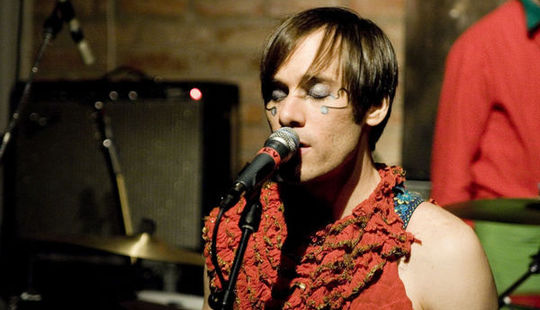
​Of Montreal frontman, Kevin Barnes, and his brother, David, the band's artistic director, grew up in West Palm Beach and are returning to their South Florida roots tonight for a show (or, more aptly, an energetic, colorful, costume-laden spectacle) at Revolution in Fort Lauderdale.

The tour promotes their latest album, False Priest, which NPR calls "bonkers," but in a good way. False Priest is as energetic as a candy-addicted toddler and listening to it instantly transports you to a party -- a party full of dancing and dark secret rooms. The music, with its synthetic sound-glitter along with the band's penchant for theatrics promises a Friday night that is border-line otherworldly. County Grind caught up with David, the artistic brain behind both the album art and the performances, known to involve human hair clippings, pig costumes, and a Susan Sarandon cameo...don't worry, we'll get to that.

Your performances are known for crazy costumes and lots of energy, so what do you have planned for Fort Lauderdale?
Our whole thing is really just creating a scenario for escapism, and that's why we do have all the theatrics. Me and the bass player, Davey Pierce, made a bunch of -- we made our own masks and stuff like that out of fiberglass and so we have these weird little school children characters. We have these characters that we call 'the builders,' and they're kind of modeled after Catholic priests a little bit. They kind of are bumbling idiots though. That's a little jab at organized religion I suppose. [And] we have a giant dragon that Kevin rides on.

I heard he rode on a white stallion before so I guess a dragon is the logical next step, right?
Yeah, we have a lot of theatrics going on. We have four performers with us on the trip, and just because we know so many people we tend to grab our friends every now and then.

Earlier, I was watching the clip of Susan Sarandon slapping a pig while on stage during an Of Montreal performance (video below). Was that your idea?
Yeah, it was just kind of a joke because a friend of ours was friends with her son. She could be this harsh school teacher that disciplined the pig characters for biting, and it was one of those surreal moments where what could have been just a funny idea somehow becomes reality.

Were you on stage at that point?
I was a pig, yeah. I didn't get spanked. Sometimes you give the lead character role to someone else so that you can enjoy it more. You can actually see it.

Where do you draw your inspiration for these stage performances and for the album covers you design?
draw a lot, I'm just always drawing, and so if you're always drawing and you're also reading and watching things, somehow it just all blends together naturally. There's definitely a comic book superhero influence for sure. I would definitely prefer it if everyone wore costumes all the time. False Priest, the album cover is kind of based on the idea of a false priest, which dosen't have to be religious. It can just be anyone that pretends to be something that they're not. If you meet a fish that's wearing a gas mask, then he's lying about something because fish would never need a gas mask. Maybe he's not a fish (laughs), or...

Have you ever had any ideas for performances that were just too crazy to carry out?
I have a friend that is a hairstylist, and so I had him save the hair for like two weeks. So, I had three garbage bags filled with hair, and I wanted to drop it onto the audience. The joke was kind of like, "Do you like flowers?" and every one's like, "Yea," like super excited that flowers are about to fall down, and then it's like, "Too bad, you get hair." And then hair drops down. We asked our lawyer about it, and he sent us a letter that I actually still have that's really funny..."Under no circumstances do you drop human hair on the audience." It was just a liability. It wasn't until after it was like no, it's not happening, and I kind of felt some of the hair and realized, "Oh, this is pretty disgusting." I got these weird little boxes and just put a little bit of hair in each box, and threw the boxes up so that it didn't get on them. It was not symbolic or intelligent in any way. It wasn't even really a prank. Sometimes ideas like that are just funny.

How would you describe the general vibe of False Priest compared to other Of Montreal albums?
Definitely more influence by '70s funk bands I would think. Kevin was just listening to a lot of that at the time. And there are some pretty heavy -- like the last song is the darkest ending to any of the records, which is basically God kind of apologizing for the Old Testament, basically -- for the idea that humans should worship God, so God's basically saying, "I was wrong...you guys should start worshiping each other as human beings and take care of each other, and if you're going to put your ideology above your brothers and sisters, you're going to hurt them for your ideology, then that's not right."

Do you think that message is more poignant now with the Tucson shootings?
I don't know if it's any more relevant now. I mean, people die all the time, and every now and then the nation cares about someone dying, but you know, people are being cruel to each other every single second of the day...I went to a Catholic school, so I tend to poke fun at not religion but organized religion in the sense that it's so stuffy, and there are so many rules and the rules are very arbitrary...

Did you and your brother go to the same Catholic school? I went for all four years; he went for, he couldn't even make it through a year so then he went to public school.

Was that an influence behind False Priest?
Probably not Catholic high school, but definitely we grew up in a Catholic household, and so, it definitely effects you. I'm kind of obsessed with the concept of God and religion, I suppose.

What do your parents think?
They're pretty religious, but they're also super supportive. There are certain things we've done on stage that my mom will be -- my mom especially will be like, "Ohh no, why did you do that?" But they're super super supportive and always have been. And my dad's like a business man, so he has this really funny outlook on it where it's like, "I don't understand half of what you guys do, but it appears to be working."

Video, as promised: Susan Sarandon Spanks a Pig

2011-05-04 - AOL Original

Of Montreal's Art Director David Barnes Gets 'Weird' With New Book

David Barnes
Courtesy of David Barnes


Of Montreal not only just released the new EP 'thecontrollersphere,' but the Athens, Georgia-based musical magicians also put out a book by way of David Barnes, the band's resident art director who's also the brother of frontman Kevin.

With packaging and both cover and stage art under his belt, Barnes decided to tackle books, too, releasing 'What's Weird?' last week alongside of Montreal's record.

"I wrote stuff in it, but it's not telling a story," Barnes tells Spinner. "It's more something that you could just open up every day for a year, I would hope, and if you just looked for a second, you'd find something new; it's pretty dense because I draw so small.

David Barnes Book

Courtesy of David Barnes


"I always imagined that I would do a children's book -- that's just my style. But it's sort of the thing where what I wanted to draw wasn't always appropriate for children. With children's books, you start to think, 'Well, I have put out some things that are inappropriate for children.' And so you wonder if that would affect that, like, if you've ever drawn boobs, you can never draw children's books."

But Barnes says he'd still like to write a children's book -- assuming he hasn't been blacklisted by the book police, that is -- which makes sense, since he loves juxtaposition in his work.

"My favourite thing is taking two things that aren't related and putting them together. I don't know why I find that so much fun. But, I guess, that's kind of the basis of comedy," he says.

"Anything kind of anthropomorphic is kind of good -- any time you can take a part of an animal and attach it to a human. You can spend a lifetime drawing variations on the centaur; it's a man and a squid; it's a man and an eagle."

And Barnes has been working on another odd pairing for his next book.

"It's a graphic novel about a pregnant football player who's kind of dumb and never really says how he got pregnant -- that's not really important. But he's just such a good kickoff returner that no one makes fun of him about it," he says.

"But then also going on in the story is a secondary story of his unborn child, and it takes place in this sort of sci-fi fantasy world. It's based on the idea of what goes on in a foetus' mind. It can't just be blank; there must be something happening. It's the idea that foetuses are on this journey in their minds to reach being born."

Saturday, December 11, 2010

2010-10-01 - Drowned In Sound

"If I make sense, I fail". DiS meets Of Montreal

According to the full version of the above photo, there are potentially a full 13 people in the ever-evolving Of Montreal's current incarnation. As you know, just one of them really matters: Kevin L Barnes, the genius/fruitloop behind all ten of their albums to date, including last month's funky/fucked up False Priest. On the eve of a walloping great three date UK tour, DiS caught up with Mr Barnes to talk about fish slaughtering ex-girlfriends, the futility of religion, and why you can't change the world via the medium of lampshades.

DiS: Did you have any particular plan for False Priest? It’s clearly a different mode of songwriting to the fragmentary approach you adopted for Skeletal Lamping...

Kevin Barnes: I think because I’d done that collage style writing on the last record I didn’t want to do that again, I felt like a change, so, um I leaned it more towards slightly more linear arrangement with the songs. I also wanted to create longer vamps within the songs. Skeletal Lamping was very jarring, with this one we wanted to bring out the rhythm element more. But I was still very much under the influence of Skeletal Lamping, it’s still very funky and still a fairly sexy record. But I started getting into, I guess, the heavier end of funk music.

DiS: Why did you decide to cut the entire record with live instruments this time? Was it because you had more money?

KB: Well I actually made this record at home, and by my standards it was basically done. But I’d been sending rough mixes to [producer] Jon Brion and I guess he had sort of gotten it into his head that he would like to help me realise a fuller sound. So he invited me out to California and I went in with a session drummer called Matt Chamberlain who came in and drummed on every single song. So once we’d improved the fidelity of the drum I was like ‘maybe I should recut the bass too’ so I just went through song by song and redid all the bass lines and then we sort of realised ‘well, why don’t we replace a couple of these digital pianos with real pianos’ and we kind of got carried away and sort of replaced everything.

DiS: So what you’re basically saying is that you technically made the same album twice?

KB: Yeah... it all just happened organically, I found myself out there working with this wizard of a producer and a musician and transforming my record, it’s been such a great education for me.

DiS: False Priest seems a bit more playful than your last few records; do I take it that not so many of the songs are biographical this time?

KB: Everything is based at least loosely on true stories...

DiS: So ‘Our Riotous Defects’... that actually happened to you?

KB: Yeah.

DiS: Wow. So you had a girlfriend who killed your fish?

KB: Yeah, she killed my Betta fish over some really small shit...

DiS: Wow. On the second date?

KB: Er, no, it was later, well into the relationship...

DiS: It’s not your wife is it?

KB: No, previous relationship.

DiS: How does the subject feel about the song?

KB: Um... well, they’re not really a huge Of Montreal fan, they might hear it on the radio at some point... but I don’t care, she deserves it.

DiS: Yeah, it, er, sounds like it! Does it get harder finding stories like that now you’re settled down..?

KB: It’s pretty easy I guess – when I’m feeling inspired I just let whatever happens happen and I don’t really edit myself or second guess it I just let it flow... it’s funny, a lot of songs I can’t explain the inspiration or influence behind it, I can’t remember writing or even recording them. I just have a really bad memory I guess.

DiS: Skeletal Lamping, False Priest and your upcoming The Controller Sphere EP all take their titles from a single line of the song ‘Faberge Falls For Shuggie’... is there any meaning to them beyond that? Bar the anti-religious monologue at the end of the ‘Do You Mutilate?’, False Priest wouldn’t seem to be much to do with religion...

KB: I think that maybe it has some connection to the part before it, the ‘try to connect XX infinite pleasure’, but it is abstract, that’s the only way I can really write. If I try and make sense than I just fail. I might be failing anyways, but at least I’m doing it in a way that works with my normal brain function.

But I don’t really have any strong agenda. I mean, I was raised a Catholic, I did go to church for 18 years, went to Sunday school for 18 years, my mum is very involved in the church, but I don’t think that much about it or care about it... I don’t feel like the Catholic church is bringing about the end of the world or anything. But what I was trying to say with that very frank lyric at the end, which is something that my brother and I talk about a lot, is that we should put humanity first, that we shouldn’t put god above humanity, we shouldn’t think of a religious prophet as more important than just day to day helping people. I think people get carried away by the mythology of these things, the mysticism of it, that if you don’t on the surface act a certain way they you’ll be punished and if you act another way then you’ll be rewarded in the afterlife... but who cares about the afterlife? I can’t really understand that obsession. We can do better without God, because we can do away with all the uncertainties, leaving just the certainties. If we got rid of religion and just concentrated on trying to empower each other then I’m sure that would help us a lot more.

DiS: It sounds to me like you’ve been pushing your vocals a lot more on this album, not technically, but in terms of a few more vocal personas. Is that something you were aiming for?

KB: Yeah, definitely, and I think listening to people I really like live David Bowie, Stevie Wonder, Sly Stone, Prince, a lot of people have different vocal personas and with an album they go through four or five different personas. I’m just trying to be very expressive and experimental with what potential I have on this record, really trying to put my heart into every vocal performance and just make it more unconscious, sort of natural expression. It’s a cool thing because on this tour I’m not actually playing an instrument I’m just singing.

DiS: I can imagine you’ve wanted to do that for a while.

KB: Yeah, I’m sure I’ll miss playing a guitar but it's an interesting challenge and it will allow me to put all my energy into my singing. And of course there’s the dance moves, which are really tricky.

DiS: [laughs, unsure if he is joking] Speaking of Bowie: he always took pains to point out the inauthenticity in his dabbling with black American music, referring to it as ‘plastic soul’. Do you feel similar with what you’re doing?

KB: I’m not really TRYING to make soul music, but I don’t believe in that thing that if you’re white you can only make ‘white’ music authentically and if you make music that was created by black people then it’s obviously phoney. Maybe it was at one point, but I think now there’s so much cross pollination and intermingling of ideas and releases and cultures, I don’t feel any more of a phoney doing this than when I was making Coquelicot... which was influenced by the Gershwin brothers... now it’s just a sort of different obsession, but it's emotionally and intellectually connected to me, it doesn’t feel like I’m putting on a persona or anything.

I think that it goes both ways too – I think there are a lot of R&B producers seeking influence from outside sources, it’s not as homogenous as it once was, people are starting to nod to each other... it’s kind of similar to what was happening in the Sixties, Otis Redding covering Rolling Stones songs and Aretha Franklin covering Beatles songs... I don’t really know what happened in the Seventies to make it all so segregated again...

DiS: Do you ever feel at all self-conscious about the music you make? Like, does it require a special effort to psyche yourself up to do a vocal as OTT as the one on ‘I Feel Ya Strutter’?

KB: Er, no, when I’m recording I work on my own and just forget about the world. I don’t think about playing the music live or anybody else ever hearing it, I just want to make it exceptional, powerful, and not question myself. So much of funk music and soul music is so much about swagger, about attitude and confidence and you know I think I’ve reached this point, I know I’ve accepted my flaws, I’ve accepted that I’m not a perfect person, that I’m a total fuck up and I don’t really care, because everybody’s the same way, you know? I think self-forgiveness has really allowed me to go out there and not feel vulnerable, I don’t feel like anyone can take anything from me. It’s not like a cocky thing... I’ve just been down so low that I’ve got a new understanding about myself, what can be taken and what can’t.

DiS: ‘Enemy Gene’ and ‘Sex Karma’, the tracks on False Priest with guest appearances by Janelle Monae and Solange Knowles, are very explicitly duets, it’s not just a chorus hook or whatever; is that a mode you’d been interested in writing in previously?

KB: I’ve been a big fan of Marvin Gaye and Tammi Terrell’s stuff for a while and I became sort of really obsessed with it while I was working on False Priest, so it was something that I was excited about. But I felt so privileged and so honoured to be able to work with Solange and Janelle, I think they're two of the most exceptional singers and artists and performers and human beings that we have among us on the Earth right now.

DiS: There are no novelty editions of False Priest, whereas Skeletal Lamping had all these special editions that were just a download and a fancy object; did that not pan out how you’d hoped?

KB: Um, it was kind of a funny thing, because we thought it was going to completely revolutionise the music industry. And that kind of didn’t happen, it didn’t even seem to be that big of a deal. And then you see other people who came out with similar things afterwards and we didn’t get any props for it. But we’re just some underground indie band... and maybe somebody had come up with the idea before us and I just didn’t know it. But we were all a little bit deflated because we thought it was going to be this big event, you know, abandoning the conventional product that goes along with the record and doing something totally far out.

DiS: I bought a lampshade.

KB: Maybe it was because the things that we were able to make on our budget weren’t that outrageously commercial... we were just crazy, now I think about it. We thought that this elaborate lantern or wall decal was somehow going to replace the TV or the microwave or something. But for The Controller Sphere we do have plans for some really cool packaging, something that we’ve been working on for a while.

DiS: Should we expect anything different from this tour?

KB: I think the same spirit but we’ve expanded out line-up so that we’re now an eight piece band, so this with the exception of a few samples everything is live. We’re trying to just get completely away from any sort of oppressive backing track, just try and create spontaneous energy, like we did it back in the day. We just want to be a real band, follow the spirit of Parliament. But there’s definitely going to be a theatrical element to it, we have a lot of new props that we’re very excited about bringing over to Europe.

DiS: Do you have a mental cut off point over how far into your back catalogue you’ll go?

KB: I’m weird about my back catalogue and my past in general, it’s almost like another person wrote those songs and I’d be covering some other artist if I played anything before Satanic Panic in the Attic. I think the False Priest tour will be very False Priest heavy with a few Hissing Fauna... and Skeletal Lamping songs thrown in. Luckily we don’t really have any major hits, so it’s not like anyone can go ‘they didn’t even play that’.

DiS: What about ‘The Past is a Grotesque Animal’?

KB: Yeah... that one’s hard though, it’s like a ten minute journey into hell... but I guess we’ll probably play it a couple of times. We’ve never done it with this line up, with a violinist, I think we could definitely create an interesting version of it. Maybe we’ll do it in London.

Saturday, June 27, 2009

2008-11-13 - Paste (part 5)

Of Montreal's Kevin Barnes: The complete Paste interview

Steve LaBate, photo by Jeremy Cowart |


Paste
: There was over 30 minutes of material you said you cut from the album. Are you going to put that out as an EP?
Barnes: I’m not really sure what I want to do with it. On some levels I feel like, “Well, these are the songs that weren’t good enough to get on the record, so why would I want to put out a reject EP?” But I feel like it would be OK if it was like a fan-only sort of thing. I feel like there should be some level of quality control—you don’t just put out everything. In the past I have put out everything; [at that point] I didn’t feel like it was important to worry that much about it. Now, I don’t feel like it’s necessary to release everything for everyone. It might be cool to just put out an EP and people could just download it for free if you want people to listen to it. Or we could just use the tracks for B-sides. There’s a couple songs that I like that, for whatever reason, just didn’t work. I didn’t want to make a 74-minute CD. I wanted to keep it somewhat digestible, so you could listen in one sitting, so you could listen to the whole thing without being like, “Goddammit, is this thing still going?” I wanted to make something where people would want to listen to it again rather than get to the end and be like, “OK, I don’t need to hear this again for another month.” There’s a lot of songs that I actually like that my brother [and collaborator, David Barnes] and I went back and forth on, like, “Should we keep that on there? Should we take it off?” And I actually wanted to edit it down even more, but he was like, “No, don’t do that. You gotta keep it there.”

Paste: Are you going to play some of those songs live? Some of the ones that didn’t make it on the record?
Barnes: Maybe. We have so much work ahead of us [with the touring band], just learning the songs ’cause we have a new drummer now.

Paste: Who’s the new drummer?
Barnes: His name’s Ahmed [Gallab], and he plays in this band Sinkane. It’s funny because we’ve done a lot of press photos with him, but we haven’t done a single practice with him, so hopefully it works out. I’m sure it will. He’s an awesome drummer and an awesome guy. So what we’re trying to do now—in the past we’ve had two different kinds of performance, like we would have an aspect of the show that would have backing beats on a CD player and no live drumming, and then the other side would be all live drumming and no backing tracks. And so this time we’re trying to get rid of the CD player altogether and just have drums on everything, but still have the same sounds from the record, so we had to get this MPC player to sample so we can have the actual sounds from the record, but instead of having a little disc playing, we’d actually have a human being playing it, and that way we’ll be able to really expand upon certain ideas and it won’t be as consistent from night to night—there’s going to be room for spontaneity and experimentation, so we’re all really looking forward to that.

Paste: There’s all this really cool packaging for the new record—so many different options. What was the idea behind this? What are these different options giving people?
Barnes: It just occurred to us: “Why does it have to be,” especially with digital downloads, or just packaging ion general, “why does it have to follow the same path that is always has?” Someone established, OK, we’ll have packaging that’s basically the size of a CD, and that’s just the way it’s gonna be.” We realized it doesn’t have to be that way. If you want to do something different, you can. And the only real restrictions are for the big corporations like Borders or Target or Best Buy. For stocking, they want it to fit on the shelves, so you don’t want to have something that’s going to be a specialty item that’s going to have to be stocked inside a glass case, like when you go into an indie store and they have their window or whatever. So there are different challenges we had to work out, but we really wanted to make something very unconventional, to create an object that could stand on its own. Something that wasn’t just a CD protector, or just something you’d have to categorize and put it on your shelf. Like everything that was involved with the release of the record, we wanted to make an object that would be interesting and thought-provoking, and that would blend into your design scheme in a way. You think of lifestyle, of interior-design objects, like the lamp and the wall decals and posters—these are things everyone needs, everyone uses. We go to IKEA because we don’t want to go to Rooms To Go or whatever, we want there to be a design element in our own house. Ecko and different companies are producing interesting objects that are thought-provoking and inspiring. We felt there was a lack of these things—it’s difficult to find interesting objects for your house, so we thought it’d be cool to produce our own. And luckily, [our label] Polyvinyl has been amazing about figuring out how to make that happen. A lot of labels would be like, “Uh, that sounds expensive.”

Paste: Yeah, because you have to come up with whole new ways to manufacture this stuff, right?
Barnes: Yeah. But also, I think that the spirit of the times, like with what Radiohead did [releasing an independent album as a name-your-own-price download, and then also offering a gorgeous, high-priced special edition]—it sent ripples through the industry. All of a sudden you realize there’s a lot of potential, you can do a lot of different things. You don’t have to just follow the boring path. Everyone involved in of Montreal is very creative and we all want to do interesting, important things, so it’s cool to give people an opportunity, like [my wife] Nina and David, to design these objects, and to also give people the option, so when they download the record, they don’t have to just get this tiny little thumbnail image of the album cover. They get a T-shirt or a tote bag or a lantern or a wall decal—it’s that much more exciting to get that in the mail.

Paste: [Your publicist], Frank, told me about a book and a play and an art show related to the release of Skeletal Lamping. Is that stuff still in the works?
Barnes: Well, we’re trying. David’s working on a book of his illustrations and what we’d like to do is come out with another Skeletal Lamping collection of all new objects, probably in early spring. I love the idea of creating a whole collection of art objects that are somehow affiliated with the release of a record. It makes it so much more interesting than just a record. It becomes a lot bigger, and I love that idea of like—in fashion you get it all the time, the spring collection, like the Marc Jacobs spring collection. It’s always something that’s—it’s not just one pair of pants, it’s a lot of different items. And I really hope that, in the future, it’d be really cool if it caught on and every band did that—released four or five objects with their record. It’s always good to have options, you know? And it’s also really exciting to try to create different things. What we really wanted to do was put on an art show in every major city and coordinate that with the release of the record. I think we’re trying to do one at the MoMAs in every city, and we’re gonna try to work on that in the spring. It would be awesome to do something like that, where you get a group of really creative people in every city and give them a rough idea of what you want to do, and people could put on this performance-art piece at the same time all over the world, and it’s in some way connected to the release of the record. Art is fun in that way, when you try to think of different ways to inspire people, and different reasons to make art, and different reasons to produce things. A lot of our production comes down to inspiration. And a lot of times, you’re just sitting there, you don’t really know what to do and then something will just click. And then, you’re off. You spend the next month working on this thing. So I love that about art—that it’s sort of laying there dormant until you find the switch to turn it on and it just explodes.

Paste: What about that play? Is there something going on with that? Is it something you’re writing?
Barnes: I guess there’s other performance-art troops doing things like this already—the idea was to have a happening in every city on the day we play. So it’s sort of like the circus coming to town, it’s not just the rock show that lasts for three or four hours—the whole day is an event. It’s probably not gonna happen on this tour, but we’re going to try to do that in the future, maybe the next tour, where we get to the city a little early and set up an art installation and a performance-art piece in an art gallery. And we had this idea for this machine that would like record people’s voices, and then you use the voices from that day’s event in the performance at night so everything ties together. I think that would be really exciting for people to feel more connected, to feel a part of it. I think art should always be communal. I always want the live performance to be more of a communal experience so it’s not just us entertaining people. I want people to feel like this is a chance for them to dress up and step out of their normal reality. And this is outside of time, outside of whoever they’re expected to be in their day job. It’s an exceptional moment in time that matters, that has value, and it’s exciting, and it has potential and anything can happen.

Paste: Of Montreal’s live performances have really evolved over the years. I saw you guys at a bar in a strip mall in Mt. Pleasant, S.C., in early 2003, and [drummer] Jamie [Huggins] was in the parking lot sewing costumes before the show. How has the show changed and how has the experience of performing evolved, now that you have some money to help live out your fantasies?
Barnes: It’s really cool now because we have this group of people like Dan Korn, our sound guy, and Nick Gould, our video tech. The two of them and Davey [Pierce], our bass player, are very crafty. They understand woodworking and electronics. So we don’t have to farm out our ideas. We can do everything in house. Everything we do now, because we have a stage concept, we can still realize on a pretty small budget. Any idea we have, we figure out a way to realize it, unless it’s totally cost prohibitive, but then we just tone it down a little and find another way to realize the same vision, just maybe not as extreme as we might’ve wanted. Like Liberace, there are a lot of people who have done some really awesome things because they didn’t have a budget to worry about. Eventually we’d love to get to that point, even if we had a government grant. What I like is to focus on one show at a time—for example, when we did Pitchfork [Festival] a couple years ago, we said, “OK, let’s put everything into this one show and make it really exceptional and different from any show we’ve ever done.” It’s fun to work like that, one show at a time. We’re doing that same kind of thing with the Roseland show in New York in October and then we’re going to keep some of the ideas and use them for other shows. You can feel OK about spending a shitload of money if its only gonna be for one show. The cool thing is, the reason we have a budget is because everyone in the band wants to do this. We’re spending band money to make this happen, so it’s great that I have this group of people who care just as much about putting on a performance as I do. If they thought, “Whoa, I’d have so much more money if I was just in a straightforward rock band…” But at the same time, it wouldn’t be as much fun, it wouldn’t be as fulfilling for anyone. I think we all get off on that. The production planning is just as exciting as the production itself.

Paste: Last year a big deal was made about you taking all your clothes off at a show. What is it like to be naked on stage in front of so many people and how did you feel?
Barnes: I feel really relaxed with my body. I could easily be naked right now and not feel insecure. It wasn’t a big stretch for me. I wasn’t putting myself in this really awkward, vulnerable place because I was totally fine with it. It’s amazing, though: You do something and it’s stamped in time forever. Twenty years from now, it’ll be one of those stories—the way I heard about Iggy Pop rolling around in broken glass. If you wanted to, you could very easily make yourself this huge, iconic figure just by doing wild things and sacrificing your body. A lot of people don’t realize the potential there. But at the same time, you’re walking a line where it’s like, “Is it for shock value?” It might take away from the music if everyone thinks the singer is just trying to get attention because he’s really insecure.

Paste: How important do you think it is for an artist to let go?
Barnes: I think it’s very important that you allow yourself to be vulnerable in your art. It’s important that you don’t put up a wall between you and the rest of the world. I did that for a while. Early on, I had gotten some really negative reviews and they had really hurt me and made me hesitant to share my personal feelings with the rest of the world.

Paste: After Cherry Peel [Of Montreal's 1997 debut album]?
Barnes: Yes. And then, eventually, I realized that there’s always going to be bad reviews no matter what you do. And it’s more important, from a production standpoint to present things that are full of genuine emotion and represent where you’re at personally, and I don’t think I’ll ever feel embarrassed of those things. I think the only time I might feel embarrassed is if I’m doing something I’m not touched by. I’d never do that, but if I did… I think it’s important that people wear their heart on their sleeve as artists. I think that’s something that really resonates with the audience; its something people can identify with, and also it’s very brave. People like bravery.

Paste: So after Cherry Peel you got away from writing personal stuff, and more into characters. At what point did you come back to writing personal stuff?
Barnes: I guess around Satanic Panic in the Attic. I got married to Nina and moved out of the house with the band, and me and Nina and my brother got a place together. It was a supportive environment being with the band, but it was also more challenging as far as accommodating everyone, being in a communal household, being reliant on each other for so many things, and then you’re in a band together, and you spend so much time together. Every artist I know is totally crazy and neurotic, so it’s kind of a dangerous situation to be in. It was really liberating for me to get out of that and move in with Nina and David. They didn’t really have any demands, it was just do what you want, just create something we find interesting and fun. Their life wasn’t really—I mean, it was connected to mine on an emotional level, but not a financial level. And they had their own creative outputs, so it wasn’t the same situation. Like when [the band and I] were living out in the country, if I wanted to do something like on Satanic Panic or Sunlandic Twins—where I recorded every part—then feelings would be hurt. [Former bassist] Derek [Almstead] would be like, “Why are you writing the bass lines? I want to write the bass lines,” which is totally understandable. I was depriving them of their creative outlet that was fulfilling and exciting. So that was a difficult transition for the band, when I took it over again and started doing everything by myself. [Barnes had briefly taken that approach on the band’s sophomore album, 1998’s The Bedside Drama: A Petite Tragedy.]

Paste: Do you feel like your friendships with all these former bandmates have endured that transition, or has it been difficult?
Barnes: It’s definitely been difficult with some people more than others, but I can totally understand any sort of problem that arose from that. And I love everyone that plays with me, and I really support them and everyone is so talented, and they all have their own projects and I totally want to encourage them—like, Jamie is an amazing songwriter and an amazing singer and performer. And Bryan [Poole], and Davey, and Dottie [Alexander] are all fantastic composers as well as performers, and it’s pretty amazing that they’ve been with me all this time and have gone through all these different phases with me, musically, and every time have been able to adapt and get excited about it, and encourage me and basically stay connected through all of it. It’s been pretty amazing. We’re like a family, and you can’t divorce your family. I think we’re like that—we’re like brothers and sisters.

Paste: I read an interview where you talked about the trappings of the Elephant 6 Collective and some of its unwritten rules. Tell me what those rules were, and about breaking free from them.
Barnes: All of it was just my perception of what the rules were; there was no manifesto we all had to sign or anything like that, but there was a spirit of that time, and I started to go this other direction. I had these weird hang-ups that maybe I created myself—this idea that nothing had any value unless it was recorded on an analog tape machine. I couldn’t stand any contemporary bands—I never listened to any of them, really, except for the Elephant 6 bands. I was living in a self-imposed fascist state. I had all these rules about what was good and what was bad, and I was really critical of other bands, and just really stupid. And I know it sounds clichéd, but I can’t help but think that [getting away from that mindset] was influenced by 9/11. After 9/11, it was a universal thing in the United States where everyone felt like they need to connect with other people more. It really influenced me in that way. [Suddenly], I wanted to listen to and support contemporary bands. I wanted to feel a part of my time, my generation, and not be so obsessed with ’60s music, and music made by dead people. I’d always loved dance music, but it was kind of taboo to use a drum machine in the Elephant 6 world. Obviously studio trickery was encouraged, but you probably shouldn’t do anything you couldn’t pull off live. Somehow it felt like disco or electro-pop or attitude music wasn’t that cool. [There were] just all these really weird rules I thought existed and that probably don’t exist at all. I started getting into electronic pop music and really wanted to make this weird disco hybrid—you know, pulling from all these different influences. I started getting turned on to ’70s Afrobeat and soul and dub and Jamaican music, and I got all these Soul Jazz and Trojan reissues, and rediscovered my love for Prince and Stevie Wonder, Sly & the Family Stone and Curtis Mayfield, and that’s what brought me to where I am now. I don’tlisten to The Kinks anymore—I still like that stuff, but I’d never really think to put on a Kinks record.


Friday, June 26, 2009

2009-02-04 - Drowned In Sound

DiS meets Of Montreal - part #2

44714

In the second part of our in depth interview, Brainlove & Alcxxk met with Kevin Barnes on the eve of the inauguration to talk Barack Obama, lampshade vs CD vs vinyl, 70s funk, dancing buddhas, and what comes next for Of Montreal.

DiS: Are you feeling positive about the new presidency, like there'll be real change, or do you think a lot of it's hype?

KB: "Well it's definitely good superficially, the symbolism of a black man in power, politics has been dominated by wealthy white men and that's not healthy. It might seem superficial, I mean Condoleeza Rice was black but she was as white as anyone in her thinking. Just because you're black doesn't mean you're going to be progressive. But I think Barack... there's a lot of rhetoric and his rhetoric is very positive, so I'm hoping there's something more behind it."

DiS: Do you have a suggested to-do list for Barack Obama?

KB: "I think setting up more accountability in the government and in corporations. Republicans feel like the government should stay out of the private sector, and I'm not sure that's such a healthy thing, because we've proven ourselves to be not the most moral characters. You can do a lot of things if you're protected by it being business. Business ethics is almost like a contradiction in terms, people seem to think they can get away with things that are inhumane because it's the business that's doing it not them personally. I feel like we need watchdogs that are gonna make corporations protect their employees and regulate products so we don't get products that hurt people. We have a lot of crap from China that makes people sick... I'm suspicious of the food and drug administration, and their ability to control quality.

But there's a number of things... obviously it'd be difficult for one man and one administration to change things, but obviously there's ecology and more green policies, that's essential."

DiS: You guys have been around for a long time now and built up slowly. What do you think about the rapid turnover of bands getting signed and dropped earlier and earlier in their career?

KB: "Well we've been around since 1997, and we've never ever really had that much support from labels or from the press or the industry in general, but we kept trucking along because we just love making music. What I get from music doesn't come from the outside world, I get it internally. It doesn't matter that much to me if it sells and if it gets good reviews and people come to the shows. That's not the motivating factor. For me the creative process keeps me going. A label couldn't keep me from making music. I mean, if I wasn't getting support from my label, I'd just say 'fuck you' and go figure out a way to make it work. Forever we weren't selling shit, you know, we had day jobs. I had one operating a spotlight at a circus, but that was an interesting one - we've had miserable stuff. Video stores, telemarketing, soul-sucking non-committal jobs that we could leave and come back in a month from a tour, reapply and just get it again. They need people because nobody can stand to work there for more than a couple of weeks.

If you think about it realistically and you're on a major label, you're an investment. You're like any other product. These people are investing money in it, and if they're not seeing a return on that they don't have a reason to keep you. There's no big artistic ideas about what they're doing. You don't get people thinking "I'm so proud of working at Universal because we get to give the world Christina Aguilera" or whatever, you know? But if you're on an indie and they don't expect you to sell more than five or ten thousand records, and their overheads are so low that you can't really fail as long as you have a good relationship with the label, and they're into it it and you want to keep doing it, you don't have a problem. It's a problem if you really want to strike it rich, that scene is superficial and unhealthy. It's better to be on a label that doesn't really expect you to sell a certain amount and they believe in what you're doing and they wanna be part of it, and it becomes more like a family."

DiS: How's your side-project (Blikk Fang) with MGMT going?

KB: "It's slow going right now, we've both been traveling and touring. I've been building a studio, I haven't had a studio for a while, and he's been out of pocket and doing different things, so hopefully it'll happen this year. It's one of my new year's resolutions to make that happen."

kevin barnes

DiS: You've said your inspiration comes from older pop music - how do you think 'hit factories' like Motown, which came out of the soul, gospel and blues tradition, compares with similar things today?

KB: "Not very inspired and not very exciting. But then every once in a while there's something great. There are actually a lot of songs that come out of the major label system that are really cool, like Britney Spears' Toxic, but there's a lot of crap. But there's just as many crap indie bands. Well, I say crappy, but I mean it just doesn't appeal to me, and I don't think it's good. But that doesn't mean they shouldn't put out records or whatever. I think it's easy to romanticise a period that you're not involved in, to fall into that trap of thinking something that happened a long time ago is more interesting, but there were probably kids born in 1968 who hated The Beatles for being so commercial and just were like 'John Lennon, just go away' or whatever.

Production has a lot to with it too I think. I love the sound of the 60s and 70s. You can't ever really duplicate the sound of those old records because technology moves on. You can try but it'll just end up like a retro sounding record. And that can make older records more interesting because nobody's making things that sound like that any more. That's one thing I love is that when you record music it's like a time capsule, it's put down and it can never be replicated.

A lot of what I listen to is because I like the sound of it. I'm listening to Sly and The Family Stone, their record 'There's a Riot Going On' is one of my favourites. And I love Stevie Wonder and Curtis Mayfield's 'Curtis' is one of my faves by him. I listen to Mingus, 60s and 70s. For a long time that was the only stuff I listened to and I didn't wanna listen to anything contemporary, it had no charm. No mystery.

But I'm more in touch with my contemporaries now. I'm really, really excited about what people are doing now - Animal Collective's new record is fantastic, and I love Gang Gang Dance. Now I really wanna make music that's progressive so I'm listening to my contemporaries and drawing from what they do more than I ever have in the past. I mean, The Kinks, Ray Davies' songwriting, John Lennon and Pete Townsend, those are my idols. But I am looking more to my contemporaries now."

DiS: I've seen you play with a couple of different setups, with backing tracks, and with two drummers, which I thought added a lot...

"Yeah? We've actually gone back to one drummer. It was great to have Ahmed, but we're so used to playing to playing to the backing track, and it's so hard to play to the backing track and have a live drummer. So we had a click track in our ears, and it was so demoralizing, you know? It was so hard to get into with this "clack, clack, clack" in the background through every single song. So it's almost better on a personal level to play to the backing tracks just to not have to have the click. But we'd like to eventually have another full time drummer, having someone actually play the drums is so much more visually interesting than just a CD player or an iPod. But a lot of bands do it, I mean I could just do it by myself and put everything on the backing track, some people don't have any musicians. But I think it's a better experience for the audience to have as many people onstage playing instruments as possible."

DiS: Is the theatrical show with extras and costumes something that you always wanted to do, or did it grow alongside the stages sizes and possibilities?

"It's all kind of learning as we go. Well we always wanted to do something visually interesting and create these almost photographic moments, cinematic moments that'll just look good. A lot of stuff you have to process so quickly in the audience, we wanted it to be over-stimulating, so that people will talk about later over coffee and be like 'do you remember that part, and what about that part'."

DiS: Do you have a frame of reference laid out for the visual iconography, or is it more free form than that?

KB: "Yeah it's more like the series of wild ideas. We tried to do all kinds of visual things like the golden buddhas, we're like 'can it be done?' and then we take it as a challenge and try to make it happen. A lot of the people in the band are also artistic and crafty, like our sound guy helped build the set, our bass player does electronic and built the fog machines. It's an exciting thing, having an idea and making it happen. It's the same spirit with the collection of objects that go with the records, like the Chinese lantern with my wife's artwork. Polyvinyl helped out and got their interns involved and all these different people involved to make it a reality. It's so awesome to have an idea and then figure out a way to make it real."

DiS: Did the thinking for the equally flamboyant formats of Skeletal Lamping come from the band, or was that from the label?

"Well we were thinking that now that the industry is in a difficult position and needs to rethink everything, artists actually have more power - we can say, let's try this idea or this idea, and they might so okay, whereas before a label might have said the cost was prohibitive or whatever. But now they need to create value in objects again... Polyvinyl were really supportive, another label might have said no. I hope it catches on, it would be really cool if you went in not knowing what the record you wanted was going to be..."

DiS: That would be great! Choosing between the formats of boiler suit or kitchenware...

KB: "Yeah, then there'd be another function, if you're going to download it anyway you might as well get a piece of silverware that you're gonna use every day."

DiS: Do you collect any formats or are you an MP3 person?

KB: "Well, I don't collect anything really. I like vinyl but not an extreme enthusiast, for me it's all about listening. I only have a crappy turntable so I don't even have good stereo. I listen to more on my computer. But I do like the physical weight of the vinyl, it's an impressive physical object. CD I hate, I can't stand the plastic, it drives me crazy. Polyvinyl are great, they release everything on big heavy quality vinyl, it's always gatefold, they spend a lot of time on the packaging."

DiS: How did you feel about the slightly cooler critical reception Skeletal Lamping has had compared to Hissing Fauna?

"Well, I'm a fan of Drowned In Sound, it was one of the few places that really got Skeletal Lamping. Drowned In Sound gave us the review that I kinda hoped Pitchfork would give, it really got the record."

DiS: I've found Skeletal Lamping to be a record I love more and more after struggling with it at first, but then Hissing Fauna was like that too...

KB: "Yeah? I think, some music you don't really get straight away, like Fiery Furnaces or Animal Collective, it's not as easily classifiable and some people get frustrated because they don't get much time or whatever, and they have deadlines to review. I sometimes get people say 'I gave this a really crappy review and now I really like it'. I remember Neutral Milk Hotel In the Airplane Over The Sea got really crappy reviews, but now it's considered a masterpiece. A lot of times people jump too quickly but I guess they come around to it later. I mean, I spend a whole year working on a record, and sometimes a journalist will get like only a few listens or days to create a whole synopsis or description of the record that people can use as a reference."

DiS: You played the Hissing Fauna live show for a really long time, are you planning to do the same with Skeletal Lamping?

KB: "Yeah, we've already done a lot of Skeletal Lamping shows, this is our second time here on this record, we have Australia, New Zealand, Japan and Singapore in March and then th US again in April. We're hoping to come back over here for the summer festivals."

DiS: And are you working on new stuff?

KB: "Yeah I am. It's probably gonna be even less accessible... I wanna make something progressive, maybe not pulling as much from my outside influences, but something more personal, something only I could make, not like genre-hopping pieces where I'm channelling Prince or channelling Sly Stone... a lot of the stuff I've been doing has clear reference points like Arthur Russell or Brian Eno or whoever, you know. And that was the fun thing, doing collage work, pulling from other people and putting into this blend. But what I wanna do now is really create something a bit more esoteric, that's the direction I'm going in, that's what I'm excited about. More textural, more atmospheric, still with lyrics, for me at least it's good to have lyrics, that's interesting, and then musically what has developed so far is like a controlled chaos, things rising up for a moment and taking your attention then being overtaken by something else. In abstract terms I see it like an oceanic storm, but it wasn't water it was all these different kinds of substances, all intermingling or fighting each other, then a wave comes up and breaks, and you see it and get a bit of it's personality, and then it sinks back down into the chaos, and it's gone again."

Thursday, June 25, 2009

2008-10-20 - Pitchfork


by Tyler Grisham

October 20, 2008

Kevin Barnes isn't himself these days. Or at least, that's the impression you get listening to the lyrics from Of Montreal's ninth album, Skeletal Lamping. Since the band's earliest days, their output has often been a repository of his own diaristic compositions-- all the way back to Barnes' time spent as a loner teen making four-track recordings at home. On the band's last album, 2007's Hissing Fauna, Are You the Destroyer?, Barnes broadcast his personal battles with anxiety, his use of antidepressants, and some brutally revealing musings on his marital troubles. Now, as if emerging from a musically induced catharsis, Skeletal Lamping finds the eccentric performer shedding his skin and taking on the alter ego of a middle-aged, sharp-tongued, transgender black man-- about as far as you can get from a reserved high schooler making his own tapes at home-- and dressing it up with equally schizophrenic arrangements. But Barnes claims to have more in common with his outsize stage characters than it seems, and now he's trying to help his audience connect with their inner Georgie Fruits.

Pitchfork:
It seems as if electronic and dance elements are becoming more prevalent in indie music these days, and your work is no exception. To what do you attribute this shift?

Kevin Barnes: I don't know, maybe there's more exciting technology out there. Back in the 1970s and early 80s, synthesizers were very expensive. Now they're so affordable-- you can get a really good one for just a couple hundred dollars. Most people are recording on computer software. Every computer recording program comes with a bunch of software synthesizers and drum machines. So I think even with GarageBand or whatever, you can probably make a pretty decent record.

Pitchfork: Are these disco and funk elements things you always wanted to work into your music?

KB: [On] the early records, I was into a completely different thing-- really creative, psychedelic pop music from the 60s. That's all I really listened to, and really the only kind of music I really wanted to make, and eventually I realized I was tired of making that kind of stuff. I wanted to make something new. As a kid I was really into Kool and the Gang and stuff like that. I always had an interest in that stuff, but I went through different phases and I have kind of come back around to stuff like that again. I just sort of rediscovered Prince. When I was in high school I was a big Prince fan, and then I sort of lost it and got into other things, and then I came back to Sign O' the Times and realized what a masterpiece it was. Then I got into some Curtis Mayfield, Sly & the Family Stone, and Stevie Wonder, and also there's definitely a hip-hop influence as well. I really like Kanye West, the Neptunes, Timbaland. All sorts of modern, really great producers in that genre inspire me. I really like André 3000 and Cee-Lo and everything that Danger Mouse touches seems pretty, pretty golden.

Pitchfork: There's also a lot of dance-inspired material on Skeletal Lamping, but the record is not exactly made for the dancefloor. Do you ever consider pursuing a more dance-oriented approach in the future?

KB: I like dance music a lot, but I find it to be way too repetitive. And lyrically it's usually not that exciting. I've sort of created a new form of dance music. It's a bit heady and slightly more dense and complicated lyrically, but still has the immediacy that great pop music has. I geared further away from the pop template that a lot of people work within. It's really fun to try to craft the perfect pop song, but [on] this record I've definitely been trying to create something that is more fragmented-- elements of pop music and dance music and soul and funk-- and throw them all together in a really chaotic collage.

Pitchfork: You said that you think in contemporary songs "you can finish the artists' sentences musically and lyrically." Were you thinking about yourself, or are there artists that you specifically have in mind there?

KB: When you're trying to create a song, there's a natural path you take and you're definitely influenced by the things you've listened to and the music that you like. So I was trying to, in a way, defy that natural instinct. When something seemed like it might go in [a] direction that seemed kind of obvious and natural, it sort of intentionally forced us to go in another direction-- to create something unpredictable.

The music I really like is unpredictable. Deerhoof, for example. You're listening to a Deerhoof song, you don't really know where it's going to take you and that's really exciting. There's other bands like that too: Animal Collective... and Ariel Pink is one of my favorites in that way, too. You know, I really love the Beatles, and I really love like everybody from like Gwen Stefani to like whoever [laughs]. I love hot music. And I love a "good-time" type of song. But I think the stuff that I find the most interesting and the stuff I go back to the most-- or for longer periods of time-- have a lot of twists and turns and you can't memorize everything. And so things still surprise you even though you've listened to them 10 times. There's definitely these moments in time-- the Beach Boys' Smile is a great example of one of the first records that I discovered that was like that. You never really know, like, "Is this the same song?" They have three or four different versions and you don't really know if you're still listening to the same song or if you've moved onto a new song.

Pitchfork: I got that same feeling when I went to a listening party for Skeletal Lamping and couldn't tell if I was hearing a 12-minute epic disco song à la "The Past Is a Grotesque Animal", or just a string of four songs somewhere in the middle of the record. I wonder how the process was to assemble those. Did you just have fragments of songs and just kind of cut and paste them?

KB: I'm sure that, for a lot of people, it might just be completely random where the sections are pieced together. But I did record a bunch of pieces and then somehow said, "Okay, well, these kind of go together." I worked on them in sections, so I wasn't really thinking in terms of making a song that had a natural flow. Or even a song that had-- I mean, some of the songs do have repeating verses and choruses, but we were trying to shy away from that as much possible and just tried to work in different sections and piece them together in a way that would be interesting. I actually recorded probably another 40 minutes of material that had to be cut away from the finished record. Just because I wanted to make something that people could listen to in one sitting. I didn't want it to be like, "Yeah, I never even heard like the last six songs on that record."

It might be something really dense that hurts some people's heads at some points. But at least it's definitely not for mass consumption, I don't think. I read the Spin review that came out recently, and the writer clearly did not enjoy the experience. He's obviously very frustrated and confused by the way I put it together. But then, there are so many people like that, that are going to be like hoping for really easily compartmentalized songs. Like, "Okay, this is this kind of song. And these are the references to the point here. Okay, that makes sense." It's really for people who like creative pop music, who are searching for things that are interesting. There are a lot of people out there.

Pitchfork: You are now writing for probably the biggest audience you've ever had, and yet your lyrics seem to be more personal than before. Does the size or composition of your audience affect your songwriting?

KB: Luckily, it didn't factor into it at all. I purposely tried not to read anything about me, or written about my music or anything like that, 'cause I didn't want to be influenced by people's perceptions of what I am or what I should do. I think it's very damaging for an artist to do that. If you have that voice in you're head, like, "are they going to like this?" There's nothing that kills your buzz more than that. I definitely try to just get lost in my own little world, my own little bubble, and sort of exist outside of the critical world when I'm making music, and try not to allow that to enter in at all. I think it could be paralyzing, and it would just make you really confused and worried all the time-- second guessing everything. I wanted to take a lot of chances with this record and really do something more out there and more interesting. And if I was worrying about what people would think, then god only knows what kind of record I'd make.

Pitchfork: You said in a recent interview that you were writing this in response to the perceived backlash about the Outback commercial. You said you wanted to show them that "I am not a sellout and show them how talented I am." Were you trying to make something that sounded immediately less accessible to sound less commercial?

KB: I didn't really think about it till later, but I think I was definitely influenced subconsciously by that. I think it motivated me in a good way. It gives me fire. Like, okay, some people are going to say I'm a sellout. No one is actually coming to my house, knocking on my door, and calling me a sellout or anything. It's just a perceived sense of the world criticizing me over something, but it still affected me and filled me with this new desire to create something really interesting. And it's cool, because I've been wanting to make this sort of record for a really long time. But because, as you said, the band had become a bit more successful, maybe you become a bit more conservative because you don't want to lose that popularity that you've worked so hard for. At the same time, luckily, that did not really factor into it. It was kind of the reverse-- I was like, "Okay, well, I'm gonna show that I can make a really creative record, a really thought-out record, and produce it. And prove that I'm not only motivated by record sales." I think that was just one aspect of the motivation.

I also have this sense that there is this movement going on right now-- really great artists putting out these amazing records. I'd really like to be a part of that world of taking back music and making it an art form. It's a really interesting art form, and it doesn't have to be something that people are just putting in their iPod Shuffles. You don't have to think about it in that way, "Oh, I just want to make a song that like gets used in a car commercial, or gets used in a hit movie, or gets used in an iPod commercial." I want to make art, something that's really interesting and bizarre. You don't have to dumb it down. You don't have to worry about people not understanding it because it's too complicated.

Pitchfork: I wonder who exactly you have in mind, as far as recent albums that you consider truly artistic.

KB: My favorite artists right now-- Deerhoof, Animal Collective, Fiery Furnaces, Caribou, Gang Gang Dance... I think HEALTH are great. There are just so many great bands. I feel like it's an amazing period of time. I think this is a time period we'll be looking back on in 10, 15 years from now and being like, "There were so many great records being made at that time." It's kind of hard to have a sense of the moment, but I'm trying to not take it for granted and realize there's so much great stuff out there. There are so many talented people out there.

Pitchfork: Are you still enjoying working completely on your own, apart from the Elephant 6 Collective? Are there any aspects of like a more collaborative style that you find that you miss?

KB: Let's just say that there's this perception of the Elephant 6 manifesto, or whatever.... You know, it's not like Jeff Mangum would ever in a million years discourage me from exploring different forms of music. It was just in my mind at that time. I had just kind of created restrictions for myself, like, it's only real if it's recorded on a tape or if there's analog or something, and we gotta do everything in an organic way. I thought that somehow that was legitimate. But then I realized that was very close-minded of me, and that there are so many awesome tools out there for you to use creatively, and there's no reason to stick yourself and say, "Okay, I am only going to do it like this." You become sort of a self-fascist in a way. But, um... I can't really remember the question.

Pitchfork: Well do you still find it easiest to work by yourself?

KB: When I first started making music, when I was in high school, I didn't really have any friends. My parents had moved from Michigan down to Florida, and it's really hard when you move in the middle of high school-- it took me a really long time to meet people. I was really fortunate to discover a good four-track recorder and a cheap microphone. I did everything myself-- I'd write everything and record, arrange, and engineer by myself. I made hundreds of songs that way. The process of making music like that was so fulfilling, putting on the headphones and escaping from the outside world. You are sort of living within this inner world, and it becomes almost this meditative process where the outside world-- things that might bother you-- dissolve, and you're able to transform the problems or anxieties you might have, or the emptiness you feel is out there, into something more beautiful and more romantic.

And that's something that, when you work in a collaboration with a bunch of people, becomes slightly less personal, because you all have to compromise a bit. After making a couple records with a full band, that I really missed the process of working by myself. I missed that escapism that you get when you're by yourself, taking everything piece by piece, one instrument at a time, putting it all together and thinking about it at night when people are going to bed. It becomes such a powerful force in my life-- it's so important and exciting. And of course when it's done, then it's not as fulfilling, I forget about it. I never listen to my old records. I just get bored with them after a couple of months. I realize it's the process that I really love. It's not as much about the end result, if your thing is good or if people like it-- that's not as important as the actual experience of creation.

Pitchfork: So it seems like you're making this music at least as much for yourself as for anyone else?

KB: Yeah, definitely. What I thought about other people's reactions would be never really factored in, because it is just very pure and organic. Just making new things. I can't really say what motivated one song or another song or this or that. I just get it in my mind, "Okay, I want to make it like this." And then I do it and it's really fun, and then I forget about it and do something else.

Pitchfork: Since Hissing Fauna, you've been experimenting with the quasi-fictional characters Georgie Fruit and List Christie-- are there any other alter egos you're developing right now?

KB: Every once in a while I fool around with different ideas. I thought that maybe there'd be a character named "Chandeliera." I don't really know, like, List Christie... it's kind of just wordplay. It's just fun. Georgie Fruit, he's definitely a fun character to think about, but I try not to propagate the myth too much, just because I don't want people thinking that Skeletal Lamping is some sort of concept album and that I wrote it from the persona of some fictional character. It's not like that at all. I created Georgie, or I thought of him as this sort of device that would enable me to explore different aspects of my personality.

At least at first, I would feel a little too vulnerable if I said, "Well okay, this is me." At first it gave me a weapon or a defense against criticism. But then I realized that there's no real way to create something that is not you. There's no way to really defy who you are, even though who you are is very fluid. Georgie is just kind of an aspect of my personality. It's not really a character outside of myself. I don't want people to feel like I've divorced myself from the songs in any way. It definitely feels Kevin Barnes. It sort of enabled me to go to a place outside of my personal experience. But it's kind of just more a fantasy then.

Pitchfork: Do you consider Georgie Fruit to be more a caricature of yourself or does his personality simply stem from you as a writer?

KB: I think, to some degree, it's sort of an exaggeration of this image I have. You know, when I think or when I write something it's, like, more sexual and it's almost more like R&B or something. You know like something you would find in an Ohio Players record or something. I think that there are so many weird cultural restrictions are placed on us. Like, "You're a white person, this is who you are, and you can't really do this because that's for black people." And vice-versa-- "You're a black person, you can't make techno... or British folk music," whatever. There's some stupid, prissy restrictions that limit what we do, or maybe put borders around our minds in a way that is very limiting. When I think of this Georgie Fruit character, I try to think of him as a middle-aged black man, probably in his fifties. And somehow-- even though it sounds totally absurd and ridiculous-- there is a middle-aged black man inside of me. But there's also an adolescent Chinese girl inside of me, or whatever.

The things that you see-- movies where you identify with certain characters even though they come from different walks of life-- I think there are these universal themes that everyone can identify with, and even though someone comes from a different culture or a different part of the world, or a different gender, there are so many universal feelings that everyone shares. The human experience is very complex, but at the same time we all can identify with anything that anyone goes through for the most part. Or at least, if we have an imagination, we can go there. In a way, I think that means we house the potential to be all these different kinds of people. So I'm a middle-aged black man, and I am a Chinese girl. I don't really feel like I need to be what my human vessel tells the world that I am. I don't feel like I need to be a 34-year-old caucasian man. Just because the human vessel sends out that message to people, that doesn't mean that's who I am, that that's the limit to who I can be.

Pitchfork: Do you think that a character like that helps you sort of communicate through a live performance? How much do you plan to involve Georgie Fruit in the live show?

KB: That is something that sprung up during the Hissing Fauna tour. I was definitely in a funny state of mind that I'd never really been in before. And I really enjoyed wearing the most outrageous and unflattering outfits I could find, just piecing together the craziest things-- you realize how much fun it is when you have no real hang ups about that. Performing gives me the ability to do things like that. In my daily life, I wouldn't want to wear a bright green thong and a muscle shirt to the grocery store.

Pitchfork: Oh, really?

KB: [laughs] But I'm serious-- it's fun to do that. And everyone laughs. It's just playfulness. It's fun, you know. That's what I love about performing now, it really is just like dress-up time. It's a fun game, and everyone can get into it. I see that a bit at our shows-- people dressing up and wearing outrageous things. I think it's healthy for people to do that sort of gender bending, to escape from these gender roles that are enforced upon us, or that we perceive are enforced upon us. I really hope that the live performance gives people the opportunity to let their hair down and just say, "Okay, fuck it, I'm going to be someone nobody thinks I am tonight." Just for one night. I don't think you have to do it all the time.

And that's kind of the thing, too. It's interesting-- in my daily life, I just want to be anonymous. I just want to be invisible. But when I am on stage, I don't want to be invisible at all. I want to be a peacock, because I'm on stage and that's the point. If people are going to pay to see you on stage, you have the opportunity to do something in front of all these people and help them escape from the limiting aspects of public existence.

Pitchfork: I am particularly curious about that idea of gender-bending. Does that play into the universalism of having experiences that other people do, or is that coming out of a more literal place in your psyche?

KB: I don't really think of it as gender-bending. It's funny because a lot of people think that if you put on makeup and you put on a dress, then you're cross-dressing. But I don't think that just because-- I mean it sounds kinda stupid and teenager whatever-- just because women wear dresses and men typically don't wear dresses; it's not like dresses are only for women. It's not like there are certain clothes that are really exclusively for a certain gender. So I don't really think of it as really role playing. But in a way it is kind of fun, because it is like, yeah naturally men don't wear dresses. But, there is no reason you can't wear dresses. But, at the same time if you do wear a dress and you live in like Cheyenne, Wyoming or whatever, you might like get dragged from behind a pick-up-truck and murdered. Or whatever, you know. So it kinda gives people like a safe venue to do something more interesting and sort of breaking out of the norm of like what is acceptable and what's not acceptable. It's kind of a friendly environment to just experiment and just do something that's out of the ordinary.

Pitchfork: In an interview with Pitchfork last year, you talked about reliving your personal life on stage and said that there's a communal aspect of sharing something with other people and receiving feedback from the audience. Putting your personal lyrics on display for people, does it help you explore these things going on in your mind?

KB: Well the weird thing is, when you're performing the same songs every night for months at a time, they tend to transform in a way that you didn't really expect them to. I noticed with the Hissing Fauna tour, these songs, which at the time were very personal-- when I created them I was in a really bad state of mind-- when we performed them they became almost like these anthemic celebrations. People are pumping their fists, because it's like an anthem to anxiety and paranoia. Which might seem a bit bizarre. I mean, it was definitely bizarre at first, but then I realized it's kind of natural, and it isn't something I should be freaked out about.

I don't really go there for every song. For example, with "The Past is a Grotesque Animal", it's almost like it has taken on this new meaning. I'm not transported back to the time of me and Nina breaking up, to all of the horrible anxiety and depression and paranoia that was going on at that time. Somehow it sort of formed into something different, it's like a different animal now; it's hard to put into words what that means to me. It doesn't really have less value, it just has different value-- you know, it's a different thing. And so, when you perform it every night, and you associate it with this glam, crazy, colorful, avant-garde circus or whatever the hell we're doing now, those songs still fit into it in a weird way. Because the density of the songs or the subject matter is definitely in touch with the complexity of the human spirit.

I don't want it just to be a completely vacuous party all the time. I like the fact that there are these deeper elements that speak to the complexities of the human mind and the human experience. So that's the thing I really wanted to do: make music that's dancey, fun, and infectious and has immediacy, but also speaks to the darker side of the psyche-- things that maybe we're not that comfortable, forcing ourselves to accept things that everyone tries to push under the surface, and trying to bring them up to the surface and realize that they are interesting and magical just like everything else.

Pitchfork: You said that this album was your attempt at lamping, or hunting, your proverbial skeletons. What part of your thought life exactly did you want to explore through this record, and how has the process of making it helped you do so?

KB: The record is very sexual-- the thing about sex that I find so interesting is that it's never boring. It doesn't matter how many times you have it, or how many times you've seen it on television, or how many times you have conversations about it, it never gets boring. And that's kind of fascinating. It's one of the few subjects that is like that. Most things, the more you do it, it sort of loses its appeal and becomes mundane. But sex never becomes mundane. And the way it plays off our psyche, there are so many different levels, it's so complex. So I think with this record, I was definitely exploring more of my concept of my sexuality and the role that sexuality plays socially in our lives-- how it sort of creates our own identity. Like, "This is who I am, a heterosexual man, and these are the attributes of a heterosexual male. And I subscribe to all of these things." And I realize how political it is, and it's just really interesting to me, like on "Womens Studies Victims".

But there are a lot of things that I've just thought about that I haven't really shelled out in a completely linear fashion. I've been thinking about feminism, for example, and homosexuality and bisexuality and how whatever path you feel is your path can really help create this identity that you have. But I realize that identity is not fixed, I could be-- like I was saying before-- a homosexual. And I can be a feminist. And I can be a butch dude. I can be all these things, and I am all these things. There is no reason for me to say I am just one thing. Like, "I am a Republican," "I am an evangelical," and, "These are the things I believe in and subscribe to everything else that everyone else in this group believes in." I don't really feel like I need to make that decision. I don't need to commit to being one thing-- I can allow myself to be everything, even if all these things contradict each other.

Pitchfork: That's interesting. Did the sexual nature of the subject matter directly influence the cover art?

KB: Yeah, it's definitely supposed to be this liberated cast of people. And it's interesting, when you think maybe there is some symbolism with the one character in the foreground, who's pointing out that cancer-- which kind of looks like this beastly vine-- is about to devour everything. I didn't create the artwork, and I didn't even visualize it. I just left it up to [brother] David and [wife] Nina to create. But it's interesting how it does directly connect to the record in a sort of unintentional way. I know that my brother and Nina were listening to the record a lot, so I'm sure it definitely influenced their hands when they were creating the artwork.

Pitchfork: So it was just their response to hearing the album? Nothing more?

KB: Pretty much, I mean, we didn't really sit down and say, "Okay, this is what we want to accomplish." And that's the way it's always been with David and Nina. It's basically just, "You guys do your own thing." It works because I think we are sort of the same animal and we are connected in that way. We really, really appreciate what the other one does. There are certain artists that really seem to speak to you personally and you can't really understand why. I think we just have a really natural, artistic rapport with each other.

Pitchfork: Whose idea was it to release Skeletal Lamping in several packages, and do you think that is a necessary way to combat illegal downloading of the album?

KB: I think it was an idea my brother and I came up with. What we tried to do with the Hissing Fauna packaging was create something that was slightly unconventional, kind of interesting, that wasn't the same thing we had done, because we've already put out like 10 records, 11 records or something. And basically they're just all the same, you know, maybe you get a six-page booklet instead of a three-page booklet this time. But we wanted to make something that had more value as an object, that wasn't just a little booklet that goes into this little plastic rectangle. So we just started talking-- what sort of objects could we create? What would be interesting? And we started thinking that interior design objects would be really great, because then people could incorporate that into their daily lives. And the object would flow with the rest of the things they have in their house, and it wouldn't just be this thing that you would need to put on a shelf or whatever. We wanted to create an exceptional object for the album, and then we were thinking, "Well why stop at one?"

It didn't really take very long, luckily, for us to convince Polyvinyl that this would be really exciting. And luckily, they got super excited about it, too, and they helped do all the legwork-- to [find out] who we had to talk to get all these objects manufactured. 'Cause, you know, we had never made a Chinese lantern before, and they had never made a Chinese lantern before, so it was like, "We know Chinese lanterns exist, and we know they're not that expensive." It couldn't be that hard to put album artwork on one of them, right? So they were like, "Yeah, this shouldn't be that hard." So we went back and forth with them for a couple months, and eventually we found someone that would produce them for us. It was really fun.

I really like finding interesting objects, and I know a lot of people really like finding interesting objects for their living spaces. We wanted to produce these kinds of things that people get excited about and find inspiring and fun, and that are not just disposable. They have a value beyond just transporting the music from your car to your house or whatever. So we created a Chinese lantern, and we created these wall decals. They're sort of-- well not really stickers, because you can unpeal them and move them around in your house. Nina and David designed two wall decal sets. And the CD packaging itself is really, really crazy and really interesting. It folds into the normal shrink wrap you would get at your local record store, but it's all one piece of paper, and when you open it up you realize, "Oh my god, this thing is almost like a paper sculpture in a way."

It's kind of hard to describe, but it folds out to become almost this weird beast with a gaping mouth-- kind of nefarious looking. And on the inside, there's this triangular object that houses the CD. And you can open the object-- the triangle-- and pull out the CD, and then close it up again. So your CD doesn't get scratched or anything, but at the same time you can put it on your table, or you can put it next to your bed, or you can put it on your mantle. Kind of a conversation piece. It's just this weird and interesting object. It goes back to this thought that we had, that it would be so cool if that becomes the norm and no one is creating just jewel cases anymore. Everyone has to create an interesting object and something that's singular from other objects. So you go to a record store, and it's filled with these totally bizarre art objects. It's like, "Hey, I'm looking for the new Panda Bear record, what is it?" "Oh, it's this bonsai tree."

Pitchfork: I hope he doesn't take your idea now.

KB: I think it would be cool! He can have the bonsai tree.

Pitchfork: You must have had a decent response so far. Is that why the album had to be pushed back a little bit?

KB: No, to be honest, it was a printing error. It was really frustrating, especially for the label, because they had been doing all the grunt work, getting everything in line so it could all come out in time. And it's obviously way more complicated than a normal release, so they were under the impression that everything was running smoothly. And then they got the sample from the printing place and they were like, "This looks like shit. What happened?" For some reason they didn't proof it before they created 75,000 copies of it. So they had to start from scratch. That's why it got pushed back. It's really frustrating and annoying, because we had submitted all the artwork on time, and they had done everything they were supposed to do, and then it's just one dude sitting at the printing place who doesn't take the time to look at it and be like, "Oh, you know what, this doesn't look anything like the template that they created for us. But I don't care, let's just make 75,000 of these and see what happens!" Really, really dumb. It sucks, but in a couple months' time, it won't really matter anymore.

Pitchfork: Are there plans to sell the lamp and the decals separately? I want to decorate my room in all Of Montreal stuff, so do I have to buy the album five times?

KB: [laughs] Well that's the thing, you buy the object and then you get the record, you get the download coupon. You get that with every object, so you can basically give them to your friends or give them to homeless people or whatever.

Pitchfork: Are there plans for an EP or other release to feature the 40 minutes of extra material you said you had?

KB: I want to release the stuff, but at the same time I don't want to put out the "Loser EP"-- you know, the EP of songs that weren't good enough to make the record. I think that some of the songs are actually kind of interesting, and I'll probably release two or three of them at some point.

Pitchfork: You have a pretty crazy tour schedule for the rest of the year. Is there any new stuff we should expect on the tour?

KB: This tour is definitely the most ambitious. We're investing more time, energy, and money into this one than we ever have before. We're viewing it as almost a once in a lifetime experience, and we're bringing a lot of people on board. We're going to create this room, and on one side, when it's facing away from the audience, it will have projections screens on it. And then when you turn it around, then you'll expose this new environment, and I'll interact with some performance artists within the room at the same time. It is going to be sort of a meta performance. I'll be performing, and then maybe it will go along with the theme of the song in the background. And then, maybe something completely absurd that will have no connection to anything else will be on the screen. We're going to have, like, five projection screens, and it's just going to be so much crazy visual stuff. And at shows in certain cities we are going to be doing special things, but I can't really give away what they're going to be. But they're going to be really far out, really visual things.

The record itself is so dense with ideas, it's very bizarre and all over the place, so we wanted to make something that is visually representative of that. On some level, it might be a lot. It's going to be a crazy banquet for the senses. It's going to be touching so many different parts of the brain, hopefully. We don't want to make just a party atmosphere. Parties are fun, but what I'd really like to do is make something that is more, you know, with moments of tension and drama. Maybe even you feel scared for a second, or you feel disgusted for a second. You don't really often feel disgusted at like an indie-rock show, you know what I mean?

I kinda want it to be like a great film in that, it's like pretty long and you go through all these different moods and have all these different experiences, and at the end of it you feel a little bit depleted but happy. You know you just have something to talk about on the drive home, as you're still like piecing it together you're like, "Oh, yeah and remember that part?" "Yeah, what the hell was that?" We want it to be along those lines, where people are leaving the venue feeling a little bit nauseous. You know, in a pleasant way. Like, when you're leaving an amusement park.