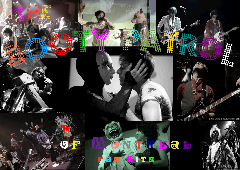
Catching Up With... Nina Barnes, Of Montreal's creative partner
By Steve LaBate, on November 24, 2008 4:00 PM
Of Montreal frontman (and Paste's November 2008 cover subject) Kevin Barnes and his wife Nina have been through a lot together since they met at a music festival in Oslo, Norway in 2001: A few amazing nights in Europe, months of long-distance email correspondence, flights across the Atlantic, a tour, plenty of musical and artistic collaboration, a wedding, a child, struggling to pay the bills, a painful breakup and a joyful reunion. In this exclusive Paste interview, Nina Barnes sheds some light on her husband and his work, and tells her side of the Of Montreal story.
Paste: Tell me about your creative role in Of Montreal.
Nina: Oh, dear. (Laughs) Back in Norway I used to play music and I played in the band. I played bass with Kevin for one tour, and it was so much fun. But then I found out while we were on tour that I was pregnant, so that kind of ended my musical career in Of Montreal, ’cause having a kid, and tour buses and that sort of thing, it’s not very simple, it’s not very ideal for anyone. So, I had always been drawing and got suddenly a lot of time on my hands just walking around being pregnant and finding an outlet for my very scattered brain. (Laughs) So I started making posters, doing T-shirt designs and all kinds of stuff like that [for the band]. [Kevin’s brother] David always did all the album art and everything, and his role in the band was very strong. I think a lot of the early fans saw [David] as the heart of Of Montreal—you know, the aesthetic of Of Montreal. So I never wanted to—what do you say?—like, take his role. We are such good friends and we have this like—when we get together, we just overflow of ideas…
Paste: You and David?
Nina: Yeah, me, David and Kevin. Like, if we sit down, things are bound to happen. And we just started collaborating on small things and one thing led to the other and, suddenly, you know, we came up with this idea for Skeletal Lamping. We wanted to do something totally different, and we decided we wanted to do it together. So it’s just one big collaboration. You know, like Kevin, of course, making the music and then me and David listening to the music and having ideas.
Paste: So all these great new ideas for packaging the new album, was that something that you and David came up with?
Nina: Initially, David had the idea that we should make a lantern. And we were all like, “Yeah!” And then we started talking about packaging, we started talking about—for me, I’m so old, you know, when I started buying music it was all vinyl. And I just remember the feeling of, you know, buying Clash, for example, like Sandinista! And the vinyl with this pamphlet inside, like comic books and all this crazy madness, and that sort of excitement of having art with the music. We just realized we should actually make people excited about that part of an album or a record—[to remind them] that it doesn’t have to be that boring, mundane little square. That doesn’t really matter anymore because everyone is downloading things. So we were like, “Can we give them something else? Something they can actually appreciate and have in their homes and be a part of their life?” And then one thing took the other and we started out with the lantern, but it became hard for the CD to be the lantern for the packaging. And from then on, we knew we had to be very inventive in how we did things. But the construction, the sculpture that me and David made for the CD —you fold it up and you put it together. It’s very easy and becomes this pretty big sculpture. Just trying to find that shape, and making it work with the packaging, was such a huge challenge and I think David did an amazing job. He was so amazing. From the engineering of it, he stared filling it up with art, and he made something and sent it over to me, and I would make something and I would send it over to him, and then we had one of those huge disagreements about something, but it turned out to be a good thing and we all agreed upon, you know, changes and everything. So we really have a very good flow between us when it comes to the working process.
Paste: Kevin also told me that when he’s making an album or writing songs, he’ll frequently bounce ideas off of you and David. Can you tell me a little bit about that?
Nina: Yeah. Kevin will be very open—I think he trusts David and me and our opinions, and he takes them into regards. In our old house, he had a studio in the attic and he would make music like for 12, 14 hours and then he would some down time and he’s like, “Listen to this,” and I’ll listen to it and then comment on it and say, “What if I did this for the bass, adding something here, [or] what if you layered there.” And he doesn’t necessarily agree with me, [but sometimes] he’ll say, “OK, no, that’s a great idea.” He has a lot of respect for both David’s and my opinion, and I think it’s because we’re so close, and I think both me and David are kind of connected to [Kevin], so we understand immediately what he’s trying to do, and it’s just an amazing thing—to encourage each other and be a part of each other’s creative outlets.
Paste: How and when did you and Kevin meet?
Nina: Oh, a long time ago. We met in Oslo [in 2001]. He was on tour in Europe with
Great Lakes, and he was playing one show at a Swedish festival with Of Montreal. They played two shows in Oslo, and they stayed at my best friend’s house ’cause the whole show was arranged by the record label my band [The Ethnobabes] was on, and the whole crew, there were like eight or nine people, they stayed at my friend’s house, and that’s how I met them. Actually, I knew of Of Montreal, I had the old vinyl and everything, and really loved it and was excited to see them. And after one of the shows we talked for a couple of hours and hit it off. There was a connection there— just telling stories and talking about music and art and life and my crazy family. If I get started, I can talk and talk and talk. So it was really pleasant, and then we just had some email correspondence for like six months. And then I decided to come over here to visit. That was my first trip to the U.S. That was in 2002. And then I came back like 3 or 4 times, and we were a little bit back and forth about the whole deal, but the last time I came over it was like, “How the hell are we going to be able to stay together?” We were like, “Well, it’s the only thing, we have to get married”—so that I could have a green card, you know? So, I flew back home to my Norway, and I arranged everything in like one month, and Kevin and his parents and David came over, and we got married in Oslo. And I moved to the U.S. after that. And I love it here!
Paste: When I met with Kevin last time, we talked a lot about the difficult time the two of you had between Sunlandic Twins and Hissing Fauna. Kevin was going through a depression, you guys split up and he left you to take care of [your daughter] Alabee on your own. I’ve heard his side of the story, but I was wondering what this time in your life was like? Because he said he got to tell his side in some of his songs, like “Past is a Grotesque Animal,” but that you’ve never been able to tell your side of the story.
Nina: It’s true, yeah, it’s true. But I have a double view of Hissing Fauna. I see the artistic statement. And even though listening to it can hurt, I totally respect it, and I’m totally like, “This is his artistic freedom, his freedom to take something very hard and difficult and make it into a personal statement, an artistic statement.” And I think it’s beautiful and moving. I really, really love that record. But it’s not something I’m going to hang out and listen to and rock out. I couldn’t really do that. But it’s true. When the record was released, it was interview upon interview about our breakup, and it was a story about me and my child, and I had no say in it. I became this sort of object. And at first, I was really like, “ But no one really knows me.” I became like a character in a book. On a totally personal level, of course, it was rough for both of us, but it’s one of those things—I roll with the punches in life. When you have a kid you just have no choice other than to shape up, take control of your life and make the best of it. And also, it’s a source of humongous inspiration for both of us, you know, artistically.
Paste: Having a child?
Nina: No, well, having a child and having the big break up, you know? Like, being a single mom. I have to say for every single mom or single dad out there, it’s a hell of a job. I have so much respect for all those people who are alone in the world and bringing up a child. It’s not easy. But you become aware of those aspects of life, and then you really appreciate the little time you have. For me it’s like—Kevin is very much like me: When he is in the process of making things—he does it all the time and he doesn’t really stop—but he will work for like 14 hours. So, basically, I’m taking on the majority of the childcare.
Paste: Is it difficult to find time for your own art?
Nina: Well, since I’m from Norway and Kevin’s touring so much, we travel so much, so it hasn’t been possible to have Alabee in any kind of daycare. But she just started school now, so that frees up the day for me, so I can do my stuff to a much greater extent. I have more time on my hands, which is an amazing feeling. But I think, actually having to work under pressure, it makes you extremely focused. Anyone who’s had a kid knows you just have to organize your time well to do everything. It actually has been a really positive force in my life because my mind wanders off, and there’s so many distractions in life. So it made me actually focus so much more. I love [Alabee] more than anything, but being a stay-at-home Mom, I don’t think it really applies to my personality. So I had to have my own thing, I had to have my outlet. I think that also became a very strong force. When Kevin was on tour, and I was home with Alabee, when she went to bed I would just start making stuff. I lost an enormous amount of sleep. It’s probably going to shorten my life a little bit, but I’m having fun, so it’s a good thing. Now, I have Gemini Tactics—it’s my company name, or at least some sort of name for what I’m doing. I make T-shirts and underwear and bags and prints and all sorts of things that I sell online. And I do illustration and designs for other people, so I can earn some money for what I do, which is a great feeling.
Paste: With all that going on for you, creatively, and with Of Montreal finally starting to have success, how do you feel these days?
Nina: It feels great. We were able to actually buy a house. That may seem like a small thing for some people, but for us, it was like, “HOLY SHIT!” And we can actually afford to pay our bills! When Kevin started in 1997, the success didn’t come until Sunlandic Twins, a little bit, and then with Hissing Fauna. Living, it was hard, and having a kid, and the expenses of that. Now, being able to—it’s not a luxurious life, but it’s comfortable. Ant that’s a good thing, even though we were terrified buying a house, just getting a taste of, “We’re settling down.” I think it’s probably a little bit of the Peter Pan syndrome; we don’t really want to be adults, but our life situation—having a kid—has forced us to be that, at least for parts of the day. But hopefully we won’t get mundane and boring. We’re always out there looking for some sort of enlightenment, through reading and philosophy and art and books and film or whatever. It’s all about creating a lot of friction, and keeping yourself mentally stimulated.
Showing posts with label Alabee. Show all posts
Showing posts with label Alabee. Show all posts
Thursday, June 25, 2009

2008-10-10 - Emusic
eMusic Q&A: Of Montreal's Kevin Barnes
by Michaelangelo Matos
Ten years ago, Kevin Barnes would have seemed like the least-likely-to-succeed satellite of the Athens, Georgia-based Elephant 6 troupe, a loose collective of bands and artists that became a mini-phenomenon among indie-rock fans in the mid-to-late-'90s. Barnes' group, Of Montreal, were maybe the most whimsical of the E6'ers; their early records, even ones as good as 1999's The Gay Parade, were more notable for what they weren't (meaning, actually from the '60s) as for what they were (modern recordings that pined for the '60s).
Then, shortly after 2002's Aldhils Arboretum, Of Montreal fell apart. Barnes, newly married, moved out of the house shared by most of the band, and the group's power dynamic shifted. Later that same year, Barnes recorded Satanic Panic in the Attic alone, and regrouped the band. By 2005, Barnes had re-conceived Of Montreal as something just as knotty and psychedelic as before, but with wider spaces and deeper grooves. That approach has resulted in three albums that tower over the band's earlier work: 2005's The Sunlandic Twins, featuring the irresistible disco workout "Wraith Pinned to the Mist and Other Games" ("Let's pretend we don't exist/Let's pretend we're in Antarctica," goes the chorus); 2007's Hissing Fauna, Are You the Destroyer?, No. 8 in the eMusic user poll of 2007's Top 10 albums; and now the new Skeletal Lamping.
Skeletal Lamping is denser than the two albums preceding it, thanks to tunes and arrangements that jump all over the place stylistically a la the Fiery Furnaces, and looser, thanks to lyrics that both acknowledge and make fun of therapy-speak, as on "Id Engager": "Ladies, I'm screaming out to you from the depths of this phallocentric tyranny/My self-conceptions awaiting your invasion clumsy penetration punishment/When the hope of another wet nightmare is all we have to live for." Say that ten times fast.
eMusic spoke with Barnes over the phone from his home in Athens.
What would you say the primary difference is between Skeletal Lamping and Hissing Fauna, Are You the Destroyer? in terms of the way you made them? Did you work differently?
Not really. I guess maybe the way I've arranged the songs is a little different. I experimented with that on Hissing Fauna, and it's something I'd done more on older albums like [2001's] Coquelicot Asleep in the Poppies and [1999's] The Gay Parade. But basically [on Skeletal Lamping] I'm creating fragmented songs out of separate sections that I just piece together. Some feel more random than others. Basically, I recorded everything myself in a home studio for both [Skeletal and Hissing], so the similarities are there in that aspect.
Was that something you went in knowing you wanted to do in advance?
I think I was naturally compelled to do that now — it was a more interesting way to write. I just wanted to have fun. Sometimes when you're trying to craft the perfect pop song or whatever, it can be a bit tedious: "I've got the music for the verse and chorus, and now I have to come up with the music for the second verse." I find it more interesting to just work with an idea until it becomes boring and then move onto something else, not force [myself] to make it kind of linear. It definitely works better with my attention span to constantly change things and not try to make things have a continuity, to just evolve in an abstract way.
When you put the album together, was everything in pieces waiting to be put in order, or did you have an idea for a sequence laid out beforehand?
I didn't really think about making a record very much, more so just thinking about making a one-and-a-half-minute piece of music. And then if I made another piece of music, I'd say, "Is it interesting together?" If not, I'd make another piece of music and see if it worked. I had about two hours' worth of these fragments — I didn't think about them as fragments, just as little pieces. It was fun to see what worked, to see what was interesting. I couldn't really lose; they were all different from each other. I wasn't trying to create something fragmented, just [something] that flowed and was consistently interesting.
Is there an element to Of Montreal, either musically or in concert, that you think is obvious but no one else seems to have caught onto?
I can't say that's ever really crossed my mind [laughs]. We don't have an agenda; we're just trying to do something that's artistically satisfying. We don't really think whether people like or want it; we do what we feel compelled to do. We're not checking bloggers or whatever.
On "An Eluardian Instance," you sing about "Koster Island" and then about climbing "upon the rocky shore and freak[ing] out to the Mountain Goats." Are you referring to Julian Koster and John Darnielle here?
I'm friends with them, but no: Koster Island is a place in Sweden, and it was the last place my wife and I were before out daughter was born.
How old is your daughter?
She's three.
How does she respond to your music? Is she an Of Montreal fan?
She likes it. I don't really listen to my music, so I don't really play it for her that often. But she does seem to respond to it. It's kind of funny, she's singing, "We can do softcore if you want" [from Skeletal Lamping's "For Our Elegant Caste"] — we don't try to hide any of that stuff from her. I couldn't care less about whether she says the word "fuck." It's kind of a Lenny Bruce thing [laughs]. We're not militant about it — she can say what she wants to say.
Athens is a college town, and you've written about academia a little — particularly on the song "Art Snob Solutions." Let's say Of Montreal dries up tomorrow and you went back to school. What would you major in?
I've never really responded to the world of academia for some reason. I sort of had this romantic view of intellectualism, and I've definitely tried on my own to broaden my mind and expose myself to different philosophies and things like that. I don't think I would ever go back to school. I dropped out of community college after three days; I never went beyond high school.
Who controls the tour-bus iPod?
[Laughs] We don't really have one. There is a communal area where people hang out afterwards, but we're into the same things. There are maybe some guilty pleasures that some of us might have.
What do you typically listen to while on tour?
Prince, David Bowie, the Rolling Stones — music that's more high energy, playful, and frisky. A lot of Sly & the Family Stone — mostly stuff from the '70s. We're all into Fela Kuti and Afrobeat and things like that — we'll put that stuff on, and the tried and true stuff we've grown up listening to.
Did any particular incident or situation inspire "Id Engager"? It's obviously an idea-driven lyric but it sounds like it could have come from a real-life situation.
With every song I've ever written, it's a mystery to me as well. Once it's written, in that spirit, I sort of lose the thread of what the inspiration was. I'm sure it had its root in something personal, but now I can't even recall it. Something to do with this concept of players — it's a bit weird, because the chorus is about, "I just wanna play with you, I just wanna have fun," and the verses are sort of condemning that. But it is what it is. It's hard for me: I'm not thinking about motivation or understanding why. I don't second-guess it; I just let it happen in an organic way. I'm moving on; I'm thinking about what I want to do next. I feel divorced from the songs in that way.
Maybe that's one reason why the lyrics on Skeletal Lamping generally feel even less inhibited than those of earlier Of Montreal albums. Some of them seem almost therapeutic.
I really felt this freedom to take chances and go somewhere that would have been more insecure in the past, and let it all out there. Part of that is the soul influence, the freedom that people Sly and Prince had. People that are basically — I don't even know if this is a term, but "freak-funk." It's intellectual but it hits you on a visceral level as well. One of my favorite contemporary artists is Erykah Badu: she embodies that spirit for me: soulful and playful and organic, but she can also turn and go really serious and introspective.
Wednesday, June 24, 2009
2007-03-?? - Chicago Innerview
The Universal Experience of Depression.
If band biographies have taught us anything, it’s that one’s career success is often inversely proportional to the success of one’s interpersonal relationships. Sure, it’s a laughable music biz cliché — the climb up the ladder (or the charts, as it were) heralding the downward spiral, with the whiskey bottle only revealing its projectile properties until after the sold-out show — but that doesn’t mean these things can’t (and don't) really happen.
Take Kevin Barnes, creative core of Athens, Georgia’s Of Montreal, who perfected his sunny candy-coated synth-pop sound on 2005's infectious Sunlandic Twins, only to then battle depression and a separation with his girlfriend, Nina, and his now two-year-old daughter, Alabee. Meanwhile, Of Montreal was becoming a critical darling and playing sold-out shows across the country. While Barnes’ tale may not be of What’s Love Got to Do With It proportions, Barnes, unlike Tina Turner, was able to mend his wounded personal life and take a great artistic step forward in the process.
BARNES' INNER VIEW
“I started to totally freak out. I had this really serious, kind of like the very beginnings of this insane chemical depression period. It was, like, insane and almost led me to kill myself...”
The recently released Hissing Fauna, Are You the Destroyer? (Polyvinyl Records) is Of Montreal’s most introspective effort to date, but, thankfully, the bright harmonies and rhythmic fun that has become the band’s fingerprint isn’t lost along the way. Barnes pours his heart out, but only so we can dance happily along. Chicago Innerview called Barnes during a tour stop in Las Vegas to discuss how everything from anxiety to antidepressants to alter egos factored into his band’s newest album.
Chicago Innerview: Can you talk about what you were going through when you were writing and recording Hissing Fauna?
Kevin Barnes: The very first part of the record I wrote before my daughter was born. I was living in Norway because my girlfriend is Norwegian and we didn’t have health insurance because we thought it would make more sense — because they have socialized medicine in Norway — to have our daughter over there. So we’re living in Norway and I started to totally freak out. I had this really serious, kind of like the very beginnings of this insane chemical depression period. It was, like, insane and almost led me to kill myself. So all the early songs like 'Cato as a Pun' and 'Heimdalsgate Like a Promethean Curse' and 'A Sentence of Sorts in Kongsvinger' — all those songs were written and recorded while I was living in Norway, during the beginning of that really insane period, using the very limited resources that I had — just a laptop, a MIDI-keyboard and a microphone. At the same time, right after my daughter was born, I went on tour in support of Sunlandic Twins because that record had just come out. I had this newborn baby that was like two or three months old and I had to leave my daughter and girlfriend back in Athens, Georgia. It was really difficult for me because the band was taking off at that point. We were sort of finally reaching a larger audience and feeling like all our hard work, all our paid dues were sort of paying off. But at the same time, I couldn’t really enjoy it because I knew that I was putting my girlfriend and my daughter in a crazy situation. I just basically abandoned both of them to go on tour and pursue music. Everything was just on fire, exploding all around me. So then my girlfriend and I split up and she went back to Norway with our daughter and I kept touring.
Chicago Innerview: Had you experienced depression before?
Kevin Barnes: No, never. That was the thing. It totally just hit me. I had never ever seen anything like it. And coming from this sort of blue-collar background, my parents never accepted depression as a real affliction or as a real physical thing. It was just basically like, ‘If you’re depressed you need to just pull yourself together. You can do it. Don’t be weak.’ So I had to kind of cast that aside and go, 'Okay, I have a problem and this is something that I need to face and I need to fix. If I’m smart about it, then I’ll be able to recover from it. If I’m stupid, then I’ll either get into serious drugs or just try to find some type of escape.' That’s why a lot of the songs, or some of the songs, make reference to spiritual longing, you know, like desperate for something to sort of help me. I needed help, but nothing was helping. You know, no conversation is going to help, no therapy, no drinking or drugs, no exercise, eating healthy, yoga — I went through all that stuff and none of it helped. And then, luckily, I got on antidepressants and that did help.
CI: Were you afraid the medicine would inhibit your creative impulses?
KB: It hasn’t turned me into a zombie. I was worried it was going to make me like a numb person and not feel anything emotionally. Luckily, I was on a pretty low dose of this thing called Cymbalta, which I still take, but I take it like every other day. And to some degree it made me more detached when I was taking it everyday. I was on the medicine before my girlfriend and I split up, and I think that being on the medicine just made me feel like, 'Okay, I don’t really care. I can’t help you right now and it doesn’t bother me right now because I’m on medicine.' So we split up. That’s what 'The Past Is a Grotesque Animal' is about — the split-up, that time apart not knowing if we were going to get back together and freaking out, to some degree, about that.
CI: Lyrically, Hissing Fauna reflects your experience with your separation and depression, but musically it’s a very jovial record. Like on 'A Sentence of Sorts in Kongsvinger' you’re candidly singing about a nervous breakdown over keyboards that sound like the soundtrack to a bike ride on a warm, sunny day.
KB: Well, I was relying on music in a way that I haven’t really in the past, sort of using it as a form of therapy. It was the only real escapism afforded to me that actually helped in any way. I wasn’t really writing songs and then going into the studio after I had worked out the arrangements. For the first time I was composing everything in the studio, in the moment as this form of therapy. So all the songs up until 'The Past is a Grotesque Animal' were written when we were still together. I wrote 'The Past is a Grotesque Animal' after we broke up. And then the songs after 'The Past is a Grotesque Animal' I wrote after we had gotten back together. So that’s why the music on Hissing Fauna, a lot of times, doesn’t really make sense with the lyrical subject matter. I was trying to create something that was more buoyant and upbeat and happier-sounding to lift my spirits, rather than create something that matched my mood, which wouldn’t really help me anyway because it would just reinforce this darkness that I really didn’t want to be a part of anyway. I was just trying to create something that was a bit more optimistic and positive and hopeful musically, but then when it came to the lyrics, there was no way I could really fake that sort of thing. I couldn’t really say, ‘Oh, life is grand,’ you know?
CI: I’ve heard the second part of the album is also about you reinventing yourself as Georgie Fruit. Was this alter ego another part of your escape?
KB: It’s definitely a strange occurrence. To some degree, I have always experimented with different recording personas and stage personas. But this new character, Georgie Fruit, definitely sprung forth after the breakup with Nina and the reconciliation and all that. He’s like this middle-aged, black, she-male with a checkered past; he’s been to prison a couple times and he was in a band called Arousal in the late-‘70s. I created a pretty thorough backstory for this character, so he seems very real to me. It, in a way, enabled me to breathe life to this different aspect to my personality, my creative spirit.
CI: Now that you’re doing better, is it going to be tough to relive the Hissing Fauna material night after night on tour?
KB: Unless I just completely go through the motions, I’m going to have to relive the inspiration for those songs. But it also translates into something more positive when you are performing it with your friends in front of an audience of people that are, ostensibly, nice and cool and supportive and can also somewhat identify with universal experiences like depression and suicidal thoughts and intense anxiety.
Of Montreal :: with Walter Meego :: Metro :: March 15.
2007-04-18 - Creative Loafing
Of Athens
Published 04.18.07
By Cooper Levey-Baker

Rennie Solis
YOUR NORMAL, AVERAGE, EVERYDAY INDIE ROCK BAND: Kevin Barnes (standing, middle) and band mates Matt Dawson(left to right), Dottie Alexander, Jamey Huggins and Bryan Poole
INFO
of Montreal
Sarasota Film Festival Independent Visions, 8 p.m. Thurs., April 19, Minxx Nightclub, 7111 S. Tamiami Trail, Sarasota, 923-6200. $20.
The website for the loose indie rock collective known as Elephant 6 features a bewilderingly dense, overlapping network of bands and individuals from Athens, Ga. Twenty-five groups are listed as full-fledged members of the scene; 14 others are dubbed "The Extended Family." Entries on the history of each band are chock full of hyperlinks to bios of transient band members and brief collaborative projects.
Trying to make sense of who recorded what with whom in Athens over the past 15 years quickly makes you dizzy.
For of Montreal bassist Bryan Poole, though, the Elephant 6 thing is notably less complex. The scene "was just a group of friends getting together making music," he says on the phone from Athens during a tour break. "[It] just kind of had a name." Poole had grown up in Columbia, S.C., and was lured to the college town by word-of-mouth buzz about its first-rate music scene, still hoppin' a decade after luminaries like R.E.M. and The B-52's lit it up.
"Back then the Athens scene was more like math rock," Poole remembers. "It wasn't quite the Seattle grunge thing, but it was really heavy." Things were "heavy" in most underground rock spots around the country during the early '90s, with bands offering up variations on the post-punk blueprint but always keeping the noise and the chaos right up front.
Elephant 6ers, though, had a jones for something a little different.
"The Elephant 6 thing was a dollop of psychedelic sunshine," says Poole. That meant flourishes like brass sections and keyboards, and hooks -- loads and loads of hooks. Scenesters that normally regarded musicianship as more of a handicap than an asset weren't quite sure what to make of the new breed. For Poole, though, the period was magical: "Back in the day, it was a utopian collective feeling."
Poole began playing in various incarnations of the band Elf Power, led by friend Andrew Rieger, and joined of Montreal's inaugural lineup, put together by chief songwriter Kevin Barnes, circa 1997. While of Montreal is generally regarded as little more than a pseudonym for Barnes' solo work, Poole -- except for a brief stretch when he left the band because playing in two groups "just got too hectic" -- has been there for the entire run.
"I've been his foil behind the curtain, behind the terry cloth or something," Poole says. "We've been friends for a long time."
Although the Elephant 6 scene started producing some nationally recognized acts (The Apples in Stereo, The Olivia Tremor Control) and even one indisputably classic disc (Neutral Milk Hotel's 1998 burner In the Aeroplane Over the Sea), of Montreal still languished on the Athens B-list.
But while of Montreal toiled in small venues, the Elephant 6 sound started conquering indie rock clubs across the country.
Today, you can hear the bands everywhere. The Shins -- early Athens fans -- took the town's '60s pop obsession all the way to the no. 2 spot on the Billboard charts this past January. The Decemberists performed a similar feat last fall. Even the relentlessly serious art rock of The Arcade Fire owes something to the expanded sonic palette the Elephant 6 groups gave to the underground.
Indie kids today -- for better or worse -- would much rather be pop than Iggy.
Poole doesn't sign on to my theory, calling the game of Who Influenced Who "a big puzzle." He was flattered and honored, though, when The Shins played Athens before they were big and specifically invited the town's indie elite to the show.
The new zeitgeist helped of Montreal generate more and more buzz over its past few albums (2004's Satanic Panic in the Attic and 2005's The Sunlandic Twins), but no praise had ever matched the acclaim that greeted the release of Hissing Fauna, Are You the Destroyer? early this year. Tastemakers at Pitchfork gave it a rep-confirming 8.7.
And the disc is superb. "Suffer for Fashion" kicks it all off, with programmed beats, buzzing synths and Barnes' funky upper-register vocal hysterics. "Cato as a Pun" accentuates a not-quite-hip-hop beat with an assortment of odd sound effects and electric guitar squiggles. "Labyrinthian Pop" references the sexed-up funk Beck brought on Midnite Vultures.
The melodies are so bright, I forget pretty quickly that the songs originated in the heartbreak and confusion of a tenuous marriage and an unexpected child.
Before Barnes' wife Nina gave birth to the couple's now-2-year-old daughter Alabee, Barnes poured all the worry and self-doubt of impending fatherhood into some of the songs that would eventually populate Fauna.
Nina, who played bass in the band, was now saddled by motherhood and couldn't tour with her husband. "We're like, 'Wow, we're doing better than ever! We're selling out shows!' but Nina's at home," Poole remembers. "You know, the typical calling home, 'We sold out so-and-so!' and, 'Well. Great.'" After the conclusion of that jaunt, Barnes struggled. "All these things came to a head," Poole says. "And Kevin had a psychosis. He didn't want to leave his house. We came home from tour and he didn't leave his room."
Poole had to begin conducting band rehearsals sans Barnes and the entire group had serious doubts about whether of Montreal would continue. Barnes was eventually coaxed out for a second tour, only to have Nina and Alabee move to Oslo, Norway, while he was on the road. "The pinnacle of the record, 'The Past Is a Grotesque Animal,' he wrote that one after Nina had left him, and he's just alone and spewed it all out," says Poole.
The couple eventually reconciled, but despite Fauna's critical triumph, touring has still proven tough on Barnes and his wife. When I ask Poole if they're bearing up better than before, he answers with a curt "nope," although he notes that now that Alabee's no longer a newborn, she can accompany the band for one-week stretches, helping the mindset of all involved.
of Montreal follows up its Sarasota Film Festival date with a long string of European shows, and then it's on to more recording or gigging later this year. Barnes -- ever prolific -- has already scripted a new set of tunes. And while times seem better for the singer, Poole assures me that the fresh material is "definitely showing a bit of the psychosis in there as well."
Based on Fauna, I wouldn't want it any other way.
Published 04.18.07
By Cooper Levey-Baker
Rennie Solis
YOUR NORMAL, AVERAGE, EVERYDAY INDIE ROCK BAND: Kevin Barnes (standing, middle) and band mates Matt Dawson(left to right), Dottie Alexander, Jamey Huggins and Bryan Poole
INFO
of Montreal
Sarasota Film Festival Independent Visions, 8 p.m. Thurs., April 19, Minxx Nightclub, 7111 S. Tamiami Trail, Sarasota, 923-6200. $20.
The website for the loose indie rock collective known as Elephant 6 features a bewilderingly dense, overlapping network of bands and individuals from Athens, Ga. Twenty-five groups are listed as full-fledged members of the scene; 14 others are dubbed "The Extended Family." Entries on the history of each band are chock full of hyperlinks to bios of transient band members and brief collaborative projects.
Trying to make sense of who recorded what with whom in Athens over the past 15 years quickly makes you dizzy.
For of Montreal bassist Bryan Poole, though, the Elephant 6 thing is notably less complex. The scene "was just a group of friends getting together making music," he says on the phone from Athens during a tour break. "[It] just kind of had a name." Poole had grown up in Columbia, S.C., and was lured to the college town by word-of-mouth buzz about its first-rate music scene, still hoppin' a decade after luminaries like R.E.M. and The B-52's lit it up.
"Back then the Athens scene was more like math rock," Poole remembers. "It wasn't quite the Seattle grunge thing, but it was really heavy." Things were "heavy" in most underground rock spots around the country during the early '90s, with bands offering up variations on the post-punk blueprint but always keeping the noise and the chaos right up front.
Elephant 6ers, though, had a jones for something a little different.
"The Elephant 6 thing was a dollop of psychedelic sunshine," says Poole. That meant flourishes like brass sections and keyboards, and hooks -- loads and loads of hooks. Scenesters that normally regarded musicianship as more of a handicap than an asset weren't quite sure what to make of the new breed. For Poole, though, the period was magical: "Back in the day, it was a utopian collective feeling."
Poole began playing in various incarnations of the band Elf Power, led by friend Andrew Rieger, and joined of Montreal's inaugural lineup, put together by chief songwriter Kevin Barnes, circa 1997. While of Montreal is generally regarded as little more than a pseudonym for Barnes' solo work, Poole -- except for a brief stretch when he left the band because playing in two groups "just got too hectic" -- has been there for the entire run.
"I've been his foil behind the curtain, behind the terry cloth or something," Poole says. "We've been friends for a long time."
Although the Elephant 6 scene started producing some nationally recognized acts (The Apples in Stereo, The Olivia Tremor Control) and even one indisputably classic disc (Neutral Milk Hotel's 1998 burner In the Aeroplane Over the Sea), of Montreal still languished on the Athens B-list.
But while of Montreal toiled in small venues, the Elephant 6 sound started conquering indie rock clubs across the country.
Today, you can hear the bands everywhere. The Shins -- early Athens fans -- took the town's '60s pop obsession all the way to the no. 2 spot on the Billboard charts this past January. The Decemberists performed a similar feat last fall. Even the relentlessly serious art rock of The Arcade Fire owes something to the expanded sonic palette the Elephant 6 groups gave to the underground.
Indie kids today -- for better or worse -- would much rather be pop than Iggy.
Poole doesn't sign on to my theory, calling the game of Who Influenced Who "a big puzzle." He was flattered and honored, though, when The Shins played Athens before they were big and specifically invited the town's indie elite to the show.
The new zeitgeist helped of Montreal generate more and more buzz over its past few albums (2004's Satanic Panic in the Attic and 2005's The Sunlandic Twins), but no praise had ever matched the acclaim that greeted the release of Hissing Fauna, Are You the Destroyer? early this year. Tastemakers at Pitchfork gave it a rep-confirming 8.7.
And the disc is superb. "Suffer for Fashion" kicks it all off, with programmed beats, buzzing synths and Barnes' funky upper-register vocal hysterics. "Cato as a Pun" accentuates a not-quite-hip-hop beat with an assortment of odd sound effects and electric guitar squiggles. "Labyrinthian Pop" references the sexed-up funk Beck brought on Midnite Vultures.
The melodies are so bright, I forget pretty quickly that the songs originated in the heartbreak and confusion of a tenuous marriage and an unexpected child.
Before Barnes' wife Nina gave birth to the couple's now-2-year-old daughter Alabee, Barnes poured all the worry and self-doubt of impending fatherhood into some of the songs that would eventually populate Fauna.
Nina, who played bass in the band, was now saddled by motherhood and couldn't tour with her husband. "We're like, 'Wow, we're doing better than ever! We're selling out shows!' but Nina's at home," Poole remembers. "You know, the typical calling home, 'We sold out so-and-so!' and, 'Well. Great.'" After the conclusion of that jaunt, Barnes struggled. "All these things came to a head," Poole says. "And Kevin had a psychosis. He didn't want to leave his house. We came home from tour and he didn't leave his room."
Poole had to begin conducting band rehearsals sans Barnes and the entire group had serious doubts about whether of Montreal would continue. Barnes was eventually coaxed out for a second tour, only to have Nina and Alabee move to Oslo, Norway, while he was on the road. "The pinnacle of the record, 'The Past Is a Grotesque Animal,' he wrote that one after Nina had left him, and he's just alone and spewed it all out," says Poole.
The couple eventually reconciled, but despite Fauna's critical triumph, touring has still proven tough on Barnes and his wife. When I ask Poole if they're bearing up better than before, he answers with a curt "nope," although he notes that now that Alabee's no longer a newborn, she can accompany the band for one-week stretches, helping the mindset of all involved.
of Montreal follows up its Sarasota Film Festival date with a long string of European shows, and then it's on to more recording or gigging later this year. Barnes -- ever prolific -- has already scripted a new set of tunes. And while times seem better for the singer, Poole assures me that the fresh material is "definitely showing a bit of the psychosis in there as well."
Based on Fauna, I wouldn't want it any other way.
Tuesday, June 23, 2009
2008-07-14 - You Ain't No Picasso
An Interview with Of Montreal’s Kevin Barnes
July 14th, 2008


Of Montreal’s new record Skeletal Lamping, like the band’s live show, is a take-it-or-leave-it showing of craziness. Songs not only have schizophrenic changes in melody, but are also lyrically at war with themselves from minute to minute. And as you might expect from a group who often perform in dresses, once in the nude and always with makeup, Kevin doesn’t really care what you think. He’s not writing for the fans, he’s not writing to please his label and he surely isn’t writing to please us armchair music critics.
For the first time in over ten years, Kevin Barnes is writing for himself.
This past June I was lucky enough to be invited down to Athens, GA to hear Skeletal Lamping shortly after it was finished. After sitting in silence for about an hour to listen to the record — all the while wishing I’d brought a pen and paper to jot down notes about album (Sparks, Funkadelic and Prince produced by the Dust Brothers?) — Kevin was nice enough talk for a while about a great many things. He shared a lot about his motivation for the new album (the Outback Steakhouse commercial), how his wife gave him the courage to start writing personally again and what it was like to cover his three-year-old daughter’s favorite song.
An Interview with Of Montreal’s Kevin Barnes
YANP: Obviously this record is very different from anything you’ve done prior. Was it a conscious decision to move away from the old sound or is that just where your writing took you?
Kevin: For some reason I’ve been gravitating more towards… I mean there’s always going to be more pop sensibilities there because I love pop music, but I try to incorporate different things. Obviously some funk influences and even some hip hop influences.. I feel like I have more in common with contemporary hip hop artists than I do contemporary indie pop artists.
Do you follow any producers?
I always like the stuff that Danger Mouse does, I think he’s awesome. Even like Timbaland’s stuff I think is really cool usually. Pharell, a lot.
Did your time in Norway influence you musically?
Disco is pretty hot over there still. Not like 70s disco, but like club music. Electronic music is big there too. I didn’t really meet anybody or see any bands, but that probably did have an effect on me. You know, that sort of sophisticated electronic music. That definitely played a part. A lot of this record I actually did write and record when I was in Norway last summer, though.
So Skeletal Lamping is a very sexual record. Were those themes in your mind at the time or a part of Georgie Fruit?
It was definitely, for whatever reasons, one of those natural, organic things that just happen. I just was compelled to do that and sing about those things. Those were the things that I’d be singing in the shower and go upstairs and start working on. It wasn’t anything premeditated (laughs).
Is the full album supposed to be taken as fully from Georgie Fruit’s point of view or just occasional bits?
I don’t even separate them in my mind. the Georgie Fruit character is not separate from Kevin Barnes. I can’t really say “oh that was just this role I was playing,” because it’s just a part of my personality. All of it is just a part of me anyways.
Have you seen the documentary This Film Not Yet Rated? No.
It’s about the MPAA and how they focus more on sex rather than violence in movies...
It’s a weird thing. A lot of people think about that: why is sex so dangerous? Why is it a frightening concept.
Well it seems handled differently in this record. All your characters seem comfortable with sex.
Definitely. You should be comfortable.
When I make a record, I try not to let the world in. It’s kind of me in my own little island in my head. The only reason you’d ever feel insecure is from worrying how other people would perceive you; and if you’re the only person in the world, you’ll be totally secure.
Do you still do most of the instruments on the record?
I did basically everything on this record myself. There’s some cello and one song where basically everyone in the band plays something.
I picked up on a couple songs you’ve been playing live for a while. Did anything change in “Softcore” or “Our Last Summer as Independents?”
Some lyrics changed and some new melodic parts were added to Last Summer, but Softcore was basically done when we performed it last summer. We didn’t really change anything.
Was creating this album more about linking melodic sections together or about seeing where the song goes?
Some of the things that seemed to flow better were probably ones where I would make one section and then use that as inpiration for the next section and then use that. And then some of the stuff I just tried to piece together in a collagey sort of way. It’s a very collagey sort of record.
A lot of stuff is me intentionally putting two things together that weren’t written with each other in mind, so it’s kind of awkward when they’re next to each other. But I liked that when I stared doing that. It’s cool because you don’t expect that. Like I said in the blog, a lot of the time you can finish the artists’ sentences. That’s obvious. That’s obvious. It’s always obvious. At times it can be great, but I didn’t want to make anything obvious. I wanted to surprise the listener.
Listening to the album for the first time was so strange. There were parts that would sound really good, and I’d be thinking “yeah, keep that going,” but it always switches before you’re ready. It’s like musical denial.
I think that’s why it has a lot in common with Coquelicot, because nothing is really extended. Even though something might be really cool and you’re like “oh, I wish that would go on longer,” it never goes on longer. It’s always replaced by something new. That could be potentially be frustrating for some people if they like something, but hopefully they’ll go back and listen to it again.
The record kind of feels like … when it starts, the first maybe fifteen minutes are kind of conventional and makes sense but then when you get in the heart of it, that’s when it becomes more dense and more complicated.
Yeah. It’s one of the more forward songs on the record, but ends in that great whirl of layers. It’s a great first song for the record.
Actually, it was intended to be the last song and then everyone was like “man, you should put that first” because it’s the most different as far as coming out of Hissing Fauna into that song. The second half is sort of abrasive…
Yeah… [Laughs] Sorry, I’m still trying to process the record.
I understand. It’s like seeing this complicated movie just one time and then you’re like “God… and then that one part!” You can’t photograph music in your mind like you can with movies. With movies you have all these other things that are being recorded in your mind like dialogue, images and emotional memories and things like that. With music, you don’t have any sort of visual photographs.
Does doing music for movies interest you at all?
It would, if I could get into the movie. It’s weird, because with that stuff — unless the movie’s already done and you’re making music to it — it seems difficult if someone was like “well here’s what I want, make music to it.”
I remember reading how Leone extended the opening scene in Once Upon a Time in the West because he didn’t want to edit down the song Morricone had written for it.
Oh, nice.
What will you remember when you look back at this album?
I think that… I think it really was inspired by the commercial backlash when I was getting a lot of backlash from the Outback Steakhouse commercial. I think it did influence me as far as like “I’ll show them I’m not a sell-out. I’ll show them how talented I am…. I can’t be marginalized. I have a lot of value”
I’d never had to deal with that before because we were always so underground. It was a weird thing to face. You can only have backlash if you have success and we’d never really had success, so I’d never had to deal with backlash. So I definitely think that played a part psychologically in the making of the record.
Who confuses who more: you or your fans?
I definitely am not confused by my fans. It’s hard to tell if people are fans.. because a fan is a temporary thing in a lot of cases. People will enjoy a thing and then get bored with it and move on to something else. So does that make them less of a fan when they were a fan? It’s kind of like love in a weird way: when you break up with someone, does that completely undermine what you experienced together and the good times you had just because you’re not together now?
Dealing with criticism is confusing when you put out records. It can be really distracting and weird. I remember when I put out my very first record, Cherry Peel, I was so excited and so full of the joy of making music and sharing it with the world. It got so many bad reviews that I read that I was like Oh man, the world is a bitch, you know?
Were the escapism and fictional characters in the Gay Parade and Coquelicot reactions to that?
Definitely. In a way, it was to protect myself. I’m not going to make myself vulnerable. …But then those records got bad reviews too (laughs)
When did you make the switch to being comfortable writing about yourself again?
I guess when I got married. I’d always been single. I was basically celibate all through my mid-20s, I never dated anyone and kind of lived in this fantasy world. When I met Nina, she somehow gave me this great sense of empowerment. I have this great person at my side and that’s all I need. I don’t need the rest of the world’s approval as long as I have this one person who believe in me and supports me. It’s funny how that works. Having my brother, having Nina — that’s all I need. If they say “man, you’re doing some good stuff” then I know my work has value.
I caught the “I wish David was here” lyric in new record. That’s really great. I love how you summed all that up in Du Og Meg: “his thoughts were not just rubbish.”
It seemed like that was almost what I needed. Because I had gone through this period of being disconnected emotionally. My emotional world was not really finding itself within my artistic production.
Was that frustrating?
I had become really cynical. In the back of my mind — even though it sounds dreadful — trying to figure out a way to reach people and to have a song that actually mattered to people and wasn’t just throwaway bullshit. I felt like a lot of stuff I had done, just because I wasn’t selling records, I thought “well these songs must not be very good because nobody’s into them and they’re not resonating with people.” But then once I gave up on that, organically it all just worked out and people started caring about us and we started reaching a larger audience.
Was it a coincidence that stylistic chances match up for the ability to be more personal?
There was a weird, almost fascist state of mind in the Elephant 6 collective, at least from my perspective. There were sort of these rules to keep it analog, keep it 60s and 70s. There are sort of unspoken rules in a weird way and I was so influenced by those guys. They weren’t dictating these things, but that’s what they were into and I was so smitten.
But I wanted to branch out. I wanted to do different things. I felt a bit nervous, you know, about drum programming and using midi instruments because those were definitely off limits within that clique. Or at least no one did it and it was not respected. You had to actually be able to physically be able to do it.
Then I realized that was holding me back and I really wanted to explore this other kind of music. We all lived in a house together and I moved out of that house and into a house with Nina and my brother. Then I didn’t have anyone in my immediate space who could influence me. Everyone in my immediate surroundings was very positive and very supportive and everyone wanted me to try something new.
Who all did you live with before moving in with your brother and Nina?
The whole band was living in like a big house together out in the country for a couple years. it sort of became an entropic sort of thing: fighting over stupid things, living in this insular environment that was far enough from Athens that you didn’t really want to leave the house. Even though it was positive at times and we definitely had good times together, I felt smothered by it. If I was going to make a recording by myself where I’d play the bass, Derek would be like “what’re you doing, man?” and if I did drums, Jamie would be like “when am I going to play?” So it was good for me to get out of that and into my own world. Because before I met those guys I used to do everything myself. In high school, that was my great escape from the harsh realities of life: just put on the headphones and lose yourself in the creative process. And when you’re collaborating with a lot of people, you can’t really do that as easily. There’s a lot of compromising that goes on and a lot of political stuff you have to deal with. When you get alone and do it by yourself, I get a great surge of energy that I’d been holding inside for so long. And finally when there was no one to tell me no or to tell me “do it this way” or whatever, it was like an explosion of creativity and I still feel like I’m kind of riding that wave.
Are you writing more songs because of it?
When you’re working with a bunch of people, there are a lot of schedules that you have to deal with. But when you’re doing it by yourself, then it’s whenever you feel like it — which for me is all the time — I just go and work, I don’t have to say “oh, I have to wait for Derek to get off his shift at the coffee shop” to do the bass line, I just do the bass line … I do six bass lines! (laughs)
Has music ever felt like work?
For me, the process is what’s exciting. Listening to the record when it’s done is exciting for a little bit, but I never listen to my old records and I don’t really like playing most of the old songs. So this record is new and it’s kind of exciting to listen to but in a couple months I’m not going to want to listen to it and I’m going to want to do something new.
Is that why you like to debut new material live?
It takes so long for a record to come out — it takes five or six months usually — that I have half a new album recorded.
So I wanted to ask you about Arlene… [Kevin's guitar has "Arlene" scratched into it]
I was living in Minneapolis. When I got out of high school, I moved around a lot trying to find people to play with and I’d heard Minneapolis had a scene. I just happened upon this used guitar shop and I got Arlene there really cheap. And it’s a great guitar.
I don’t know the story behind the etching. It was there when I got it and the guy at the store didn’t know either. I mean, imagine just some weird dude, maybe some metalhead dude just like “this is for you, babe…” No one has ever come up to me and been like “man, that was my old guitar!” but maybe one day. [Laughs]
One day… So what happened to “Feminine Effects?” That’s one of my favorite new songs of yours and it’s noticeably absent from the record.
We’re trying to figure out if I want to do an EP or what. There’s a lot of songs that I cut from this record — about 35 minutes worth of material. So I could do an EP or just have extra songs for bsides or bonus tracks and things like that. I like that song. We’ve only recorded it once. We’re recorded it a couple times, but only once that I liked. I never recorded it in my studio, but we did it live a few times.
Like the MPR recording you used for the Green Owl compilation? That’s one of my favorite recordings you’ve ever done.
Yeah. My brother was like “man, that’s the only version … you can’t do another version. You’ve got to use that version if you’re going to do it.”
Wow. I’d never thought of it that way, but he’s kind of right. Speaking of which, I’ve got to say that I love the return of the piano on the new album. Did I hear some horns on the record as well?
Yeah. Originally we had these kind of electronic sampled horns. Every time I’d listen to it, I’d think “man, we’ve got to get some real horns on this.” So eventually we got the guys from Dark Meat to come in and do some real horns for us.
Oh, fantastic! I love those guys. So when you were thinking of the sequence and flow of the record, what were some albums you had in mind as good examples?
In the Aereoplane over the Sea is one of the best sequence records ever. Everything flows so perfectly through the whole record — it never gets boring. And OTC did that with their two records. That was definitely the spirit that I was using and sort of pulling from. And the Fiery Furnaces stuff kind of hurts the brain a little bit more because the songs are bit more dense and the lyrics are some times impenetrable. That’s what I love about them, lyrically they’re so far ahead of everyone else.
I loved when you all covered their song “Tropical Iceland.”
That was my daughter Alabee’s favorite song for a long time. That was the first song she really connected with. At that time she called ice cream “icey” and she was a big fan of ice cream. So when she heard that song she was like “oh! icey land!”
[Laughs] A land made of ice cream!
[Laughs] Exactly.
Subscribe to:
Posts (Atom)