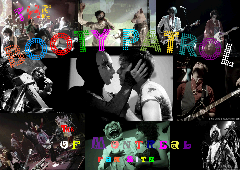
Of Montreal's Kevin Barnes tackles some POINTLESS QUESTIONS
--------------------------------------------------------------------------------
What's the worst "day job" you've ever had?
Kevin Barnes: I worked at a donut shop called Krispy Kreme. I was responsible for making the donuts. It was surprisingly difficult because there were about six steps to the process and all six had to be performed at the same time. I wasn't very good at it and there would be donuts falling everywhere and batter all over the floor. Needless to say my position there was short lived.
PC or Mac (or Linux/etc.)? Why?
Kevin Barnes: I have a PC but for no other reason then I didn't know anything about computers and my friend helped me assemble one.
What is your definition of a "good person"?
Kevin Barnes: Someone who is compassionate and intelligent and improves the world around them.
What is the dumbest fashion trend of the last hundred years?
Kevin Barnes: The dumbest one in my opinion is cosmetic braces for your teeth. My mind was blown when I heard people were getting braces not because they needed them but because it was the hip thing to do.
If you could elect to never, ever, ever have to kiss one particular person now living, who would that person be?
Kevin Barnes: Pat Buchanan.
What's your position on gun control?
Kevin Barnes: I think hand guns and automatic weapons should be outlawed.
What album or albums in your music collection would you have to replace immediately if they wore out, were stolen, etc.?
Kevin Barnes: The Kinks' Village Green Preservation Society, The Boredoms' Super R, Kevin Ayers' Joy of a Toy.
You are able to get away with murder once, and only once. Who, if anyone, do you kill?
Kevin Barnes: I would kill Murray Wilson for being such an abusive father to Brian.
You're stuck at my house. It's your turn to cook. What meal do you cook me?
Kevin Barnes: Crepes with peaches served near a lactating mule.
If you could make a rock 'n' roll porn movie, who would be your two co-stars?
Kevin Barnes: Chan Marshall from Cat Power and Francoise Hardy.
What's the most evil thing in the world?
Kevin Barnes: People who abuse children or animals.
You have the power to bring one famous dead person back to life. Who's it gonna be?
Kevin Barnes: I would bring back Vladimir Nabokov because I think he would find it interesting to be brought back to life. I would also like for him to write some more novels for us.
Was Betsy Ross hot for George Washington?
Kevin Barnes: Who wasn't?
What "official version" of a historical event do you most suspect to be a load of crap?
Kevin Barnes: The original Thanksgiving.
What is the "most wanted" item on your holiday wish list?
Kevin Barnes: I would love a Roland Space Echo in perfect working order.
· · · · · · ·
While constantly busy with Of Montreal and its various associated offshoots, Kevin Barnes is probably eagerly anticipating the release of his band's next full-length album, Coquelicot Asleep in the Poppies, which is expected in April 2001.
-- George Zahora
Showing posts with label 2000. Show all posts
Showing posts with label 2000. Show all posts
Monday, June 22, 2009

2000-??-?? Splendid Ezine
From Splendid Ezine.
This article, while purportedly informative and entertaining, is also meant to serve as an impassioned plea to readers: please pay more attention to Of Montreal. I have noticed over the course of the last year or so that, of all the bands currently existing in the revolving musical circus known as the Elephant Six Collective, few if any receive less press than Of Montreal... Which is strange, for they're possibly the Collective's most prolific act -- and when you're talking about the E6, that's quite an accomplishment indeed.
The core members of the group -- Kevin Barnes, Jamey Huggins, Andy Gonzales, Dottie Alexander and Derek Almstead -- consistently churn out whimsically-titled and fiendishly catchy records full of sunburst 60’s inflected pop. Of Montreal's most recent full-length, The Gay Parade, was a pop tour-de-force on a par with Pet Sounds or the Byrds’ Younger Than Yesterday. We expect even greater things from their forthcoming opus Coquelicot Asleep with the Poppies, which is due in early 2001. When not occupied with the recording of the new album, members keep busy by collaborating with other musicians/friends in groups like My First Keyboard, Great Lakes, Summer Hymns and Marshmallow Coast. All told, Of Montreal's members have released -- under various guises -- over a dozen albums, EPs and singles over the last couple of years, and perhaps even more importantly, most have been spectacular. This is a band worthy of your praise, your listening time and most assuredly your undivided attention.
Attention was a hard-won commodity during our interview with Of Montreal -- an interview conducted in a busy restaurant, open to the street, while the band members attempted to wolf down dinner before heading for the stage. Interviewing several members of a group can be confusing enough; interviewing them over dinner is often next to impossible. As a result, while we've done our best to provide an accurate representation of who said what, some statements may have been attributed to the people who didn't actually make them, or interpolated from semi-audible responses. Life can be confusing sometimes.
· · · · · · ·
SPLENDID: So how did the first night of your tour go?
DEREK: Great.
DOTTIE: Really good. It exceeded expectations.
KEVIN: We didn't know what to expect because none of us had ever been to Murfreesboro (Tennessee) --
DOTTIE: (sarcastically) We'd heard amazing things about it...
KEVIN: It's a rock and roll town. It turned out to be really really great despite the early sound problems.
JAMEY: The continuing sound problems.
DOTTIE: Which is always great to print in interviews...badmouthing the clubs we just played in.
KEVIN: But a really nice sound man.
JAMEY: But that was our first night, not only for the tour, but to try out our new "acting bits". We're putting on two little one act plays during the set, and last night three of the six members of the band had never even heard one of them, and had to actually come on stage and act it out, and one of (the plays) kind of turned into...well, it didn't work out.
DOTTIE: Unintentional comedy.
JAMEY: But tonight we're gonna iron out the pieces.
SPLENDID: That's good. What are they about?
JAMEY: Well, one of them is a detective story that Kevin wrote, and one is a sort of vaudeville kind of musical number that I wrote.
SPLENDID: Will those be appearing on the new record?
JAMEY: One of them will, and one of them's on our new 7", so they're both available, or will be soon.
DOTTIE: The new 7" is a split between Of Montreal and Marshmallow Coast.
JAMEY: It's the three newest songs that we've recorded.
DOTTIE: Kindercore put it out, but it's kind of a tour-only thing...
JAMEY: Not really.
DOTTIE: That's what we want to call it.
JAMEY: It's the newest thing. It's got Marshmallow Coast on one side, a song that Andy wrote about David, and then on the other side it's got a duet that Kevin and I sing together, that we wrote, and then that other skit is on there too.
KEVIN: It's a super-limited release. Only 500 copies.
JAMEY: But I'm sure there'll be plenty of them downloaded as MP3s.
SPLENDID: Do you have problems with your stuff being bootlegged via MP3?
DOTTIE: No, it's really only ones that we've made ourselves, and put on the website.
DEREK: The only ones that I see a problem with is, there's some 3 CD box-set of Jeff Mangum's solo stuff that's out there on the web, being sold, and Jeff buys up all the copies he can when he finds them, because he wants to put that stuff out.
DOTTIE: It's just random stuff, bootleg stuff that he's not happy.
DEREK: We don't have that problem. Not yet.
SPLENDID: Yeah, he seems to provoke that kind of fanatical reaction.
DOTTIE: He ended up paying a few hundred dollars for a copy of his own stuff.
SPLENDID: Okay, new question. The Singles and Songles album: what prompted its release?
KEVIN: Two main things. First, we new it was gonna take a long time to make this new record, so we wanted to put something out so people wouldn't forget about us, and the other thing was that we didn't have a very good deal with our label -- we signed the contract when we were pretty young and we didn't know anything about record contracts, so we had a pretty crappy royalty rate. So Kindercore -- the label we've been doing stuff with recently -- offered us a pretty good deal, so to get out of the contract we released the Singles and Songles album.
DEREK: It's our last option at Bar/None.
JAMEY: A third reason is there are some extra songs that never get put out --
KEVIN: Yeah.
JAMEY: Most everything's on the singles and Japanese releases and stuff, but there's some other stuff that probably wasn't going to make it on any record, so it's a good chance to put it out.
DOTTIE: And also we recently licensed all of our records in Japan, and they have a policy when they release a record -- they want bonus tracks. So over the past year we've had to record about six bonus tracks, which was a lot of fun.
KEVIN: Yeah, and the funny thing is that we re-released Singles and Songles in Japan with another bonus track.
DEREK: A new bonus track to put on the bonus tracks compilation that's all stuff they already have.
SPLENDID: Have you guys toured Japan or even been there yet?
DOTTIE: We're going in August for the first time. It's probably our biggest news -- we're all really excited about that.
SPLENDID: Is it just you guys going, or are you taking any other bands with you?
DEREK: I think maybe our biggest news is that we just signed a lease for a new house that we're all gonna live together in -- except for Andy. But it's a big pink house so we're gonna live in Big Pink for a year, at least, and record our record. But yeah, Elf Power is coming with us to Japan.
DOTTIE: They're playing a couple shows with us, and then we're playing one label showcase where I think we're the only American band in Tokyo.
DEREK: Calvin Don't Jump is playing too.
KEVIN: Whoever they are.
SPLENDID: You brought up the new album...I can't pronounce the name of it -- Co-quee-a-lot?
KEVIN: Coquelicot.
SPLENDID: Yeah, that. What stage is it at? Will we see it before the end of the year?
KEVIN: It'll be done by the end of the year; it probably won't be released until the beginning of Spring (2001).
DEREK: It's probably about one fifth done.
JAMEY: I'd say closer to a third.
DEREK: You think a third?
JAMEY: It's ten out of twenty-seven songs, or something?
KEVIN: It's like eight or nine songs done. It's a long album.
JAMEY: We've been working on it already for almost nine months. But not continuously. We've been really slow.
DOTTIE: It's been really sporadic, like we'll work on it and then we'll have to do a bonus track, or go on tour, so it's kind of jumpy.
SPLENDID: Will it be a single album, or a double?
DEREK: It'll just be a long-playing CD.
JAMEY: It'll probably be close to 74 minutes I think.
DEREK: Yeah, but most of the songs are short anyway, so you can have 27 songs on there that are all under three minutes long.
JAMEY: I've clocked it and right now it's at 23 minutes -- nine songs.
DEREK: Ooh. We may have to trim the fat a little bit to make it all fit, but it'll work out.
SPLENDID: And that'll come out on Kindercore?
DEREK: Yes.
DOTTIE: We've just signed with them, so it'll be our first record for them.
KEVIN: It's the first record that we've really all collaborated on, the five -- the six -- of us.
SPLENDID: Everything else I guess you mostly did yourself?
KEVIN: No, not really. Derek and I were the original members, and we had a third guy who didn't really contribute that much to the recording. And then he left and we slowly started gathering everyone else in.
DEREK: Everybody started slowly integrating. But The Petite Tragedy has one song that everybody plays something on, and then The Gay Parade is where everybody starts to slowly filter in, and now it's all the way there.
JAMEY: It'll be the fully realized Of Montreal.
SPLENDID: Are you hashing out new album stuff on the road?
JAMEY: Not really. This is kind of like the greatest hits tour. Last time we played we realized we were playing a lot of new songs and people weren't familiar with them, so we got on our website and asked people what songs they wanted to hear, and we took the most requested songs. We're playing a lot of stuff from the first and second album -- the favorites.
DEREK: We're playing a few new ones.
JAMEY: But mostly it's like a Greatest Hits set.
DEREK: With a couple of songs from Singles and Songles, too.
SPLENDID: I know you have a lot of side projects -- Dottie, you have My First Keyboard.
DOTTIE: I wouldn't even mention that or call it a side project. I've recorded three songs, maybe, in the history of it. It's not really a band...if I ever get around to writing a song, I have a ready-made band.
SPLENDID: So you have no definite plans for a My First Keyboard record.
DOTTIE: No. Derek and I are both in Summer Hymns, and we're all in Great Lakes as well, so.
JAMEY: And another band we'll be getting around to tonight, which is called Marshmallow Coast!
DOTTIE: Marshmallow Coast!
DEREK: You probably know this, but we're doing Marshmallow Coast and Of Montreal stuff, so we get to go onstage twice.
JAMEY: And unlike the Of Montreal set, almost all of the Marshmallow Coast set is new songs from the new record -- it was just recorded recently and you might want to ask Andy about it. It's an incredible record and he wrote it. So, Andy...
ANDY: (looking startled) I've gotta talk?!
JAMEY: How long do you think it'll be before that record comes out?
ANDY: We're gonna have a meeting when we get back. A couple of months I guess.
JASON: I read on a website that it's going to be called Marshmallow Coasting. Is that true?
JAMEY: I like to call it simply -Ing.
ANDY: Yeah. Yeah.
SPLENDID: So how's the new Of Montreal material different from the greatest hits?
KEVIN: More hi-fi and creative. We've all grown musically...
JAMEY: I guess we're paying a lot more attention to the recording -- not that we didn't in the past, but we're continuing to develop the production and the recording of it, and I think that's the thing we all get into the most -- creating the song in the studio. The songs now are starting to take shape as we record 'em...more so than in the past, when they were totally written and we just recorded 'em.
DOTTIE: And our relationships as friends...we're all so much closer and I think it comes across as more intuitive when we record. It's easy to know what will please people, or what works, or what somebody else will write. For me at least, I've noticed that a lot, and I feel like it's coming across in the new recordings.
DEREK: We're more used to playing together.
DOTTIE: Yeah, more used to being a band.
JAMEY: Also we have David with us for the first time on this tour, and last night was his first time performing with us. He's responsible for all the artwork except for The Petite Tragedy, and he designed a lot of the costumes and our backdrop that you're gonna see tonight, and he's sort of responsible for the images of Of Montreal.
DEREK: That's the image.
DOTTIE: David goes by many names. He's commonly known as Lecithin Emulsifier, and he contributes to all of our records.
SPLENDID: Not to totally veer off, but on the topic of Summer Hymns and Great Lakes, is there any plan to do anything else beyond the two records you've released? Are those "real" bands?
DEREK: Yeah, they're totally real bands.
DOTTIE: The second records are being written right now.
DEREK: Nothing is a side project.
JAMEY: If you've got new songs that you want to make a record with, it's so much more difficult to find new people to form a band with. We already play together, so it seems natural that every new band -- not that they're new, as those bands have been around for two or three years now --
DEREK: They've just never had records.
JAMEY: We feel more comfortable playing together, so it always ends up being the four or five of us.
DOTTIE: It makes sense, too. If one of us is preoccupied -- if, say, Jamey was preoccupied with Great Lakes -- we wouldn't be able to do anything (as Of Montreal) anyway, so we might as well just go help him. Plus it's really fun -- the bands are all so radically different... but Summer Hymns is actually in the process of recording our next record.
SPLENDID: That's pretty quick. The last one just came out.
DOTTIE: We actually sat on that one forever. Those songs have been around forever. It feels like a long time, anyway.
SPLENDID: Okay, now I've heard this from another band, so I'll ask you: do you ever feel slighted, being associated with the Elephant Six collective?
JAMEY: What, because of it? Like, people wouldn't listen to records because of it?
SPLENDID: Not so much that. I talked to another group, and they'll remain nameless, but they said that if you aren't one of the "big three"...
JAMEY: The only time we ever even think about it is when someone asks us a question about it...
KEVIN: We never think of ourselves as Part of the Elephant Six Collective, y'know? We never think about it.
DEREK: I don't think anybody does, really. I think for Robert and a few other people, maybe, it's really important to mention it, but for us it's like they're our friends, we put the logo on our records and all of a sudden we got all sorts of attention because of it, and that's great, but we're just friends. We hang out and we like each other's music --
JAMEY: And there's no competition whatsoever. All the bands are totally equal.
DEREK: Most of the time if it comes up in an interview, people will say "Explain the whole Elephant Six thing."
SPLENDID: There are people who write "This is another great record from the Elephant Six collective" rather than "This is another great Of Montreal record."
DEREK: I don't feel like it's under-appreciation -- that's just the critics' way of bringing people into it.
JAMEY: Either way you're fucked, though. If you make a record that sounds like a psychedelic sixties pop record, if you're not part of the Elephant Six you'll be accused of trying to rip it off, and if you are they'll say you're not as good as Jeff Mangum. Either way it's just air. It doesn't mean anything.
DOTTIE: Within the Elephant Six bands, like if we tour together, there are fans who are Elephant Six fans and then there are crossover fans -- each band attracts different fans anyway. People are gonna like what they like.
JAMEY: It's cool when they all play together. I love it when there are four, or five or six bands all playing together. It feels very powerful.
DEREK: Those are always amazing.
SPLENDID: Like Kindercore's Expo 2000?
JAMEY: Yeah, that's gonna be one of those.
DEREK: All five bands that I'm in are playing that show.
SPLENDID: Do you just get one whole day to yourself where you stay onstage all day?
DEREK: That would work out really great, because then I could just set my amp up on the stage and just stand there all night...but unfortunately I doubt it'll work that way. I'll have to come back every night...
SPLENDID: It sounds like a huge deal.
DEREK: It's gonna be really fun.
DOTTIE: It's fun to watch Kindercore grow from, like, parties in their back yard to putting on this seven-day event.
DEREK: We've known those guys forever. I knew Dan and Ryan before they even started a record label.
SPLENDID: It seems like they grew up so suddenly and so well, even before the hook-up with Emperor Norton.
DEREK: They're smart guys, and they're ambitious...
DOTTIE: Derek, will you help me eat some of this salad? I didn't realize it'd be so huge.
JAMEY: Do you have anything else you'd like to say, Kevin?
KEVIN: Wha? Is there a question out? I was kind of spacing out.
JAMEY: (in fake Beatles-ish voice) Do you have anything that you'd like to say to your brother David?
KEVIN: (in similar bad fake accent) I think he's a swell fellow really. I think he's doing a top-notch job.
JAMEY: He slept all day today.
KEVIN: He slept on the floor of the van, just like a good little brother.
DOTTIE: ...no, that's zucchini. That's deceptive. I wanted cuke, not zuke.
SPLENDID: Okay, when people start arguing about vegetables, it's time to stop the interview.
· · · · · · ·
Jason Jackowiak has written sixteen episodes of the Pokémon TV series -- none of which have been broadcast in the US, due to their excessive nudity.
[ graphics credits :: header - Michael Byzewski | live photos - George Zahora :: credits graphics ]
2000-03-10 - Excellent Online
Of Montreal Interview Excellent Online
Posted by shane @ Friday March 10, 2000 @ 01:13AM PST
So, we all know Britpop’s dead, right? Limp Bizkit and the Backstreet Boys rocked and popped their way all over the charts, effectively killing off the lackluster Britpop genre. And then… along comes salvation. And it’s a salvation that comes from, of all places, Athens, Georgia – the famed home of REM, and now the famed homebase for the critically lauded Elephant Six Collective, a loose grouping of friends and bands who live and breathe by pop hooks and funny noises. Though there are only a few bands who actually carry the Elephant Six imprint on their sleeves, some of the more interesting sounds to emerge of late are from the bands on the fringe of the E6 mini-culture. Among that lengthy list is Of Montreal. Owing more to the Kinks and Blur than to Sonic Youth or Dinosaur Jr., Of Montreal are helping to redefine the American indie soundscape. Purveyors of complex songs that sound simple, every track by the band is a mini-epic in itself. It’s pop with BRAINS, with a discography of character studies and concept albums aplenty. Excellent Online was able to conduct an exclusive phone/e-mail interview with Of Montreal frontman Kevin Barnes, as the band was rehearsing for their June 2000 tour (and yes, you should go see them.)
Interview by Shane Brown
S:� When did you first start playing together, and how did the band form?
K:� Me and Derek are the original members.� We met in the summer of ’96 at a party, and then we started playing together.� And then we met Bryan Helium – from Elfpower – and he was playing bass with us for awhile.� And that outfit lasted for about a year.
S:� That was the line-up for “Cherry Peel” [the first Of Montreal full-length], right?
K:� Yeah, it was the line-up for “Cherry Peel” and the first EP.� And then, somewhere in the middle of “A Petite Tragedy,” [the band’s second album,] Bryan decided that he just didn’t have enough time to dedicate to two bands.� He’d been in Elfpower a lot longer than with us, so he just decided to stick with Elfpower.�
S:� He still maintains your official website, though, right?
K:� Yeah, we’re still really good friends.� So, we didn’t have anything resembling a touring band for a long while.� We finished the second album, and started recording “The Gay Parade.” [the third Of Montreal album.]� And then, during the middle of “The Gay Parade,” Andy, Dottie, and Jamie joined the group.� And I guess that brings us up to speed.
S:� As long as I can recall, your name has always been associated with the Elephant Six Collective, yet you don’t put the logo on your releases.� Does the association bug you, or is it a good thing?
K:� Well, we’re all friends.� It’s kind of cool, ‘cause it gives exposure to all of us.� But it’s also kind of weird, because we don’t really have anything to do with it – we weren’t a part of the creation of it or anything.� I don’t know – it seems like sometimes people have pre-conceived notions of us.� There’s a lot of myths floating around about Elephant Six.� A lot of people come up to us and are like, “So, do you guys live in the Elephant Six mansion?� Do you guys go to meetings every week?” and we just go, “Umm.. nope.”� What it started out as was Neutral Milk Hotel, Olivia Tremor Control, and Apples in Stereo.� They didn’t really have a label to put out their stuff, so they just went, “Well, let’s start our own thing and release our own records.”� But it’s just kind of like – it’s like the whole Guided By Voices thing, like how Robert Pollard used to make up band names and stuff, even though he wasn’t in the band.� It was just that sort of thing.� And then all the bands started getting recognition, and people were like, “What’s this Elephant Six thing that’s on all your records?” and it was just like, “Oh, it’s a label… sort of.”� For a while, it was like… we put the Elephant Six logo on “A Petite Tragedy” because we thought it would be really good for people to take notice of it.� Cause there’s so many releases, so many bands, who are just starting out at our level, and it’s kinda hard to really stand out, and so it was kinda cool that they said we could go ahead and do it, cause it helped us get a little bit more recognition than we would have gotten if we wouldn’t have put it on there or weren’t associated with them.
S:� A lot of the articles written about Elephant Six spend most of the time talking like, “Look at the little bands bringing back the retro sound.� Yay for the 60’s revivalism.”� Whereas it seems to me that there’s an awful lot more going on than just derivative pop.�
K:� Well, it’s not like we’re on a crusade to make people more aware of the Sixties or anything.� But we are all heavily influenced by it, among other things.� It’s more about the spirit of what was there in the Sixties, as far as trying to make music as an art, and not just as an ego trip or something, and making it really involved and really creative and conceptualized and everything.�
S:� So how do you write?� Are the songs all formed on acoustic guitar?
K:� Yeah, for the most part, either that or piano.
S:� The difference between the first two albums is really impressive.� From a musical standpoint, “Cherry Peel” is pretty much straight-forward guitar pop.� But the second album ended up being straight out of Brian Wilson’s sandbox.� Was it a natural progression towards experimentalism, or more of a concentrated sudden effort?
K:� It started on “Cherry Peel,” actually.� The first song that I started writing that seemed to be in a new style for me was “Everything Disappears,” the first track on the album.� It was the first time… See, I always respected the style of jazz guitar players, like the guitar players that would play with Cab Calloway or Benny Goodman or whatever.� I just love to watch them play, I just think they’re sooo impressive.� And it made me realize there was a lot more to a guitar than bar chords, and it made me try to experiment more and just learn more about the instrument.� I started spending a lot of time just learning how to play these new chords, even though I didn’t know the names of any of them. [laughs.]� I just kind of started going crazy, trying to put as many chords as I could into one song.� Now, I sit down and write a song, the melody line is like – I don’t know, for some reason it always seems to change every ten seconds or something.� So instead of strumming a chord for like four measures, I want to change the chord each measure. [laughs]� It started on “Everything Disappears,” and I’ve been doing it ever since.� A lot of the songs on “Cherry Peel” were written before I started getting influenced in that kind of thing.� And so a lot of songs like “Sleeping in the Beetle Bug” and “This Feeling” and “I Was Watching Your Eyes”, those are all more simple rock songs, but when I started “Everything Disappears” I also wrote “Little Viola Hidden in the Orchestra” and that was the start of the busy, chord-y songs.
S:� One of my friends says his favorite thing about Of Montreal is how when you listen to your songs for the first time, you never know where the vocal line is heading.� You expect the song to do a certain thing, but it turns around and freaks you out.
K:� Cool [laughs].
S:� When you went from the first album into the second album, you also abandoned traditional pop songs in favor of tying the whole piece together into a concept album.� [“A Petite Tragedy” tells the evolved story of a doomed love affair, from its start to its inevitable conclusion.]� What helped you make the move in that direction?
K:� I think that the Athens influence was pretty heavy there, hanging out with Julian Koster from the Music Tapes and Neutral Milk Hotel.� We were always talking about making music that was a little more involved, so that it wasn’t just like a pop record.� I’ve always written short stories also, when I was in high school and stuff, and I just wanted to combine the two.� I really enjoy doing that, and I just wanted to combine the music with the short stories.� “The Gay Parade” is like that more so than “A Petite Tragedy.” That album’s just one theme, but “The Gay Parade” is a whole bunch of little themes together into one.�
S:� It’s more vignette-style writing, which immediately brings to mind The Kinks or “Parklife”-era Blur.
K: Definitely Ray Davies is a big influence on me. When I first heard “The Kinks are the Village Green Preservation Society,” that was what made me realize that all these short stories I’d been writing, I could also put them to music, just like he does. So that was really inspiring. But I think now, with “The Gay Parade,” in some ways I feel like it’s not really as personal anymore. Like with “Cherry Peel,” I used to express more of my own personal feelings. But now, I’ve just been inventing characters and stuff. So maybe a little bit of my own personal emotion is coming through, but for the most part, it’s just me writing about these characters. It’s kind of cool in some ways, but sometimes I worry that maybe I’m kinda too detached from it, like I’m not putting enough heart into it, but I don’t know. [laughs]
S:� Is the new record going to follow in the same vein?
K:� Um, for the most part, it’s another sort of thematic album, with a whole bunch of character and story songs. But there’s also a few, or at least one or two, love song type songs. I wanted to combine my favorite elements from “A Petite Tragedy” and “The Gay Parade” into one album.
S: Looking at your lyrical topics, there’s obviously a lot of songs about love, but that’s pretty common.� What really interests me is the fact that you’ve also written a lot of songs about death, which seems pretty strange coming from someone like you.
K: I kind of went through a phase where I was thinking about death a lot. Songs like “Scenes From My Funeral” and “Buried With Me” were written when my uncle was dying, and that got me thinking about death.� So… I don’t really dwell upon it too much [laughs], but I was going through a phase where I was thinking about it an awful lot more than I do now.
S: I read that you came up with the idea for "The Gay Parade" while staring at traffic. Is this true, and could you comment on that?
K: That was just something I made up for the press bio. The Gay Parade idea was developed over time by me and my brother.
S: What's the fundamental difference between Kevin Barnes and “Claude Robert” [Barnes’ fictitious “narrator” who steps in at the end of “The Gay Parade” to thank the listeners and wrap the album up] Why not just say, “Hi, this is Kevin Barnes, and I'd like to thank you...”
K: Me and my brother are always making up different characters for ourselves and each other and Claude was one of the characters. Claude is one of the main characters in the next album. We have him falling in love with coquelicot and traveling to a new home on a frozen island created by lecithin emulsifier. I
imagine Claude to be very suave and handsome. I would like to be more like Claude.
S: What's a coquelicot, anyways?
K: Well, coquelicot means poppy in French. She is one of the main characters in our next album, entitled
“Coquelicot Asleep in the Poppies: A Variety of Whimsical Verse,” which will be released in late fall.
S:� Are any of the names used in “The Gay Parade” [many of the character studies are named: Claude Robert, Nickee Coco, Jaques Lamure, Hector Armano, Tulip Baroo, etc.] references to real people you know? Are any of the character studies inspired by anything more than imagination?
K:� Nickee Coco was very much inspired by one of my best friends. Her mom called her that when she was a baby because her head was so big. None of the other characters were inspired by anyone I know.
S:� So what’s the weirdest studio story you have?� Some of the sounds on your albums really make you sit back and go, “What the hell IS that?”� What’s the strangest thing you’ve ever done in a studio to get a certain sound?
K:� Well, I had this clothes dryer that was super, super noisy.� There was something wrong with it and it sounded like a train.� I was gonna get a new one, or get it fixed, but then I decided to record it instead.� We used it in the song “The Problem With April.” [featured on the new compilation.]� It’s not really discernable, but it’s there over the line that goes “the blues keep piling up.”� So yeah, we recorded my dryer, that was kinda fun.� Then for the same song, we wanted to have party noises in the background, so we went into the bathroom with champagne glasses and a microphone and pretended to have a party.� [laughs].� Yeah, we had a party in the bathroom.
S:� How long does it traditionally take you guys in the studio to put out an album?
K:� I don’t know how accurate I can be.� With “The Gay Parade,” it took like two years to make.� But the bulk of it was recorded in about seven months.� Oh yeah, because we were having problems with Bar-None, we didn’t really do anything more, we kind of shelved it for a while, and then six or seven months later, we started working on it some more, mixing it and finishing it up.� So they say it took us two years, but really, if you count the amount of time we actually spent working on it, it took about six months.
S:� Your choices of covers are particularly intriguing...� I'm mostly fascinated with why you chose the Yoko cover.� [“I Felt Like Smashing My Face Through a Plate Glass Window” featured on the band’s “The Bird Who Continues to Eat the Rabbit’s Flower EP.”]
K: �We chose to cover the Yoko song because we all have a deep respect for her art and love the song. She sent us a postcard last year saying Sean played it for her and that she liked our version.
S:�� On the new compilation that just come out, you guys include a cover of a song called “Spoonful of Sugar,” which was originally recorded by a band called The Gants.� Call me na�ve, but I’ve never heard of them before.
K:� The Gants were a band from Mississippi in the 1960's. Furu from 100 Guitar Mania turned us on to them. They aren't really that great, but we thought the song was pretty cool and we initially recorded it for the Gants tribute 7" that came out in Japan on the 100 Guitar Mania label.
S:� Since we’re talking about the new compilation, what's the title [“Horse and Elephant Eatery (No Elephants Allowed): The Singles and Songles Album”] mean? Is it any type of reference to E6?
K:� No. Dave, my brother, came up with the title. It was originally the title of one of his paintings.
S:� When you guys go on the road, what’s it like trying to convert the intricate studio sounds of the albums into the live setting?� Does it translate well?� A lot of your bigger songs, I have to sit back and think, “My God, there’s no way they could pull that off live.”
K: Well, we have to use samples. There are a lot of things that are, like you said, just plain impossible to do live, unless you have the best sound guys in the business who could add reverb and stuff like that. Of course we don’t have that. So it’s just like certain sounds that we have sampled. Most of it we can actually pull off live. Like when we did the Gay Parade Tour, it was really cool, ‘cause I bet a lot of people weren’t really expecting us to be able to do… like, a lot of people kept coming us to us and saying, “I didn’t think you guys could do it, but you did a pretty good job.”
S: You’ve also got a penchant for adding a theatric element to your live shows.
K: Sometimes. Usually not. But with The Gay Parade Tour, we tried to do something more theatrical to make it more of an event. I don’t know why, it just seemed like it was more appropriate. I had a little speech that I would say before… we’d play the music to “Old Familiar Way,” and I’d come onstage in face paint and be like, “Thank you, gentlemen and ladies, blah blah blah.” That was kinda fun, but then we just went back to your basic rock tour.� But this upcoming tour, we are gonna try to make it a little more theatrical – my brother David is a huge influence…
S: He does all the artwork for your records, right?
K: Yeah. He’s like the idea man, he’s got tons of ideas, and he’s totally into putting on a show. We’re gonna do something a little more interesting this time, for sure.
S: I’m sure the Julian Koster friendship doesn’t hurt, either. [Koster’s side project, The Music Tapes, is known more for their live shows than their recorded material.]
K: (laughs) No, that’s for sure. Julian and I actually did a Music Tapes tour together one time, I played banjo and stuff, and my brother David was with us, too, so that was a lot of fun.
S: In your own words, what IS your definition of “POP” music?
K:� I guess any music with lots of color. I imagine pop music to be very vibrant and beautiful. To me the band that best captures the essence of pop music is Os Mutantes from Brazil. I love them.
S:� So what are your thoughts on the current pop music scene?� In the mainstream world, is there room for Of Montreal among the N’Syncs and the Korns?� Would mainstream success be a bad thing, or are you happy on the indie scene?
K:� Well, we’re definitely not happy having to work. I’d like to be able to focus on writing and recording. So we’re definitely not satisfied financially. It is kind of depressing, but, I don’t know, born at the wrong time, maybe. [laughs]
S: What’s been the reaction to you guys among the traditional indie scene? Do the Pavement or Built to Spill fans have a hard time getting into you guys, or do you find those folks easily adapting to indiepop like Elephant Six?
K: I would imagine that the people who like indie pop like Built To Spill and Pavement could also get into what we are doing because it is basically the same sort of thing. I'm sure we all have basically the same influences. It seems like the indie community is pretty open minded and can enjoy a variety of musical
styles.
S: Since we are a website, I ask this of every band I interview. What’s your take on the Internet? Future of communication, or evil corporate tool?
K: [laughing]: It has its possibilities. It’s pretty cool. It’s just like anything else, it has its good and its bad points.
S: Do you think it’s helped in terms of the size of your fanbase?
K: It’s cool, because we have a message board. There’s people that we’re talking to on there that normally we wouldn’t be able to have any kind of real interaction with. In that way, it’s cool. But in some ways, it’s kind of scary. You read certain things and are just like, “What?� I can’t believe that person would say that.” It exposes you to so many different ways of thinking.
S: What’s the timetable like on the new album?
K: We’re in the middle of it right now.� It’ll probably be done, hopefully, by like… mid-Autumn. It probably won’t be released until late winter.� We’re working on it right now, but soon we’ll have to stop recording and start rehearsing for the tour in June. We’ll be out for three weeks, then take a week off to relax after the road, then we’ll head back into the studio.� It’s a pretty time-consuming deal.
Of Montreal’s new compilation, “Horse and Elephant Eatery (No Elephants Allowed): The Singles and Songles Album,” is out now on Bar-None Records.� You can learn more about the band by visiting their website at http://www.angelfire.com/ga/ofmontreal, or the Elephant Six Collective’s site at http://www.elephant6co.com, or at Of Montreal’s new label, http://www.kindercore.com.�
Posted by shane @ Friday March 10, 2000 @ 01:13AM PST
So, we all know Britpop’s dead, right? Limp Bizkit and the Backstreet Boys rocked and popped their way all over the charts, effectively killing off the lackluster Britpop genre. And then… along comes salvation. And it’s a salvation that comes from, of all places, Athens, Georgia – the famed home of REM, and now the famed homebase for the critically lauded Elephant Six Collective, a loose grouping of friends and bands who live and breathe by pop hooks and funny noises. Though there are only a few bands who actually carry the Elephant Six imprint on their sleeves, some of the more interesting sounds to emerge of late are from the bands on the fringe of the E6 mini-culture. Among that lengthy list is Of Montreal. Owing more to the Kinks and Blur than to Sonic Youth or Dinosaur Jr., Of Montreal are helping to redefine the American indie soundscape. Purveyors of complex songs that sound simple, every track by the band is a mini-epic in itself. It’s pop with BRAINS, with a discography of character studies and concept albums aplenty. Excellent Online was able to conduct an exclusive phone/e-mail interview with Of Montreal frontman Kevin Barnes, as the band was rehearsing for their June 2000 tour (and yes, you should go see them.)
Interview by Shane Brown
S:� When did you first start playing together, and how did the band form?
K:� Me and Derek are the original members.� We met in the summer of ’96 at a party, and then we started playing together.� And then we met Bryan Helium – from Elfpower – and he was playing bass with us for awhile.� And that outfit lasted for about a year.
S:� That was the line-up for “Cherry Peel” [the first Of Montreal full-length], right?
K:� Yeah, it was the line-up for “Cherry Peel” and the first EP.� And then, somewhere in the middle of “A Petite Tragedy,” [the band’s second album,] Bryan decided that he just didn’t have enough time to dedicate to two bands.� He’d been in Elfpower a lot longer than with us, so he just decided to stick with Elfpower.�
S:� He still maintains your official website, though, right?
K:� Yeah, we’re still really good friends.� So, we didn’t have anything resembling a touring band for a long while.� We finished the second album, and started recording “The Gay Parade.” [the third Of Montreal album.]� And then, during the middle of “The Gay Parade,” Andy, Dottie, and Jamie joined the group.� And I guess that brings us up to speed.
S:� As long as I can recall, your name has always been associated with the Elephant Six Collective, yet you don’t put the logo on your releases.� Does the association bug you, or is it a good thing?
K:� Well, we’re all friends.� It’s kind of cool, ‘cause it gives exposure to all of us.� But it’s also kind of weird, because we don’t really have anything to do with it – we weren’t a part of the creation of it or anything.� I don’t know – it seems like sometimes people have pre-conceived notions of us.� There’s a lot of myths floating around about Elephant Six.� A lot of people come up to us and are like, “So, do you guys live in the Elephant Six mansion?� Do you guys go to meetings every week?” and we just go, “Umm.. nope.”� What it started out as was Neutral Milk Hotel, Olivia Tremor Control, and Apples in Stereo.� They didn’t really have a label to put out their stuff, so they just went, “Well, let’s start our own thing and release our own records.”� But it’s just kind of like – it’s like the whole Guided By Voices thing, like how Robert Pollard used to make up band names and stuff, even though he wasn’t in the band.� It was just that sort of thing.� And then all the bands started getting recognition, and people were like, “What’s this Elephant Six thing that’s on all your records?” and it was just like, “Oh, it’s a label… sort of.”� For a while, it was like… we put the Elephant Six logo on “A Petite Tragedy” because we thought it would be really good for people to take notice of it.� Cause there’s so many releases, so many bands, who are just starting out at our level, and it’s kinda hard to really stand out, and so it was kinda cool that they said we could go ahead and do it, cause it helped us get a little bit more recognition than we would have gotten if we wouldn’t have put it on there or weren’t associated with them.
S:� A lot of the articles written about Elephant Six spend most of the time talking like, “Look at the little bands bringing back the retro sound.� Yay for the 60’s revivalism.”� Whereas it seems to me that there’s an awful lot more going on than just derivative pop.�
K:� Well, it’s not like we’re on a crusade to make people more aware of the Sixties or anything.� But we are all heavily influenced by it, among other things.� It’s more about the spirit of what was there in the Sixties, as far as trying to make music as an art, and not just as an ego trip or something, and making it really involved and really creative and conceptualized and everything.�
S:� So how do you write?� Are the songs all formed on acoustic guitar?
K:� Yeah, for the most part, either that or piano.
S:� The difference between the first two albums is really impressive.� From a musical standpoint, “Cherry Peel” is pretty much straight-forward guitar pop.� But the second album ended up being straight out of Brian Wilson’s sandbox.� Was it a natural progression towards experimentalism, or more of a concentrated sudden effort?
K:� It started on “Cherry Peel,” actually.� The first song that I started writing that seemed to be in a new style for me was “Everything Disappears,” the first track on the album.� It was the first time… See, I always respected the style of jazz guitar players, like the guitar players that would play with Cab Calloway or Benny Goodman or whatever.� I just love to watch them play, I just think they’re sooo impressive.� And it made me realize there was a lot more to a guitar than bar chords, and it made me try to experiment more and just learn more about the instrument.� I started spending a lot of time just learning how to play these new chords, even though I didn’t know the names of any of them. [laughs.]� I just kind of started going crazy, trying to put as many chords as I could into one song.� Now, I sit down and write a song, the melody line is like – I don’t know, for some reason it always seems to change every ten seconds or something.� So instead of strumming a chord for like four measures, I want to change the chord each measure. [laughs]� It started on “Everything Disappears,” and I’ve been doing it ever since.� A lot of the songs on “Cherry Peel” were written before I started getting influenced in that kind of thing.� And so a lot of songs like “Sleeping in the Beetle Bug” and “This Feeling” and “I Was Watching Your Eyes”, those are all more simple rock songs, but when I started “Everything Disappears” I also wrote “Little Viola Hidden in the Orchestra” and that was the start of the busy, chord-y songs.
S:� One of my friends says his favorite thing about Of Montreal is how when you listen to your songs for the first time, you never know where the vocal line is heading.� You expect the song to do a certain thing, but it turns around and freaks you out.
K:� Cool [laughs].
S:� When you went from the first album into the second album, you also abandoned traditional pop songs in favor of tying the whole piece together into a concept album.� [“A Petite Tragedy” tells the evolved story of a doomed love affair, from its start to its inevitable conclusion.]� What helped you make the move in that direction?
K:� I think that the Athens influence was pretty heavy there, hanging out with Julian Koster from the Music Tapes and Neutral Milk Hotel.� We were always talking about making music that was a little more involved, so that it wasn’t just like a pop record.� I’ve always written short stories also, when I was in high school and stuff, and I just wanted to combine the two.� I really enjoy doing that, and I just wanted to combine the music with the short stories.� “The Gay Parade” is like that more so than “A Petite Tragedy.” That album’s just one theme, but “The Gay Parade” is a whole bunch of little themes together into one.�
S:� It’s more vignette-style writing, which immediately brings to mind The Kinks or “Parklife”-era Blur.
K: Definitely Ray Davies is a big influence on me. When I first heard “The Kinks are the Village Green Preservation Society,” that was what made me realize that all these short stories I’d been writing, I could also put them to music, just like he does. So that was really inspiring. But I think now, with “The Gay Parade,” in some ways I feel like it’s not really as personal anymore. Like with “Cherry Peel,” I used to express more of my own personal feelings. But now, I’ve just been inventing characters and stuff. So maybe a little bit of my own personal emotion is coming through, but for the most part, it’s just me writing about these characters. It’s kind of cool in some ways, but sometimes I worry that maybe I’m kinda too detached from it, like I’m not putting enough heart into it, but I don’t know. [laughs]
S:� Is the new record going to follow in the same vein?
K:� Um, for the most part, it’s another sort of thematic album, with a whole bunch of character and story songs. But there’s also a few, or at least one or two, love song type songs. I wanted to combine my favorite elements from “A Petite Tragedy” and “The Gay Parade” into one album.
S: Looking at your lyrical topics, there’s obviously a lot of songs about love, but that’s pretty common.� What really interests me is the fact that you’ve also written a lot of songs about death, which seems pretty strange coming from someone like you.
K: I kind of went through a phase where I was thinking about death a lot. Songs like “Scenes From My Funeral” and “Buried With Me” were written when my uncle was dying, and that got me thinking about death.� So… I don’t really dwell upon it too much [laughs], but I was going through a phase where I was thinking about it an awful lot more than I do now.
S: I read that you came up with the idea for "The Gay Parade" while staring at traffic. Is this true, and could you comment on that?
K: That was just something I made up for the press bio. The Gay Parade idea was developed over time by me and my brother.
S: What's the fundamental difference between Kevin Barnes and “Claude Robert” [Barnes’ fictitious “narrator” who steps in at the end of “The Gay Parade” to thank the listeners and wrap the album up] Why not just say, “Hi, this is Kevin Barnes, and I'd like to thank you...”
K: Me and my brother are always making up different characters for ourselves and each other and Claude was one of the characters. Claude is one of the main characters in the next album. We have him falling in love with coquelicot and traveling to a new home on a frozen island created by lecithin emulsifier. I
imagine Claude to be very suave and handsome. I would like to be more like Claude.
S: What's a coquelicot, anyways?
K: Well, coquelicot means poppy in French. She is one of the main characters in our next album, entitled
“Coquelicot Asleep in the Poppies: A Variety of Whimsical Verse,” which will be released in late fall.
S:� Are any of the names used in “The Gay Parade” [many of the character studies are named: Claude Robert, Nickee Coco, Jaques Lamure, Hector Armano, Tulip Baroo, etc.] references to real people you know? Are any of the character studies inspired by anything more than imagination?
K:� Nickee Coco was very much inspired by one of my best friends. Her mom called her that when she was a baby because her head was so big. None of the other characters were inspired by anyone I know.
S:� So what’s the weirdest studio story you have?� Some of the sounds on your albums really make you sit back and go, “What the hell IS that?”� What’s the strangest thing you’ve ever done in a studio to get a certain sound?
K:� Well, I had this clothes dryer that was super, super noisy.� There was something wrong with it and it sounded like a train.� I was gonna get a new one, or get it fixed, but then I decided to record it instead.� We used it in the song “The Problem With April.” [featured on the new compilation.]� It’s not really discernable, but it’s there over the line that goes “the blues keep piling up.”� So yeah, we recorded my dryer, that was kinda fun.� Then for the same song, we wanted to have party noises in the background, so we went into the bathroom with champagne glasses and a microphone and pretended to have a party.� [laughs].� Yeah, we had a party in the bathroom.
S:� How long does it traditionally take you guys in the studio to put out an album?
K:� I don’t know how accurate I can be.� With “The Gay Parade,” it took like two years to make.� But the bulk of it was recorded in about seven months.� Oh yeah, because we were having problems with Bar-None, we didn’t really do anything more, we kind of shelved it for a while, and then six or seven months later, we started working on it some more, mixing it and finishing it up.� So they say it took us two years, but really, if you count the amount of time we actually spent working on it, it took about six months.
S:� Your choices of covers are particularly intriguing...� I'm mostly fascinated with why you chose the Yoko cover.� [“I Felt Like Smashing My Face Through a Plate Glass Window” featured on the band’s “The Bird Who Continues to Eat the Rabbit’s Flower EP.”]
K: �We chose to cover the Yoko song because we all have a deep respect for her art and love the song. She sent us a postcard last year saying Sean played it for her and that she liked our version.
S:�� On the new compilation that just come out, you guys include a cover of a song called “Spoonful of Sugar,” which was originally recorded by a band called The Gants.� Call me na�ve, but I’ve never heard of them before.
K:� The Gants were a band from Mississippi in the 1960's. Furu from 100 Guitar Mania turned us on to them. They aren't really that great, but we thought the song was pretty cool and we initially recorded it for the Gants tribute 7" that came out in Japan on the 100 Guitar Mania label.
S:� Since we’re talking about the new compilation, what's the title [“Horse and Elephant Eatery (No Elephants Allowed): The Singles and Songles Album”] mean? Is it any type of reference to E6?
K:� No. Dave, my brother, came up with the title. It was originally the title of one of his paintings.
S:� When you guys go on the road, what’s it like trying to convert the intricate studio sounds of the albums into the live setting?� Does it translate well?� A lot of your bigger songs, I have to sit back and think, “My God, there’s no way they could pull that off live.”
K: Well, we have to use samples. There are a lot of things that are, like you said, just plain impossible to do live, unless you have the best sound guys in the business who could add reverb and stuff like that. Of course we don’t have that. So it’s just like certain sounds that we have sampled. Most of it we can actually pull off live. Like when we did the Gay Parade Tour, it was really cool, ‘cause I bet a lot of people weren’t really expecting us to be able to do… like, a lot of people kept coming us to us and saying, “I didn’t think you guys could do it, but you did a pretty good job.”
S: You’ve also got a penchant for adding a theatric element to your live shows.
K: Sometimes. Usually not. But with The Gay Parade Tour, we tried to do something more theatrical to make it more of an event. I don’t know why, it just seemed like it was more appropriate. I had a little speech that I would say before… we’d play the music to “Old Familiar Way,” and I’d come onstage in face paint and be like, “Thank you, gentlemen and ladies, blah blah blah.” That was kinda fun, but then we just went back to your basic rock tour.� But this upcoming tour, we are gonna try to make it a little more theatrical – my brother David is a huge influence…
S: He does all the artwork for your records, right?
K: Yeah. He’s like the idea man, he’s got tons of ideas, and he’s totally into putting on a show. We’re gonna do something a little more interesting this time, for sure.
S: I’m sure the Julian Koster friendship doesn’t hurt, either. [Koster’s side project, The Music Tapes, is known more for their live shows than their recorded material.]
K: (laughs) No, that’s for sure. Julian and I actually did a Music Tapes tour together one time, I played banjo and stuff, and my brother David was with us, too, so that was a lot of fun.
S: In your own words, what IS your definition of “POP” music?
K:� I guess any music with lots of color. I imagine pop music to be very vibrant and beautiful. To me the band that best captures the essence of pop music is Os Mutantes from Brazil. I love them.
S:� So what are your thoughts on the current pop music scene?� In the mainstream world, is there room for Of Montreal among the N’Syncs and the Korns?� Would mainstream success be a bad thing, or are you happy on the indie scene?
K:� Well, we’re definitely not happy having to work. I’d like to be able to focus on writing and recording. So we’re definitely not satisfied financially. It is kind of depressing, but, I don’t know, born at the wrong time, maybe. [laughs]
S: What’s been the reaction to you guys among the traditional indie scene? Do the Pavement or Built to Spill fans have a hard time getting into you guys, or do you find those folks easily adapting to indiepop like Elephant Six?
K: I would imagine that the people who like indie pop like Built To Spill and Pavement could also get into what we are doing because it is basically the same sort of thing. I'm sure we all have basically the same influences. It seems like the indie community is pretty open minded and can enjoy a variety of musical
styles.
S: Since we are a website, I ask this of every band I interview. What’s your take on the Internet? Future of communication, or evil corporate tool?
K: [laughing]: It has its possibilities. It’s pretty cool. It’s just like anything else, it has its good and its bad points.
S: Do you think it’s helped in terms of the size of your fanbase?
K: It’s cool, because we have a message board. There’s people that we’re talking to on there that normally we wouldn’t be able to have any kind of real interaction with. In that way, it’s cool. But in some ways, it’s kind of scary. You read certain things and are just like, “What?� I can’t believe that person would say that.” It exposes you to so many different ways of thinking.
S: What’s the timetable like on the new album?
K: We’re in the middle of it right now.� It’ll probably be done, hopefully, by like… mid-Autumn. It probably won’t be released until late winter.� We’re working on it right now, but soon we’ll have to stop recording and start rehearsing for the tour in June. We’ll be out for three weeks, then take a week off to relax after the road, then we’ll head back into the studio.� It’s a pretty time-consuming deal.
Of Montreal’s new compilation, “Horse and Elephant Eatery (No Elephants Allowed): The Singles and Songles Album,” is out now on Bar-None Records.� You can learn more about the band by visiting their website at http://www.angelfire.com/ga/ofmontreal, or the Elephant Six Collective’s site at http://www.elephant6co.com, or at Of Montreal’s new label, http://www.kindercore.com.�
Subscribe to:
Posts (Atom)